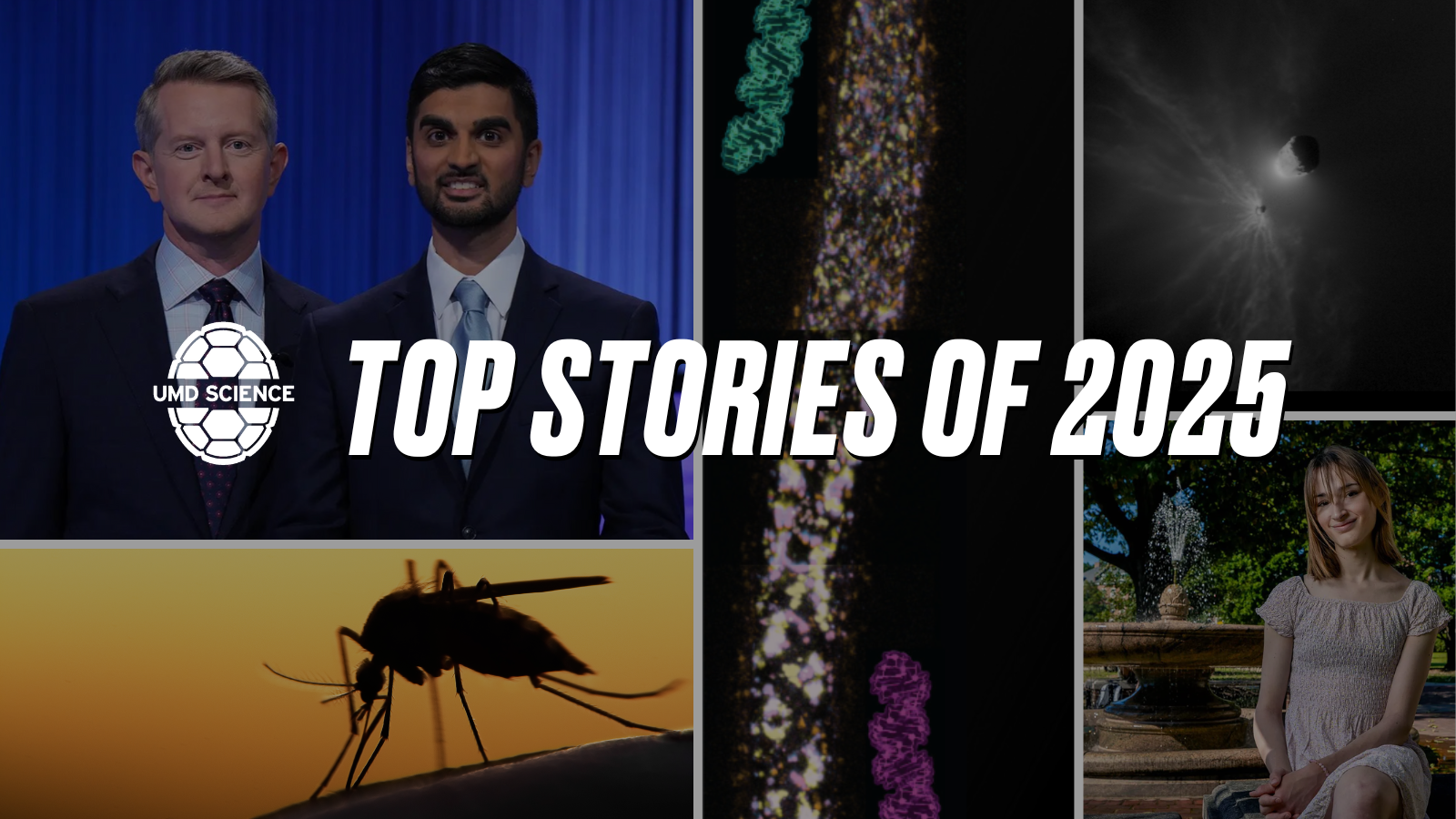
2025 has been another year of achievement and discovery for the University of Maryland’s College of Computer, Mathematical, and Natural Sciences (CMNS). CMNS students, faculty and staff members revealed the secrets of cell-to-cell communication, solved mathematical mysteries and won prestigious scholarships.
As 2025 comes to a close, take some time to revisit our most-read stories of the year and discover some that you may have missed.
1. Sougata Roy Awarded $2.5M NIH Grant After Receiving Rare ‘Unicorn Score’
When UMD Cell Biology and Molecular Genetics Associate Professor Sougata Roy applied for the National Institutes of Health’s (NIH) competitive Maximizing Investigators’ Research Award (MIRA) last year, he hoped that reviewers would recognize the value of his ongoing work: using advanced microscopy to reveal the secrets of cell-to-cell communication in developing organisms.
Not only did Roy’s application receive the green light for $2.5 million for five years, but it also earned a perfect 10—a feat so rare that it is sometimes called a “unicorn score.”
2. Massive Boulders Ejected During DART Mission Complicate Future Asteroid Deflection Efforts
When NASA’s DART spacecraft slammed into the asteroid moon Dimorphos in September 2022, it didn’t just change the asteroid’s orbit as intended—it unleashed a massive barrage of boulders that carried more than three times the momentum of the spacecraft itself.
A UMD-led team of astronomers found that while the mission successfully proved that kinetic impactors like the DART spacecraft can alter an asteroid’s path, the resulting ejected boulders created forces in unexpected directions that could complicate future deflection efforts.
3. Data-Driven, Interactive Map Shows Local Economic Impact of Cuts to Federal Funding for Health Research
In the wake of sweeping cuts to federal funding for scientific research, an interdisciplinary team of academic researchers developed an interactive, data-driven map to communicate the impact these cuts would have at national, state and county levels.
The Science & Community Impacts Mapping Project (SCIMaP) communicates how proposed federal funding cuts lead to reduced economic activity and job losses nationwide. The SCIMaP team’s analysis of across-the-board reductions to research infrastructure support for National Institutes of Health (NIH) grants, known as indirect costs, shows an estimated $16 billion in economic loss and 68,000 jobs lost nationwide.
4. UMD Launches M.S. in Artificial Intelligence
UMD will offer a new Master of Science in artificial intelligence (AI) this fall to teach the fundamentals of this transformative technology while giving students the expertise needed to address important questions about the interaction between AI, people and society.
The interdisciplinary program is administered by the Science Academy, in conjunction with the Artificial Intelligence Interdisciplinary Institute at Maryland (AIM), and is led by Computer Science Associate Professor Mohit Iyyer. This adds to the academy’s existing M.S. programs in applied machine learning, data science, bioinformatics and computational biology, and quantum computing.
5. This Teen Solved a 40-Year-Old Math Mystery. Now She’s Seeking a Ph.D. at UMD.
In February, Hannah Cairo disproved the Mizohata-Takeuchi conjecture, a math assumption that had stumped experts around the world for 40 years (and is impossible to summarize in lay terms). And she did it as a side project to her classes.
Now the remarkable teen is pursuing those answers as a Ph.D. student at UMD.
6. New Study Reveals How RNA Travels Between Cells to Control Genes Across Generations
RNA-based medicines are one of the most promising ways to fight human disease, as demonstrated by the recent successes of RNA vaccines and double-stranded RNA (dsRNA) therapies.
But while health care providers can now successfully develop drugs that use dsRNA to accurately target and silence disease-causing genes, a major challenge remains: getting these potentially life-saving RNA molecules into cells efficiently. A study published in eLife in February, may lead to breakthroughs in RNA-based drug development.
“Our findings challenge previous assumptions about RNA transport,” said the study’s senior author Antony Jose, an associate professor of cell biology and molecular genetics at UMD. “We’ve learned that RNA molecules can carry specific instructions not just between cells but across many generations, which adds a new layer to our current understanding of how inheritance works.”
7. Scientists Develop Floral-Scented Fungus That Lures Mosquitoes to Their Doom
Taking advantage of the mosquito’s natural attraction to flowers, an international team of researchers engineered a new strain of Metarhizium fungus that imitates a flower’s sweet scent and lures the bloodsucking bugs to their deaths.
Inspired by certain fungi that the team found emit a sweet-smelling chemical called longifolene to draw insect prey, they created what’s essentially a deadly perfume for mosquitoes—offering new hope against malaria, dengue and other fatal diseases that traditional methods, like chemical pesticides, can no longer control. The researchers documented their invention and its ability to control mosquitoes in a Nature Microbiology paper in October.
8. Four Science Terps Awarded 2025 Goldwater Scholarships
Four undergraduates in CMNS were among 441 Goldwater Scholars selected to receive one- or two-year scholarships that cover the cost of tuition, fees, books, and room and board.
UMD’s 2025 Goldwater Scholars included:
- Clara Abdelmalek, junior neuroscience major
- Harikesh Kailad, sophomore computer science and mathematics double major
- Luiz Mata Lopez, junior computer science and mathematics double major
- Benjamin Raufman, junior chemistry and mathematics double-degree student
9. Moon is Not As “Geologically Dead” As Previously Thought, New Study Reveals
Scientists have studied the moon’s surface for decades to help piece together its complex geological and evolutionary history. Researchers previously suspected that large, arching ridges on the moon’s near side were formed by contractions that occurred billions of years ago and have remained dormant ever since.
However, a study co-authored by UMD geologist Jaclyn Clark revealed that what lies beneath the lunar surface may be more dynamic than previously believed. Their findings were published in The Planetary Science Journal in January.
“But we're seeing that these tectonic landforms have been recently active in the last billion years and may still be active today,” Clark said. “These small mare ridges seem to have formed within the last 200 million years or so, which is relatively recent considering the moon’s timescale.”
10. Alum Buzzes in on "Jeopardy!"
Nikhil Joshi (B.S. ’07, biological sciences) took on television’s biggest trivia game as a contestant on “Jeopardy!”. To prepare for the intensity of the game itself, he watched—and played—“Jeopardy!” again and again.
“I trained by watching the show nightly, standing up, pretending to buzz in and making wagers—and in that sense, the show didn't actually seem that fast to me,” Joshi said. “As far as the categories, I tried not to overreact to each category; rather, I just responded to each individual clue.”
Take a look at our top stories from previous years.