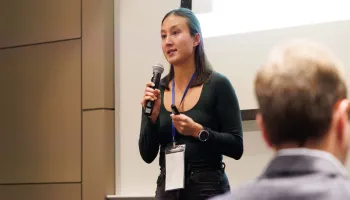
A high school internship with NOAA sparked her passion for using code to understand climate.

University of Maryland sophomore computer science major Jenny Wang had always been a math person. Growing up, she thought she would major in mathematics in college, maybe pursuing a branch of math that focused more on theory and abstract concepts than real-life applications. Then, during her senior year in high school, a research internship with the National Oceanic and Atmospheric Administration (NOAA) changed everything.
“I thought I’d be there working with numbers all day,” recalled Wang. “There was some of that, but the internship had me coding instead. I didn’t have any real experience with coding before, let alone using it to understand weather, but I ended up finishing the internship with a completely different idea of what my future could look like. I knew that something like this was what I liked and wanted to do with my life.”
Now, Wang has come full circle, receiving a 2026 Ernest F. Hollings Undergraduate Scholarship from NOAA, alongside seven other UMD students. The scholarship provides up to $19,000 in financial support, professional development opportunities and a 10-week paid summer internship at any NOAA facility across the United States. This class—the second largest ever at UMD—brings the university's total number of Hollings Scholars since 2008 to 56.
“Receiving the Hollings scholarship feels like reaffirming my goals,” Wang said. “My high school NOAA internship opened my eyes to what I could do, and now, with the scholarship and what I’ve learned at UMD since then, I can genuinely say I want to do something that combines computer science with environmental science.”
Wang’s path to NOAA began at Eleanor Roosevelt High School in Greenbelt, Maryland, just five miles away from UMD’s campus. The school’s research practicum program paired students with scientists from UMD, NASA and NOAA to work on real-life, ongoing projects. Wang was assigned to a NOAA project on inundation—the science of flooding.
“I worked with the National Water Model, a hydrological simulation developed by the National Weather Service that models stream flow across the U.S.,” Wang explained. “My task was to compare the model’s flood predictions against real-world satellite data.”
To accomplish this, Wang used two different remote sensing datasets: one that relied on infrared and visible light (which is highly consistent but often blocked by cloud cover) and another that used radar signals (which can penetrate clouds but are less consistent). Piecing together these two imperfect sources to validate the National Water Model was Wang’s introduction to what code could accomplish in the real world.
“My perception of coding at the time was pretty limited, like just getting taught how to do a loop that counts from one to 100—basically not useful outside of a class—or big tech stuff like social media,” Wang said. “But this work let me see how coding could be applied to everything around us, even nature.”
At UMD, Wang continues to build connections to environmental science. As a freshman, she took a weather and climate course taught by Department of Atmospheric & Oceanic Science Senior Faculty Specialist Jeff Henrikson that deepened her interest in the field.
Last summer, through the First-Year Innovation & Research Experience (FIRE) program, Wang worked with Assistant Clinical Professor Sara Strey on a climate computing project examining Arctic ice and atmospheric rivers—massive streams of moisture that travel toward the poles, influencing global precipitation and sea level patterns. Wang and a teammate focused specifically on moisture dynamics, calculating atmospheric vapor levels under different sea ice conditions.
“Jenny is an engaged and intelligent researcher with talent in applying her computer science skills to atmospheric research,” noted Strey, who added that the project was one of the more technically demanding assignments for Wang’s cohort. “Her cross-disciplinary talent makes her an excellent scholar, highly likely to succeed in either field.”
Wang says her experiences at UMD helped her refine her skills in both coding and climatology. More than ever, she sees her future at the intersection of those disciplines.
“Processing all this raw satellite imagery requires algorithms that can automatically classify terrain, detect water and flag flooding. No human analysts can keep up with the sheer volume of data that’s flowing in from orbit,” Wang explained. “That’s why you need programs and algorithms to take the raw data and make it readable and understandable. Whether through the use of artificial intelligence or other tools, I see myself developing better ways to use and share information about our environment with the public.”
For her Hollings internship, Wang hopes to return to the NOAA Center for Weather and Climate Prediction located in UMD’s Discovery District—the same institution where her journey began in high school. Although most of her earlier work focused on analyzing flooding and water vapor systems, Wang remains open to any research that allows her to apply her math and computer science skills.
Long-term, Wang says she’s drawn to work that carries a tangible real-world impact. Her parents, both U.S. Department of Agriculture employees, gave Wang an early model of what public service work looks like. Inspired by her parents’ examples, Wang hopes to follow in their footsteps in her future career.
“Contributing my skills where I can make a real, positive difference in the world is my real goal,” Wang said. “I’m ready to use my computer science background and passion for the environment to give us a better understanding of the world around us and how to protect it.”