The College of Computer, Mathematical, and Natural Sciences hosted a Reddit Ask-Me-Anything spotlighting mammalian behavior research.

University of Maryland Biology Professor Jerry Wilkinson participated in an Ask-Me-Anything (AMA) user-led discussion on Reddit to answer questions about bats on October 31, 2023.
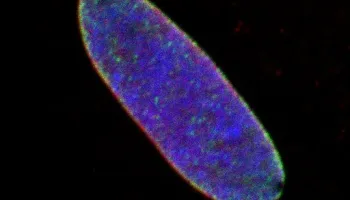
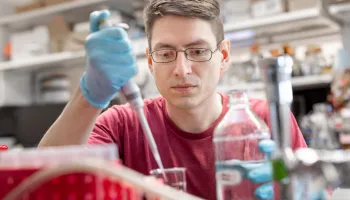
Wilkinson’s lab conducts research on social behavior, with emphasis on how genetic mechanisms may influence the outcome of evolution. Recently, his lab has used DNA methylation to predict age in bats and discovered that extreme longevity, which has evolved in multiple bat lineages, is associated with changes in methylation near genes involved in immunity. Current projects aim to identify epigenetic changes associated with social stress, immune function and sex differences in aging in bats.
Biological science Ph.D. student Katherine Armenta and postdoctoral researcher Danielle Adams joined Wilkinson to answer questions. This Reddit AMA has been edited for length and clarity.
What caused you to become interested in studying bats?
(Wilkinson) The short answer is that I started graduate school, and my advisor was studying bats. The long answer is that during my first summer as a graduate student, I took a course in tropical ecology in Costa Rica and had many opportunities to catch bats with experts and became fascinated by their behavior.
(Adams) I have always been interested in bats since watching them fly around in my backyard as a kid. When I learned about their echolocation, I was hooked. I then took a course in college and learned the details about bats' echolocation and was really fascinated.
(Armenta) In college, I studied animal behavior, and one of the professors that I took a lot of courses with studied bats, so she would always relate a lot of our topics to bats, and that just kind of stuck. Shoutout to Dr. Kirsten Bohn at Johns Hopkins!
What is the most complex social behavior/communication you've found in bats?
(Wilkinson) Most people agree that vampire bats have the most complex social behavior. Individuals will feed other individuals that have been unable to obtain a blood meal on their own. Those individuals are often (but not always) related to them. They prefer to help individuals with whom they have social bonds. It takes about nine months for them to establish such bonds. They use unique vocalizations to identify their 'friends.' Shoutout to my former graduate student, Gerald Carter, at The Ohio State—you can check out his work at socialbat.org.
I am super interested in longevity in bats! Do you think it’s more the rule or the exception across the group?
(Adams) I'd say it's more the rule, but there's a lot of variation. For example, Brandt's bat can live over 40 years. But the velvety free-tailed bat lives only about five years.
(Wilkinson) The current longevity record holder is the Indian Flying Fox, one of which lived at the San Diego Zoo for 44 years. Shoutout to Steve Austad at the University of Alabama, who emailed me with that record!
(Armenta) There is variation within species as well—for example, for the spear-nosed bat, females can live up to 20 years, and males can live up to 10 years.
I heard on Mastodon that bats crash into each other all the time when flying. Is this true?
(Wilkinson) I've definitely seen bats crashing into each other, but they are most often baby bats learning to fly. However, Mexican free-tailed bats live in colonies of millions of individuals in Texas to give birth and raise their pups. High-speed video recordings have found that collisions do occur, but do not interrupt the flight.
Fun fact, fishing bats actually make sounds to avoid colliding when they are attacking prey on the water.
Are bats found everywhere? Or are there geographic limits?
(Wilkinson) Everywhere but Antarctica!
How are bats faring/likely to fare with extreme climate change? Are they particularly sensitive to ecological disturbance, or more adaptable?
(Wilkinson) Climate change affects some bat species more than others. Unlike small terrestrial mammals, they can travel long distances and many species migrate. The problem is that there needs to be an adequate habitat for them to migrate to.
I found a bat once sleeping on the side of a brick wall, right outside the door of the Atlantic Building on the UMD campus, in the middle of the day. The weather was still VERY warm, and it was nowhere near sunset. Why did this sleepy bat pick such an open place to nap? Where did it come from? Is there a population of bats on campus?
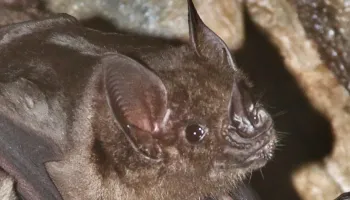
(Wilkinson) There are definitely bats in the neighborhood of College Park, Maryland. The most common species is called the big brown bat and will roost in attics, even in some of our sorority houses in the past! Another common species is the red bat, which roosts in trees and will sometimes hide in leaves during the day, which is one possible answer for what you saw outside the Atlantic Building. Another possibility is that it ran into a window and was stunned.
I’ve read that about an infection in bat populations that has been gradually spreading across North America and obliterating large groups of bats. Is a collapse of the bat population as serious as one in the bee population, where it has major ramifications for humans?
(Wilkinson) The infection is caused by a fungus called Pseudogymnoascus destructans. The bats get this white fuzz on their nose, and it really affects their hibernation because they wake up too many times and then are unable to survive the winter. It was first discovered in the United States in a cave in New York in 2005 and has since spread up to Newfoundland, down to Texas and across the West Coast to Washington State and Idaho. Some people estimate it has led to 5 million bats dying. It only affects hibernating bats and has had the largest effect on three species; for example, the little brown bat used to be the most common species in most parts of the United States and has declined. However, there are populations of little brown bats that are growing in number in the eastern United States, perhaps because they have acquired resistance or altered their behavior to avoid being affected by the fungus so severely.
The fact that we are seeing some populations increasing suggests that resistance may be occurring and is consistent with the fact that this fungus is common in Europe but has no effect on the bat populations there, suggesting they are resistant. There are ecological consequences of a decreasing bat population because bats are a major predator of insects, some of which are pests.
You can check out the White Nose Syndrome Response Team's website to learn more.
Why do you think bats have been associated with the "dark side"? Do you think it was promulgated by horror films like Dracula? Or is it a near-universal cultural thing?
(Wilkinson) The perception of bats varies around the world. This pretty well-known anthropologist, Sarah Hrdy, did her honors thesis at Harvard on Mayan mythologies and gave me a copy. In it, she describes how fruit bats with the nose leaf are often portrayed on Mayan temples, and so bats figure prominently in many Mayan stories and are associated with death and sacrifice.
In contrast, in China, bat motifs are commonly found on the entrance of palace buildings as symbols of good luck. My understanding is that they are often above doorways to ward off evil or protect people.
(Adams) There's an entire book about blood-feeding creatures called "Dark Banquet" by Bill Schutt that might be of interest. It's all about the natural history and mythology around vampire bats, etc.
What’s your worst guano moment?
(Wilkinson) For my Ph.D., I watched vampire bats in hollow trees in Costa Rica for 500 hours. Frequently, the bats would relieve themselves while I was in the tree. Vampire bats only drink blood, so their feces look like black tar and are very high in ammonia, so it can be... unpleasant.
(Adams) While catching bats in an elevator shaft of an abandoned building, I sank up to my knees in bat guano.
(Armenta) A bat pooped on my head, but I had a hat.
Why do bats seem to harbor so many diseases?
(Wilkinson) Some evidence suggests that bats can tolerate higher viral loads than other mammals, although that claim is not endorsed by everyone. Those viruses don’t usually affect the bats but can cause illness in other species, including humans. As I mentioned elsewhere, there is considerable research aimed at trying to understand how bat immune systems may enable them to avoid illness. From an epidemiological perspective, viral transmission among individuals in some species is undoubtedly facilitated by their roosting very close together in very large aggregations, sometimes in excess of a million individuals or more tightly packed in poorly ventilated caves.