The prestigious award recognizes Mathew’s accomplishments in academics, research and service.
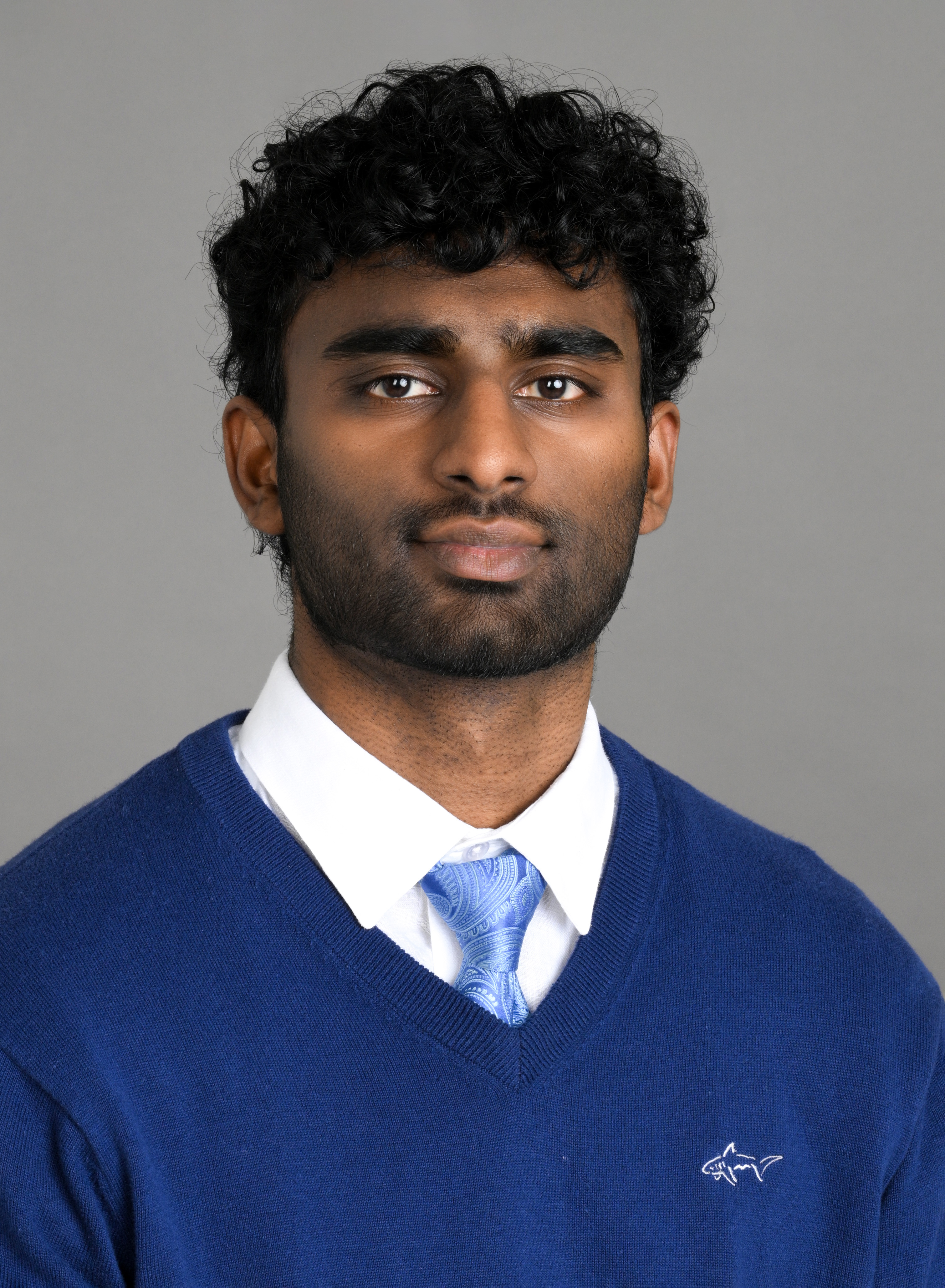
Joshua Mathew, a junior biological sciences major at the University of Maryland, was awarded a 2026 scholarship by the Barry Goldwater Scholarship and Excellence in Education Foundation, which encourages research careers in the sciences, mathematics and engineering.
Over the last 15 years, UMD’s nominations have yielded 48 scholarships—second in the nation only to Stanford.
Mathew is among 454 Goldwater Scholars selected from 1,485 nominees nationally. Goldwater Scholars receive one- or two-year scholarships that cover the cost of tuition, fees, books, and room and board up to $7,500 per year.
“Being named a Goldwater Scholar is an incredible accomplishment,” said Amitabh Varshney, dean of the College of Computer, Mathematical, and Natural Sciences (CMNS). “Joshua’s research beautifully demonstrates how CMNS scholarship delivers positive societal impact. I am very proud of him, and I cannot wait to see how he capitalizes on this opportunity.”
Since the program's first award in 1989, the Goldwater Foundation has honored 87 winners and five honorable mentions from UMD.
“Goldwater Scholars stand out as exceptional developing scientists who show early promise for high-impact research careers,” said CMNS Associate Dean of Undergraduate Education Robert Infantino, who has led UMD’s Goldwater Scholarship nominating process since 2001. “Joshua’s adaptability as a researcher in bioengineering, pharmacotherapeutics and computational biology is unusual and exemplary.”
During his freshman year, Mathew began research in Bioengineering Professor Li-Qun Zhang’s lab. His work used a wearable robotic hand that measures nerve and muscle activity to study how having a stroke changes a survivor’s ability to sense the movement and position of their fingers. This ability, called proprioception, enables important tasks like grasping, pinching and manipulating objects.
“Joshua has impressed me with his determination, strong analytical skills, quick learning and excellent technical ability,” Zhang said. “He stands out as one of my most talented students.”
The summer after his freshman year, Mathew worked in a medicinal chemistry lab at the University of Maryland, Baltimore’s School of Pharmacy under Steven Fletcher. He designed new molecules that could treat neuroblastoma—a form of cancer that mostly affects children age 5 or younger—and synthesized new types of molecules that showed potential to be more selective and potent therapeutics than existing compounds.
Around that time, Mathew also began computational biology research with Sivanesan Dakshanamurthy at Georgetown Lombardi Cancer Center. Using advanced quantitative techniques such as molecular docking, his research characterized how endocrine-disrupting chemicals interact with receptors on human cells. The compounds he analyzed included pesticides, parabens, per- and polyfluoroalkyl substances (PFAS) and other chemicals. He is a co-author of a peer-reviewed publication for this work.
Mathew has continued working in Dakshanamurthy’s lab, using computational approaches to study how more than 14,000 types of PFAS bind to different estrogen receptors. His work could help researchers screen the vast spectrum of PFAS—commonly called “forever chemicals”—for those that pose the most risk to humans. He is the co-second author on this study.
Outside the lab, Mathew is the founder and co-president of Senior Companions—a club at UMD that connects volunteers to senior and hospice patients through music, conversation and companionship. He is also a teaching assistant for CHEM 132: “General Chemistry I Laboratory” and a violinist in the UMD University Orchestra.
After graduating, Mathew plans to enroll in an M.D./Ph.D. program, with the goal of becoming a physician-scientist. He hopes to lead a structural and computational biology research program to discover more effective cancer therapies and translate those findings into practice through a clinical oncology lab at an academic medical center.
“I aim to better understand the molecular mechanisms underlying cancer,” he said. “Recent advances in computational and experimental methods are enabling more precise studies, and I hope to be part of a generation of scientists who turn these insights into treatments that benefit patients.”