The distinguished lifetime honor recognizes Farquhar’s research studying the evolution of Earth’s ancient atmosphere.
James Farquhar—a Distinguished University Professor and chair of the Department of Geological, Environmental and Planetary Sciences at the University of Maryland—was named a 2025 Fellow of the American Association for the Advancement of Science (AAAS), one of the highest distinctions among the scientific community.
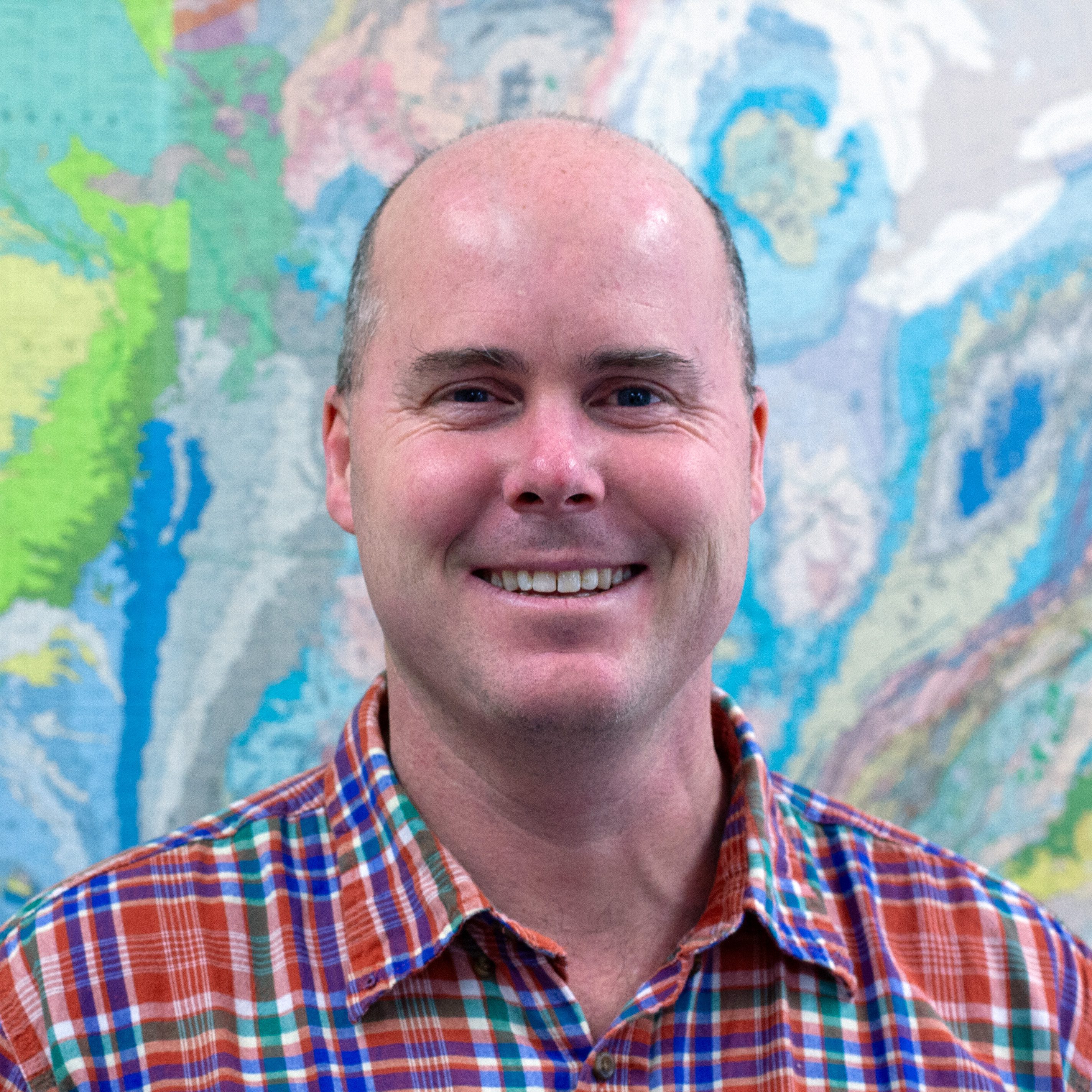
The fellowship recognizes Farquhar’s research on sulfur isotope geochemistry, which revealed novel insights into the evolution of Earth's atmosphere. He joins a class of nearly 500 scientists, engineers and innovators who received the distinguished lifetime honor this year.
“I was really honored to get it. It felt good because a lot of the work has been done here with people at UMD, so it brought back great memories,” Farquhar said.
Farquhar is also a member of the National Academy of Sciences and a Fellow of the Geochemical Society/European Association of Geochemistry and the American Geophysical Union.
“James is a great leader and a top scientist in geochemistry, and this latest honor from the AAAS is further validation of his impactful research and the wide-reaching contributions to science he has made,” said Amitabh Varshney, dean of UMD’s College of Computer, Mathematical, and Natural Sciences.
Farquhar, who also has a joint appointment in the Earth System Science Interdisciplinary Center, is best known for discovering signatures of sulfur isotopes—atoms of the same element with different numbers of neutrons—in ancient geological samples and interpreting them to reveal how oxygen evolved in Earth’s early atmosphere.
His highly cited 2000 paper published in the journal Science provided critical evidence that Earth’s oxygen levels surged about 2.4 billion years ago during what’s called the Great Oxidation Event. Around that time, the planet’s oxygen concentration rose from virtually nothing to a few percent—“a huge jump,” Farquhar said.
That finding relied on the discovery that variation involving a specific type of sulfur isotope—sulfur-33—was ubiquitous in geological samples from before 2.4 billion years ago but virtually disappeared thereafter. The most logical explanation was that chemical reactions occurred in an oxygen-depleted atmosphere until the Great Oxidation Event, when atmospheric conditions began to change.
“It provided some of the first really strong evidence for a change in atmospheric oxygen occurring at that time,” Farquhar said. “People called it the smoking gun or the nail in the coffin.”
A shift to climate change research
As the present-day atmosphere continued to rapidly change due to the influx of greenhouse gases, Farquhar became more interested in studying modern atmospheric chemistry. So, a few years ago, he pivoted his research program to focus on atmospheric methane—a greenhouse gas responsible for about a third of global warming.
Methane is more than 80 times more potent at trapping heat than carbon dioxide during the molecules’ first 20 years in the atmosphere, and its atmospheric concentration has more than doubled in the past two centuries. Plus, methane in the atmosphere degrades in a couple of decades while carbon dioxide lingers for up to a thousand years, so reducing methane emissions could substantially limit global warming this century.
Farquhar studies isotopologues of methane—forms of the same molecule with different isotopes of carbon and hydrogen—to better understand how the potent greenhouse gas enters and leaves the atmosphere. This work leverages UMD’s Nu Instruments Panorama, a top-of-the-line mass spectrometer used for stable isotope analysis, the second of its kind in the United States. The university’s Panorama Lab is one of the first and only place in the world that routinely measures methane isotopologues in air.
Methane from different sources, such as coal-burning power plants or bacteria in landfills, leaves behind different isotopic “fingerprints,” so analyzing isotopologues could help to pinpoint sources. UMD’s Panorama Lab can pick up more minute differences in methane forms than typical mass spectrometers, even distinguishing between molecules originating from bacteria in a wetland versus a landfill. The approach Farquhar is developing could also be used to validate whether proposed climate solutions actually work.
The shift in research areas represents an interest Farquhar has had since joining UMD’s faculty in 2001. That desire cemented when he had kids, who will inherit the climate-changed world his generation leaves behind. Now, as a new AAAS fellow, Farquhar hopes to leverage his platform to ramp up this research.
This year, he plans to scale beyond the lab to set up a handful of methane isotopologue monitoring stations around the world. With international coordination, the number of global stations could proliferate by the time his career as a scientist comes to an end.
“If we could do something about a powerful greenhouse gas like methane, it would be profound,” he said. “My goal would be to see that come to fruition.”