Paleobotanist Nathan Jud (Ph.D. ’14, biological sciences) digs up, compares and identifies fossils that fill holes in the story of plant evolution.
Nathan Jud (Ph.D. ’14, biological sciences) doesn’t claim to have a green thumb. But for this UMD alum, dead plants are more interesting than live ones anyway, and the longer they’ve been dead, the better.
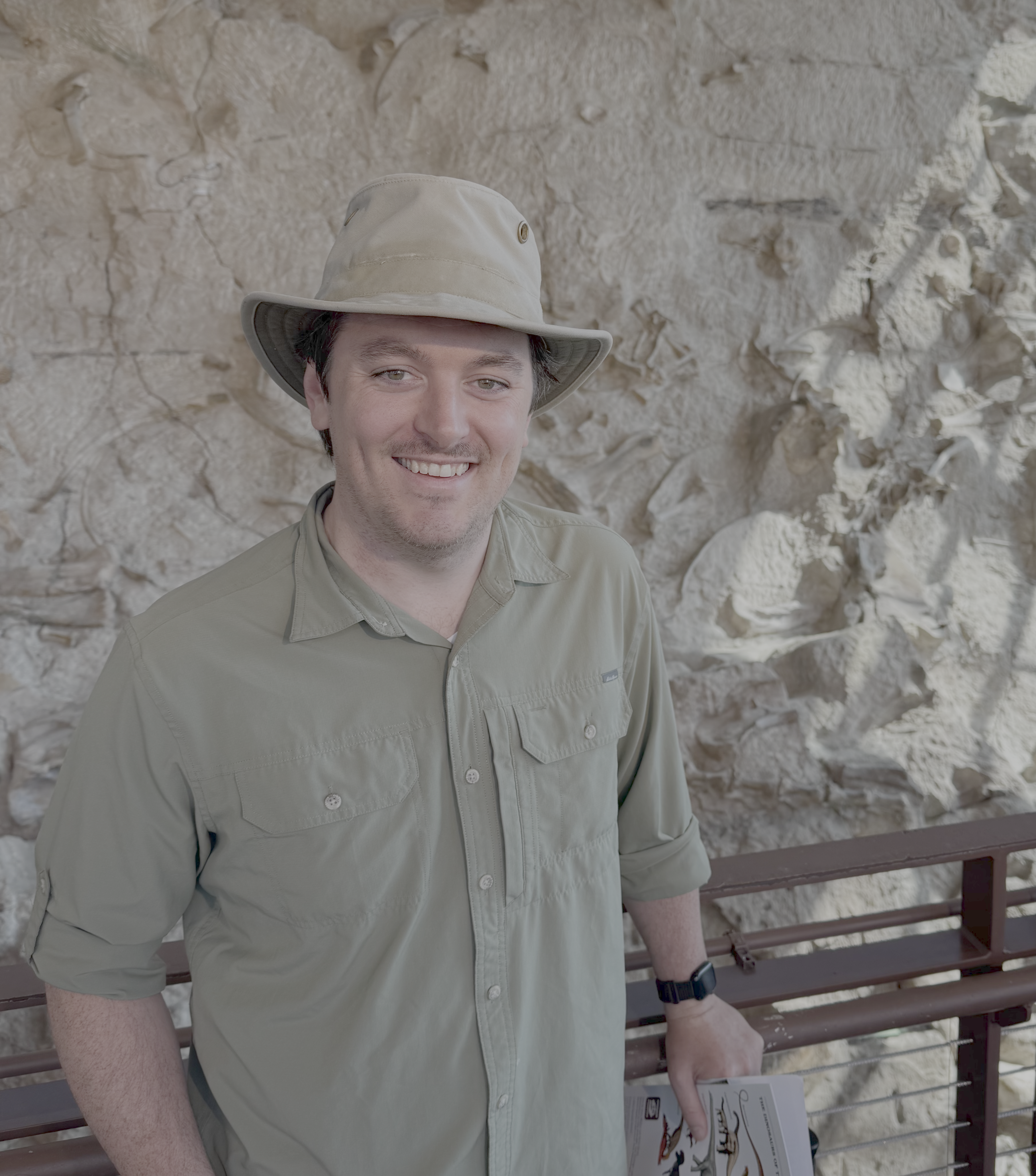
Now an associate professor of biology at William Jewell College who teaches ecology and evolution, Jud is a paleobotanist—a scientist who specializes in studying fossilized plants to reconstruct ancient ecosystems and unravel the mysteries of plant evolution. In his lab, he scours the plant fossil record, puzzling over the evolution of flora and investigating how plants’ stunning diversification helped shape life on Earth.
“My main interest is the evolution of flowering plants, or angiosperms, and not just their developmental and genetic origins, but how they lived in and transformed the world in the Cretaceous Period,” he said of the era 145 to 66 million years ago, “because their showing up was hugely impactful on ecosystems, vegetation structure and even on the climate.”
Earth goes green
The first plants—mossy, water-loving things—arose from aquatic green algae at least 480 million years ago. They had two major periods of diversification: the first, during the Devonian Period (419 to 359 million years ago), established the earliest seed plants; the second happened some 250 million years later (in the Cretaceous period that Jud studies) when flowering plants exploded and spread widely across the globe. And they did it all without the benefit of an evolutionary invitation.
“In a way, when it comes to the rise of organisms, we know the main beats of the mammal story,” Jud said, noting that mammals evolved alongside the dinosaurs at first, and then the dinosaur extinction left a big hole for the survivors to fill. “But there is no mass extinction associated with the rise of flowering plants during the Cretaceous. Instead, we’re looking at something that seems to have been fully biotically driven.”
Pursuing these plants’ triumphs (angiosperms now make up at least 80% of all plants with more than 350,000 species) led Jud to dig deep at fossil sites across the Americas, through library stacks and vast online datasets, and in specimen drawers at natural history museums—for comparative purposes but also hoping to find a “missing piece” others have missed.
“With plants, there are so many parts that can be preserved and in so many ways,” he noted. “Instead of bones and teeth, you can find leaves, you can get pollen and spores, you can uncover fossil wood, flowers or fruits, even small bits of plant cuticle—the waxy coating that helps plants keep the water inside their leaves.”
And you might find those useful remnants poking from shale, embedded in nodules, stuck inside amber or as chunks on the surface, eroded out of a hillside, he said.
For Jud, unearthing and identifying fossils is only part of the job. Figuring out the characteristics that let ancient plants adapt to changing environments is just as crucial to the story. Such details can help advance scientists’ understanding of subjects from ecology to climate change to our own evolution.
Bloom where you are
As a biological sciences grad student at UMD, Jud tackled what Charles Darwin called the “abominable mystery”: the relatively sudden appearance of flowering plants and their near-complete takeover of the planet. He worked under the late Entomology Professor Charles Mitter and the Smithsonian’s National Museum of Natural History Curator of Fossil Plants Scott Wing.
“I knew coming into grad school that I wanted to do field work and build new collections,” he said, but he began by perusing existing collections made famous by paleobotanists over the last 100-plus years.
“It was exciting to see the actual specimens behind the scientific papers that I had been reading,” he said.
Even more exciting, while digging in both the literature and the herbarium at the National Museum of Natural History, Jud made a momentous discovery: Set in a piece of shale was a tiny bit of leaf, dated to 120 million years ago, with stunningly modern and complex architecture. He wondered, could it be from an early flowering plant, mislabeled a fragment of a fern by earlier botanists?
Further investigation proved the answer was yes, and that there were other similar cases of mistaken identity—items labeled fern instead of flower—in major museum collections around the world. The correction made a splash, as it cleared up a mismatch in timing in the fossil record of leaves and pollen for the eudicots, which are the most common modern group of flowering plants today.
Gone digging
His big find might have occurred at a desk, but Jud was most in his element out in nature, work boots muddy and shovel in hand.
“I’ve always loved seeing specimens in the wild, getting to know their relationship with other organisms and their depositional context, like what kind of rock they’re preserved in,” he said. “Seeing them in situ can say a lot about the plant, its community and the ecosystem at the time.”
That added value is part of what brings Jud back time and again to the famed Cloverly Formation in Wyoming, where he first learned to recognize fossils of herbaceous flowering plants.
“I’ve become interested in how the tree canopy changed from 150 million years ago, before there were any reliable fossils of flowering plants, through the end of the Cretaceous Period 66 million years ago, when they finally dominated most terrestrial ecosystems,” Jud said. “The Cloverly fossils are one piece of that much larger puzzle, so I also study fossil woods and wood anatomy to investigate the history of the world’s forests.”
A kid in nature, a student in awe
It wasn’t fossil hunting that got Jud into science, but rocks were an important part of the story.
“I was immersed in geology throughout my childhood,” he said. “I spent a lot of time hiking and caving in the hills of Kentucky, and I think being around those formations, plus all the plant life, really made an impression on me.”
Then, in high school, Jud’s biology teacher introduced him to ethnobotany.
“He had studied how enslaved people in the American South, especially in Mississippi, repurposed their knowledge of African plant species into the context of the Americas,” Jud recalled. “His work opened my eyes to how interesting and how connected to people plants can be.”
With his bachelor’s degree in science, environmental and plant biology in hand from Ohio University, Jud came to UMD excited to explore the Smithsonian, especially the National Museum of Natural History, and to join the university’s rich community of field biologists.
“Any prospective biology student at UMD should take advantage of this proximity and these amazing resources,” he noted. “It made a huge difference in my career trajectory.”
Jud’s research continues delving into the deep past, but ultimately, the work applies to how the planet is changing now, and what might come next. Even a tiny tweak to the environment, he points out, can lead to a cascade of changes through food webs and ecosystems and across biomes.
“There are a lot of large-scale questions to answer about what could happen to our planet and our species,” Jud said. “But you can’t answer them without understanding what already happened—especially to the living things we tend to think of as background material but that are, in truth, the foundation of it all.”