Jessica Kopew (Ph.D. ’24, biological sciences) wants to see more alternatives to animal models used in research about people.
University of Maryland alum Jessica Kopew (Ph.D. ’24, biological sciences) is trying to make scientific research more human.
That is, she’d like to see science protocols rely less on animal models and shift toward using more human ones.
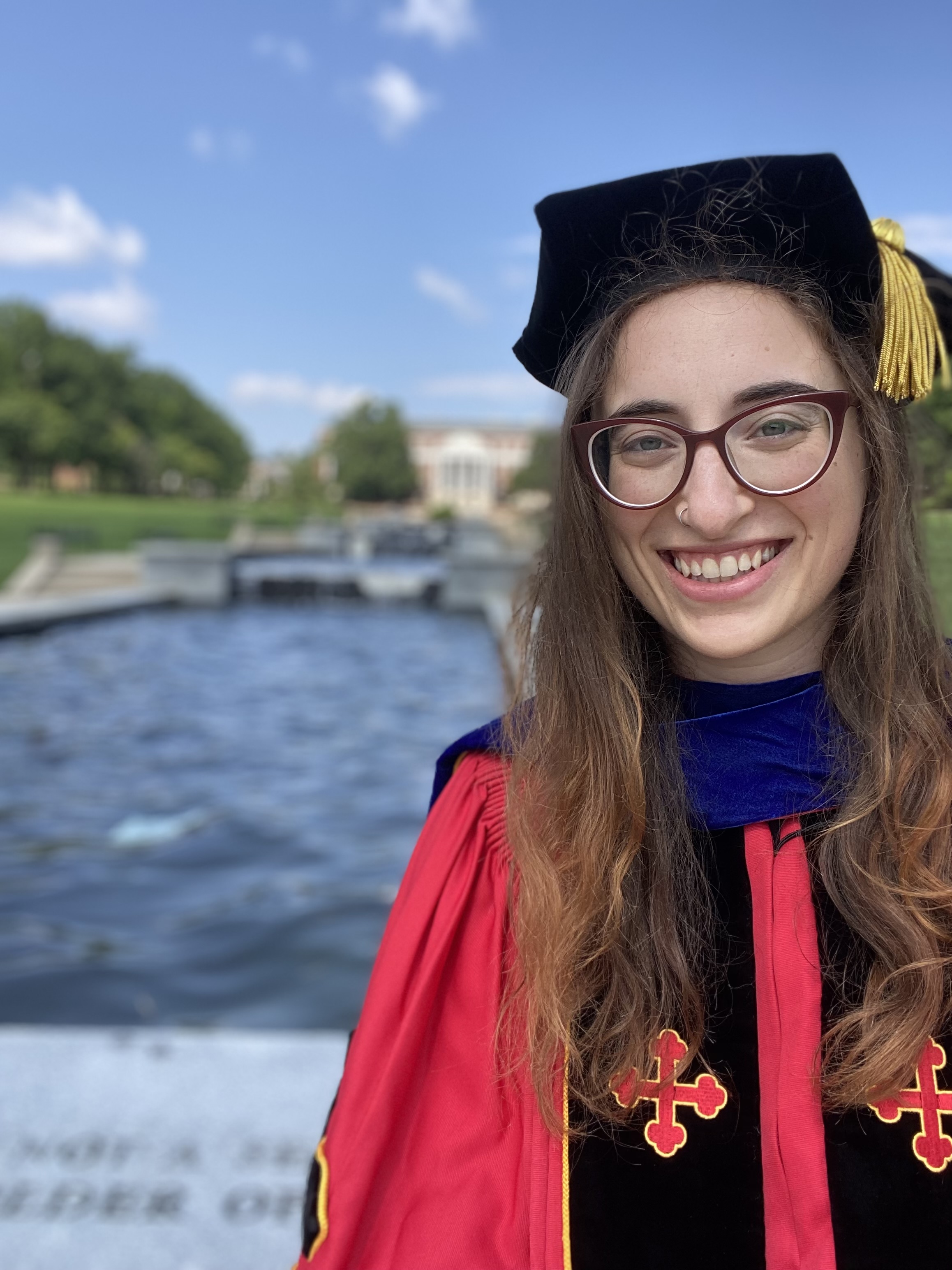
As a medical research specialist at the Physicians Committee for Responsible Medicine (PCRM), Kopew focuses on coaxing scientific research toward the growing number of non-animal alternatives or new approach methodologies (NAMs) that are often better suited to answer questions about human health.
“There are a lot of NAMs that offer things animal models can’t,” Kopew said. “Humans are simply more complex than, say, a genetically identical strain of mice, and human-based models embrace that complexity.”
A career about ‘doing things’
Kopew was drawn to lab science in college because she loved working with her hands and wanted her career to be about “doing things.” Studying under Daniel Stein, a professor in UMD’s Department of Cell Biology and Molecular Genetics, her graduate work focused on how genome organization and bacteriophages—bacteria that infect viruses—affect illness in patients with gonorrhea.
But when she began applying for postdoctoral positions, Kopew became intrigued with a different sort of work and a new way of thinking about traditional research protocols.
“A medical research specialist job opened with PCRM, an organization I had been following for their research using nutrition and lifestyle to help conquer chronic disease,” she said of the organization, which is also a big proponent of using NAMs in human research studies. “I realized I liked their point of view, and I would get to use my medical research expertise to help change science in ways that matter to me personally and could have wide-ranging benefits.”
Embracing the alternatives
At PCRM, Kopew writes and speaks about using more patient-derived samples, human biobanks and non-biological approaches. She also works to advance a host of human-based technologies, including artificial intelligence and genomics-based systems; 3D organoids, which are simplified mini-organs grown from stem cells or human tissue that allow for cell-cell interactions; and organs-on-a-chip, which are micro-engineered systems of living human cells inside a microfluidic device that mimic structural and functional characteristics of a human organ.
“These alternatives are often at least as effective, and sometimes more so, than animal models, particularly when multiple human-based methods are used together,” she said.
For example, more than 90% of drugs that appear safe and effective in animal studies ultimately fail in human clinical trials, largely due to species-specific differences, according to Kopew. Meanwhile, “many NAMs have demonstrated high sensitivity and specificity in predicting drug toxicity in humans,” she said.
But change is hard, and Kopew says skepticism about NAMs among scientists is common.
“We need to invest in developing and validating these methods so they’re more widely accepted,” Kopew said.
Small steps toward big changes
While Kopew’s “hands-on” work now involves a keyboard rather than a microscope, she’s happy as a medical researcher-turned-advocate.
“I’m chugging along trying to make little changes that add up to big ones,” she said.
To that end, she’s helping to prepare a weeklong workshop for early-career scientists to teach them about the value of NAMs before they begin shaping their own research protocols.
Still early in her own career, Kopew recalls her time at Maryland as “long and tough, but also extremely useful. I learned not just how to do an experiment, but how to ask the right questions, how to find answers and what to do next. Learning to be a good scientist gives you skills you can use in any career.”
Kopew also relishes tapping into her own lab experience when talking with other scientists about NAMs.
“Even if we disagree, they appreciate that I understand what they’re talking about and what it’s like behind the scenes, actually doing the science,” she noted.
While Kopew cares about animal welfare, she says she has grown to embrace the idea of moving away from animal models in science. A pet-free omnivore in her youth, she tried vegetarianism in college, went vegan in grad school and has since adopted two cats. Each step evolved her perspective.
“It was a shift in my thinking, away from what I was used to as a grad student,” she said. “But for me now, both scientifically and ethically, it makes sense to embrace NAMs as another, in some cases better, tool in the research toolkit.”