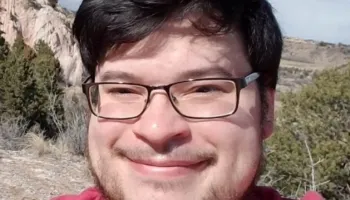
From beach trips with her family to one of the country's top science honors, Strauch found her passion where math meets the ocean.

A campus as landlocked as College Park might seem like an unlikely place to fall in love with the ocean again. But for Jenna Strauch, a sophomore at the University of Maryland pursuing bachelor's degrees in mathematics and atmospheric and oceanic science (AOSC), UMD turned out to be exactly the place where her childhood curiosity for the ocean came back to life.
This year, Strauch was awarded a 2026 Ernest F. Hollings Undergraduate Scholarship from the National Oceanic and Atmospheric Administration (NOAA). One of the most competitive undergraduate honors available to students in the field, the scholarship provides up to $19,000 in financial support, professional development opportunities and a 10-week paid summer internship at any NOAA facility across the United States. Strauch was one of four UMD students in the College of Computer, Mathematical, and Natural Sciences this year to receive the scholarship. This class—the second largest ever at UMD—brings the university's total number of Hollings Scholars since 2008 to 55.
"Hollings is such a goal to strive for in our field," said Strauch, who initially could not believe that she was chosen as a recipient. "I honestly thought it was far-fetched that I'd even have a chance, but I feel so honored to be part of this program. Even though plans aren't completely finalized yet, I know that I want to work on projects at the National Ocean Service involving marine ecosystems or coastal resilience."
When Strauch arrived at UMD in 2024 as a freshman mathematics major, she initially had plans to become a math teacher. But she had a hidden passion that she wanted to pursue as well.
"Growing up in Baltimore County, my family would always go to Ocean City every summer," Strauch recalled. "I knew as a kid that I loved the ocean and the shoreline, but I didn't really connect the dots that studying it was a viable path for me. It just seemed so distant from what I thought was possible for me. For a long time, I just assumed I would someday be a math teacher."
That began to change toward the end of her senior year of high school, when Strauch first learned about oceanography as a field of study. By the time she arrived at UMD, the idea had taken hold—and a conversation with the right professor made it real.
Strauch had enrolled in AOSC 200 through UMD's Weather and Climate Carillon Community, a living-learning program that brought her into Professor Tim Canty's classroom. It wasn't her first choice of community going in, but it quickly became her favorite. When Canty asked his students about their long-term goals, Strauch told him she was interested in the ocean. His response was immediate.
"He instantly told me to go talk to him outside of class about it," Strauch said. "It was obvious that he wanted to encourage me to pursue oceanography and that he had an idea how I could get started."
Canty introduced Strauch to Mesoterps, the student-led team behind UMD's Micronet, a distributed network of weather stations positioned across campus. The team collects hyperlocal atmospheric data and shares it with university facilities, emergency management offices and various campus partners—including the university's golf course, which relies on the network for real-time wind speed and direction readings. The Mesoterps team also works with facilities management on ongoing efforts to better understand rainfall patterns and their relationship to flooding risk in older campus buildings.

For Canty, watching Strauch grow into the field has been a source of pride.
"I first met Jenna through my Carillon community, and I was thrilled to learn she would be adding AOSC as a second degree," Canty said. "She is incredibly talented, and I look forward to following her career and seeing the great things she accomplishes."
When Strauch officially joined the Micronet project in September 2024, she had no prior experience with this kind of work. But before long, her tasks included migrating the team's data infrastructure to a new server, troubleshooting Raspberry Pi computers when they went unexpectedly offline and performing routine maintenance on equipment spread across campus—work that was messier and more technical than anything she had ever encountered in a classroom.
The experience also opened Strauch's eyes to many aspects of fieldwork and research that she hadn't expected. Working remotely with sensors and mini-computers helped her see that she could uniquely apply her math skills in a highly modern, technological context. And seeing how many people across campus—especially outside of AOSC—were genuinely invested in what her team was doing only motivated her more.
Looking to the future, Strauch plans to take on a larger role with the Micronet team and hopes to pass on the same kind of knowledge she developed to new students in the group. She also enrolled in a physical oceanography course next semester, taught by Atmospheric and Oceanic Science Assistant Professor Jacob Wenegrat, as a more concrete step toward fulfilling her dreams of attending graduate school and becoming an oceanographer.
"I've just learned so much since I started working with the Micronet—things that I never would have learned just from taking classes—and I know that it'll still be a big part of my academic life here at UMD for the next few years," Strauch said. "I think that experience is what got me here, and I'm excited to see where it all leads."