Sujay Konda, Ishan Raghavendra and Daniel Yuan each ranked in the top 200 out of more than 4,300 competitors in one of the most prestigious mathematics contests for undergraduates in North America.
Every winter, thousands of college students across the United States and Canada sit down for six hours to take the 12-question Putnam Competition exam, widely considered one of the most difficult undergraduate math contests in the world.
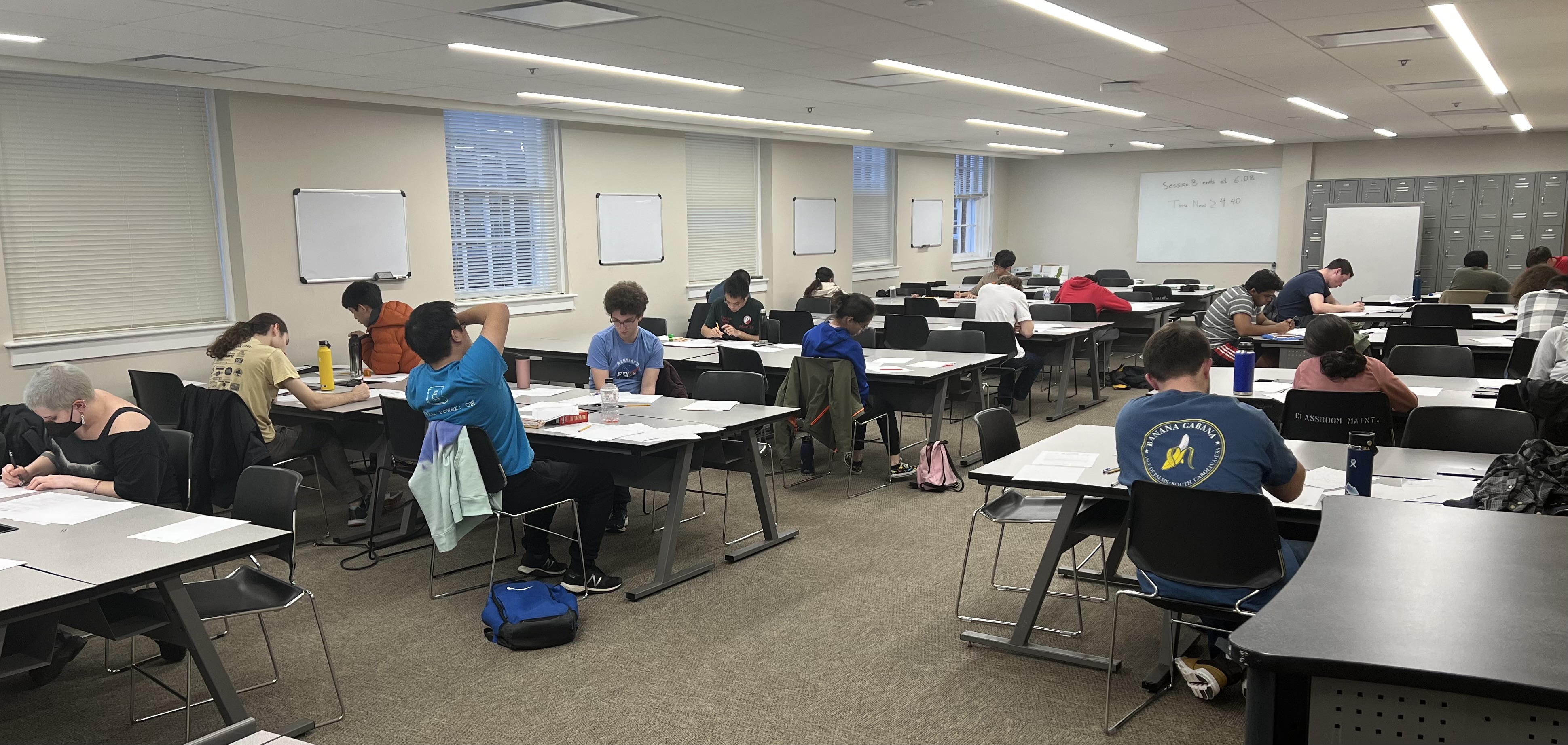
Most people who tackle the test walk away with a score of zero. Getting even a single point is considered an accomplishment.
But in December 2025, three University of Maryland students—computer science majors Sujay Konda and Ishan Raghavendra and mathematics major Daniel Yuan—represented UMD as a team and individually finished in the top 200 out of over 4,300 Putnam competitors.
Overall, UMD placed 14th among 487 participating institutions—marking the ninth consecutive year that the university has finished in the top 20 nationally. Although not part of UMD’s official team, computer science major Hanson Bai and mathematics majors Boheng Shao and Kelin Zhu were each recognized among the top 500 as well.
For Doron Levy, chair of UMD’s Department of Mathematics, this year’s results mean something beyond just a ranking.
“Schools like MIT, Princeton and Stanford recruit math majors specifically for their Putnam teams,” Levy said. “This is an amazing achievement, in particular given that there are very few public universities with comparable ranking. Our continued success says a lot about the quality of our students and the support they receive here.”
First-timers at the top
What makes this year’s results particularly striking is that two of the students who represented UMD in the competition had never tackled the Putnam before. Unlike Yuan, a returning contestant with previous Putnam success, Konda and Raghavendra were first-time competitors. Yet both freshmen finished among the top scorers in the country.

Raghavendra, who plans to add a mathematics major, arrived at UMD already well-versed in competition math after years of proof-based contests, including high school-level American Mathematics Competitions, American Invitational Mathematics Examinations and HMMT tournaments. For him, Putnam was less a leap into the unknown than a continuation of something he already loved.
“I heard about the contest in high school and decided to participate because I love proof-based math,” Raghavendra said. “I credit most of my preparation to my previous math competition background, but Putnam was still a very different experience.”
With a background rooted more in competitive programming, Konda heard about the competition through friends and decided to give it a shot. He went in curious, worked through old Putnam exams to prepare and came out with something he had not quite expected—a new way of seeing problems.
“Coming from a mostly computer science background, I think taking the Putnam helped expand the different perspectives and ways to approach problems from a different field,” he said. “It was interesting to see the different types of solutions that exist in math, stuff you don’t see in computer science.”
The formula for success
Students like Konda and Raghavendra are exactly the kind of contestants Roohollah Ebrahimian, a principal lecturer in UMD’s Department of Mathematics and the university’s Putnam coordinator, wants to reach. Ebrahimian, who has coached UMD’s Putnam team for more than a decade, noted that UMD’s nine-year winning streak was no accident.
“The formula for our success really comes down to two things,” he said. “Recruitment of our best students and extensive preparation.”
Ebrahimian maintains a running list of close to 100 students—drawn partly from top finishers at a high school math competition he runs for students in D.C. and Maryland (Yuan and Zhu both participated). Ebrahimian personally reaches out to each student at the start of every fall semester.

“UMD’s one-credit, 90-minute Putnam Express course has also helped prepare decades of students for the contests,” noted Ebrahimian, who teaches the class and established its accompanying guide. “The class predates my own time here and ensured many high scorers.”
Ebrahimian also found less conventional ways to stay connected to students, such as offering office hours in UMD’s dining halls to chat informally with students directly over a meal.
A few years ago, he also launched a YouTube channel to reach UMD math majors and prospective students and support their academic aspirations. Within weeks, students were finding his channel and emailing him about his math videos, and what began as an outreach experiment grew into something more. Ebrahimian began uploading videos specifically about Putnam and how to tackle math competition exams. The videos work through multiple failed attempts before landing on an answer, with him narrating what went wrong at each turn and explaining the “behind-the-scenes” reality of competitive test-taking.
“I wanted to be a resource for anyone trying to understand not just what the solutions to competition problems were but also how to arrive at them,” Ebrahimian said. “There are many resources that give you problems along with solutions, but not many that actually walk you through the process.”
Thanks to his efforts both online and in real life, UMD’s reputation for mathematical rigor and success in competitions has spread widely. In fall 2025, students from other institutions—including local community colleges in Maryland—began sitting in on Ebrahimian’s Putnam Express classes, hoping to find a formula for success.
“They’ve seen our success and have seen how Maryland has been consistently doing well,” Ebrahimian said. “Students want to be a part of that and learn.”
What’s next
Encouraged by their results this year, Konda and Raghavendra look forward to the next Putnam competition in December. Both freshmen are eager to test themselves against the nation’s best undergrad mathematicians again. And they hope others join them—the more, the merrier.
“Putnam’s for anyone passionate about math,” Raghavendra said. “There’s nothing to lose because even just getting a non-zero score is a big deal, and you can always try again the next year.”
“Considering how much fun I had preparing for Putnam and the different problem-solving skills I’ve developed from it, I think I’ll probably continue to participate for the rest of the time I’m here at UMD,” Konda added. “I just hope that more students will get involved in one way or another.”