Forecasting the Storm of Cancer Progression
Through multidisciplinary partnerships and a bit of weather science, Elana Fertig (M.S. ’05, Ph.D. ’07, applied mathematics & statistics, and scientific computation) aims to make cancer a predictable and manageable disease.
Elana Fertig (M.S. ’05, Ph.D. ’07, applied mathematics & statistics, and scientific computation) sees clear parallels between predicting the weather and forecasting cancer progression. Her landmark research involves using computational methods to identify cellular and molecular mechanisms of carcinogenesis and therapeutic resistance from a vast trove of multiplatform genomics data.
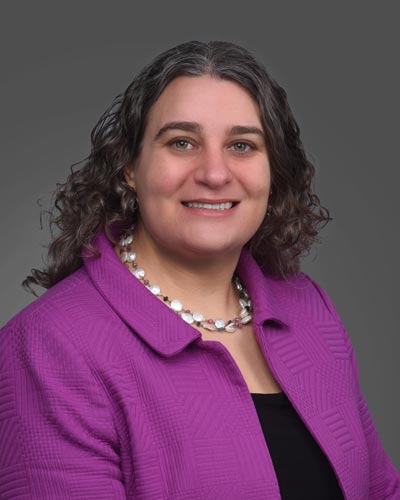
After graduating from the University of Maryland, College Park, she spent 16 years as a faculty member at Johns Hopkins University, building a transdisciplinary lab and authoring over 130 research publications.
In 2024, she was recruited to serve as director of the Institute for Genome Sciences (IGS) at the University of Maryland School of Medicine (UMSOM). She is also a professor in the Division of Hematology/Oncology, associate director for quantitative science at the University of Maryland Marlene and Stewart Greenebaum Comprehensive Cancer Center (UMGCCC) at the University of Maryland Medical System (UMMS), and a faculty member at the University of Maryland Institute for Health Computing (UM-IHC).
In this interview with UMD’s College of Computer, Mathematical, and Natural Sciences, Fertig discusses her leadership roles, the value of partnerships and how applying weather science to cancer research may lead to bluer skies in human health.
This interview has been edited for length and clarity.
Please describe your current roles.
I was recruited in 2024 to direct the IGS at the University of Maryland, Baltimore. IGS grew out of early genome sequencing efforts and is now a hub for genomics and computational biology at UMSOM. My role is to build on that foundation—advancing and applying genomics technologies and interpreting huge datasets mathematically.
I also serve as associate director for quantitative science at UMGCCC, where I help build computational programs and infrastructure for modern cancer research. We partner across the University of Maryland system, especially through UM-IHC, through which we’re working to better connect efforts between Baltimore and College Park, particularly in computational biology and artificial intelligence (AI).
What kinds of scientific questions are you trying to answer?
I often describe it as building a weather forecasting system for tumors. We want to move beyond averages and instead say: Given where your tumor is right now, this is the best treatment, here’s how it may evolve, and here’s how we’ll monitor it. Cancer is dynamic—it’s constantly changing—so we need to understand where it’s going, not just where it is.
You didn’t start out in biology—how did that shift happen?
As an undergraduate, I didn’t thrive in the hypercompetitive premedical environments, and memorizing biological details didn’t come naturally to me. I was drawn instead to the logic of mathematics and the collaboration that its complex questions demand.
What drew me to Maryland was that people were applying math to real-world data and problems. I came to study applied math, focusing on nonlinear and fluid dynamics—work closely tied to weather prediction.
My graduate training was deeply collaborative. I worked with an interdisciplinary team, with Brian Hunt [Professor Emeritus of Mathematics with a joint appointment in the Institute for Physical Science and Technology] as my primary advisor. Through a NASA fellowship, I helped integrate satellite and weather balloon data into atmospheric models. That experience with combining different types of data shaped my approach going forward.
At that time, researchers were beginning to generate large-scale biological datasets that needed mathematicians to interpret. I realized the tools we used for weather prediction could apply to biology—especially the complexity of cancer biology and therapeutic resistance.
To expand my skills, I entered a postdoc in computational biology, and I was struck by how much we still don’t understand. In weather, you know the equations from well-established laws of fluid dynamics. In biology, we’re still grappling with what the variables even are. That complexity hooked me.
Much of my work now focuses on making sense of extremely high-dimensional data—measuring thousands of genes across millions of cells—and identifying what actually matters. We look for the key variables driving the system and how they change over time, particularly in cancer progression and treatment resistance.
What’s an example of a problem you’re working on?
We work a lot on pancreatic cancer. For example, many people develop precancerous lesions that never progress, so a key question is: Why do some become cancer while others don’t?
Another challenge is that much of a pancreatic tumor isn’t made up of tumor cells. It includes other cells that block the immune system. If we can figure out how the tumor shuts down the immune response, we may be able to design therapies that turn it back on.
What would a cancer “forecast” mean for patients?
It would shift cancer care away from one-time predictions based on averages, moving toward precision medicine, predictive medicine. The goal is to make cancer manageable over time, more like a chronic disease. In some cancers, like breast cancer, we’re already seeing that shift. There’s also a psychological benefit when you give patients a clearer sense of what to expect.
How is it being back in Maryland?
It’s been very meaningful. It was humbling to step into the role previously held by Claire Fraser—even finding a pair of her shoes under my desk on my first day.
Maryland has a unique combination of strengths in nonlinear dynamics, genomics and predictive modeling—exactly what’s needed to build a tumor forecasting system. It’s the perfect place to deliver on the promise of these technologies.
What’s always stood out to me about Maryland is its emphasis on interdisciplinary work and real-world problems. You’re part of a larger effort to solve meaningful challenges, supported by connections to federal agencies, multiple campuses and a broad scientific community.
IGS already serves as a hub for systems biology across areas like cancer, infectious disease, aging and neurogenomics. I want to continue advancing new molecular profiling technologies and expanding their application. A big part of that is building bridges—across disciplines, campuses and partnerships like ours with the UM-IHC.
What has surprised you most in your career?
How quickly the technology has evolved! When I was in graduate school, the human genome hadn’t even been fully sequenced. Now measuring it is routine. And there were things that people told me would never be possible—like being able to measure all the cells in a tumor over time—and now we can do that.
How does your work connect to who you were as a kid?
It’s always felt like solving a puzzle. I loved puzzles growing up—jigsaw puzzles, logic problems—that’s just how my mind works. And this work feels like that, just at a different scale.
It’s also all about adapting and changing, as we do through our lives. Scientific puzzles and the tools are always evolving—the ability to keep learning is what lets you move between fields and keep up.
For this puzzle, we’re trying to piece together something incredibly complex. But I’ve learned that if you follow the logic step by step, eventually a beautifully clear picture starts to emerge.