Biological sciences Ph.D. candidate Eeshita Ghosh gets to the root(s) of how plants respond on the cellular level to environmental change, asking how key proteins regulate the calcium signals that sound the alarm.
Eeshita Ghosh is getting back to her roots.

Long interested in the cellular mechanisms that let plants grow and adapt, Ghosh spent part of her undergraduate years at the Indian Institutes of Science Education and Research (IISER) in Bhopal studying one plant’s intricate relationship with a fungus that promotes root development. Then a stint pulling weeds in Texas for an applied study of the invasive plants helped Ghosh find her research focus.
“It reminded me that what I really love is basic science; I wanted to be back in the lab focusing on a tiny piece of a bigger story,” she said.
Ghosh has since zoomed way in: as a biological sciences Ph.D. candidate at the University of Maryland working with Cell Biology and Molecular Genetics Professor José Feijó, she studies the roots of a flowering weed called Arabidopsis thaliana, looking at the complex mechanisms that help plants sense and respond internally to changes in light, temperature, moisture and other dynamic aspects of the environment.
“Just as our brains need to know if something is happening to our feet so we can react, plants need a mode of communication from root to shoot,” Ghosh explained.
Finding her niche
Ghosh’s interest in science and plant study was inspired by her agronomist father, whom she accompanied across India as a child as he worked in various positions.
“I was always comfortable with science. I understood it naturally,” she recalled.
Then, when a professor at the IISER recommended a book called The Secrets of Plants, she realized she found her niche.
“It was an amazing book that introduced me to the concepts I now get to see in real life, in my work, under the microscope,” she said.
Now, in Feijó’s lab at UMD, Ghosh explores how key proteins regulate the signals that tell plants that conditions are in flux. The signals occur as changes in the concentrations of ions, including calcium, and are generated by proteins, including glutamate receptor-like channels (GLRs). GLRs are studied extensively in animals, where they are essential for neurons to talk to each other inside the brain, but “in plants they are still a mystery,” Ghosh said.
In simple terms, Ghosh explained it this way: If there is a stressor like drought in a plant’s environment, GLRs and similar proteins are like doors in a cell membrane that open to let ions like calcium through. The change in calcium ion concentration is the signal—in this case, telling the plant “Hey, it’s too dry!” The alarm triggers a plant’s adaptive measures, for example, closing leaf pores called stomata to reduce water loss.
“The plant’s aim, always, is to achieve homeostasis or balance,” Ghosh said, “even at the cellular level.”
A delivery service for plants
Plants also have proteins commonly known as “cornichons,” which help GLRs reach their targets where calcium signaling occurs. Ghosh seeks to understand how these proteins function, both with and without abnormalities, and whether they do more than just shepherd messages about changing conditions.
As part of that quest, she spends her days at the lab bench pipetting, centrifuging, staining, imaging and peering through the microscope as she removes different combinations of the proteins, mutates them and assesses the effects on the plant root’s phenotype.
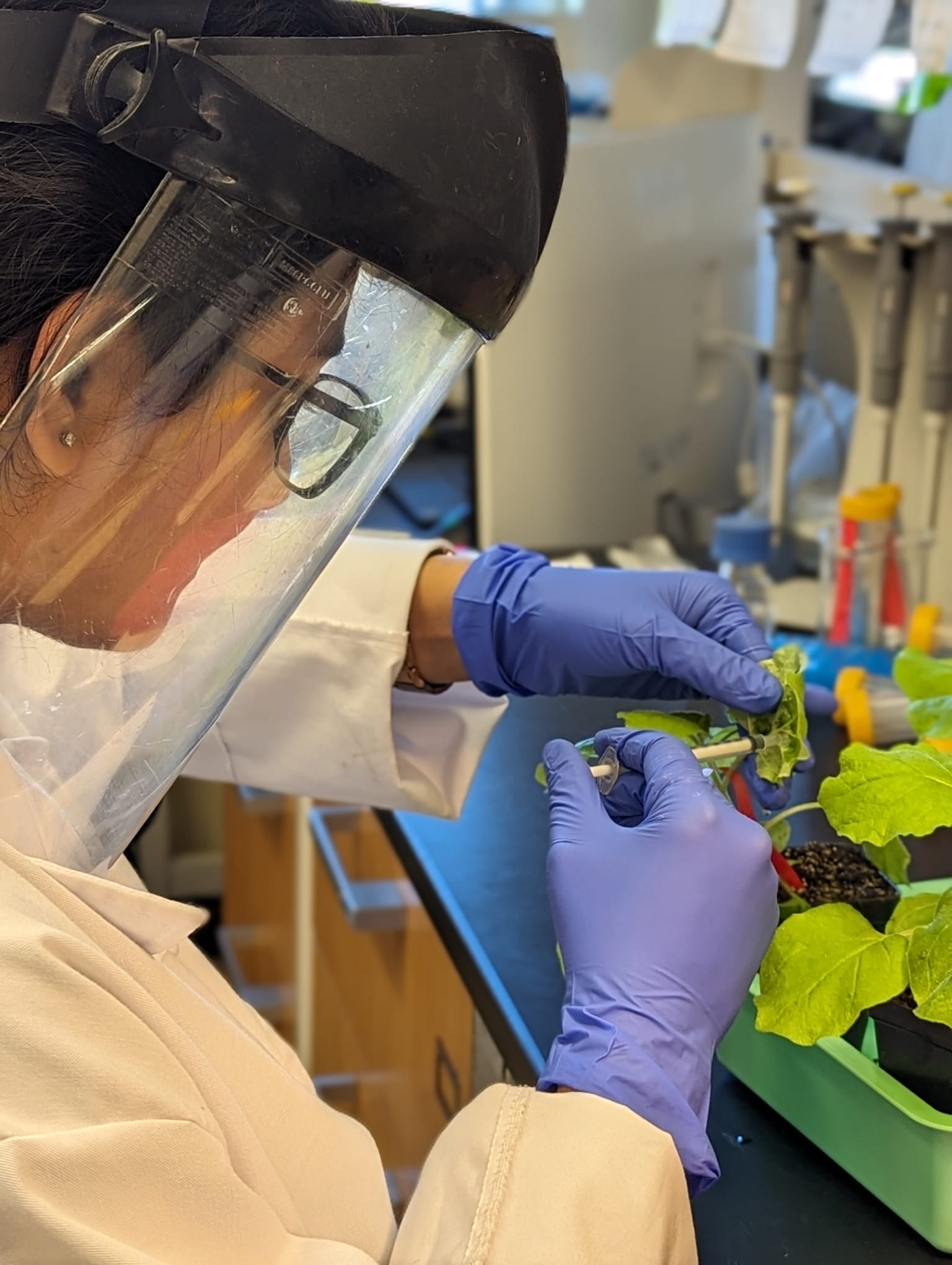
Ghosh’s studies revealed that the plant A. thaliana has five different cornichons. Why have five delivery proteins when you can do the job with one, she wondered. She found that the “extra” cornichons aren’t extra at all; in fact, having the correct combination, working together, is essential for the plant’s healthy growth.
“It’s clear the cornichons do more than just deliver proteins; they also indirectly influence calcium signaling and root development, and plant development in general,” she said.
Ghosh credits a month at the University of Antwerp in Belgium in 2025 with her learning high-tech techniques for visualizing calcium signaling, lessons that helped her present her work at the Plant Membrane Biology international conference in Copenhagen last August. The new skills are letting her paint a more complete picture of a plant’s life (or death) under changing conditions, offering the kinds of clues that might lead to more stress-resistant crops in the future.
For someone so committed to understanding plants, it may be surprising that Ghosh doesn’t even have a pot of violets on her kitchen windowsill. Her interest lies within.
“Plants are so much more than what you see,” she said. “They seem so simple growing there in front of you, but inside are all these complex mechanisms at work, and everything has to work perfectly for the plant to thrive. That flawlessness inspires me.”
While her work keeps her at the bench and zoomed in on the small stuff, in her free time Ghosh takes a more expansive view, painting oil landscapes, cooking foods from around the world (especially her mom’s Bengali recipes) and performing classical Indian dance. But Ghosh is in her happiest place when people ask about her research.
“I love explaining what I do, finding ways to make the science accessible to everyone,” she said.