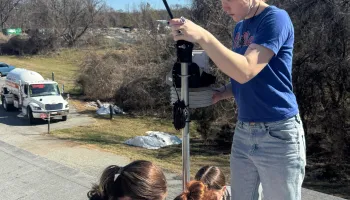
Fenley monitors weather conditions around campus and is pursuing a career engineering new meteorological sensors.
Allison Fenley, an atmospheric and oceanic science (AOSC) major at the University of Maryland, was awarded a 2026 Ernest F. Hollings Undergraduate Scholarship—one of the premier honors for undergraduate students in the field.

Fenley will receive $19,000 of academic assistance and a paid summer internship with the National Oceanic and Atmospheric Administration (NOAA). She joins six other UMD students receiving the scholarship this year—the second highest ever. Their class brings Maryland’s total number of Hollings Scholars since 2008 to 55.
“The scholarship and internship are so exciting to me,” Fenley said. “They will open up a lot of doors that I’m really grateful for.”
Fenley’s interest in atmospheric science sparked during a semester she spent studying abroad before transferring to UMD from George Washington University. In fall 2024, she participated in Semester at Sea—an academic program based on board a ship that takes students to 10 countries around the world, from Europe to Africa to Southeast Asia.
“I was experiencing so many different climates and environments in such a short period of time that I was struck by how different areas are impacted by climate change and environmental change,” Fenley said. So, she decided to major in AOSC at Maryland.
At UMD, Fenley works as an undergraduate research assistant with a student-run research group called Mesoterps. The team installs, maintains and analyzes data from nine weather stations across campus as part of the Micronet weather program.
Micronet’s environmental sensors, which are positioned on the roofs of various UMD buildings, provide minute-by-minute data on temperature, wind speed, precipitation, humidity and carbon dioxide. Those data feed into an alert system that warns community members when heat or humidity passes dangerous thresholds. Plus, the university’s Facilities Management and the Office of Emergency Management and Business Continuity can use the data to inform emergency planning for high-risk outdoor events such as football games. Fenley has played a role in every part of the Micronet, from engineering new sensors to the logistical work of adding new stations.
“Allison is a highly gifted student who consistently takes initiative to move projects forward, whether by identifying new capabilities for the campus Micronet, building instruments or developing a notification system to keep the campus informed of extreme weather events,” said AOSC Associate Professor Timothy Canty, faculty lead of the Micronet. “She has a very bright future ahead of her.”
Outside of research and class, Fenley is a member of UMD’s Epsilon Eta Environmental Science Professional Fraternity chapter, which organizes volunteer and professional development events to better care for the local environment. Next year, she will become the group’s executive director of programming.
Fenley hopes the Hollings Scholarship will serve as a springboard for her career in atmospheric science. She’s still honing her path, but she is most interested in developing sensors to detect atmospheric conditions. She is considering doing that work for a nonprofit, company, government agency or as part of her research in graduate school.
“The Hollings Scholarship is really valuable because it will give me a wider lens of places and directions I could go with my career and future,” she said. “I’m excited to branch out and dip my toes into as many different corners of the field as I can.”