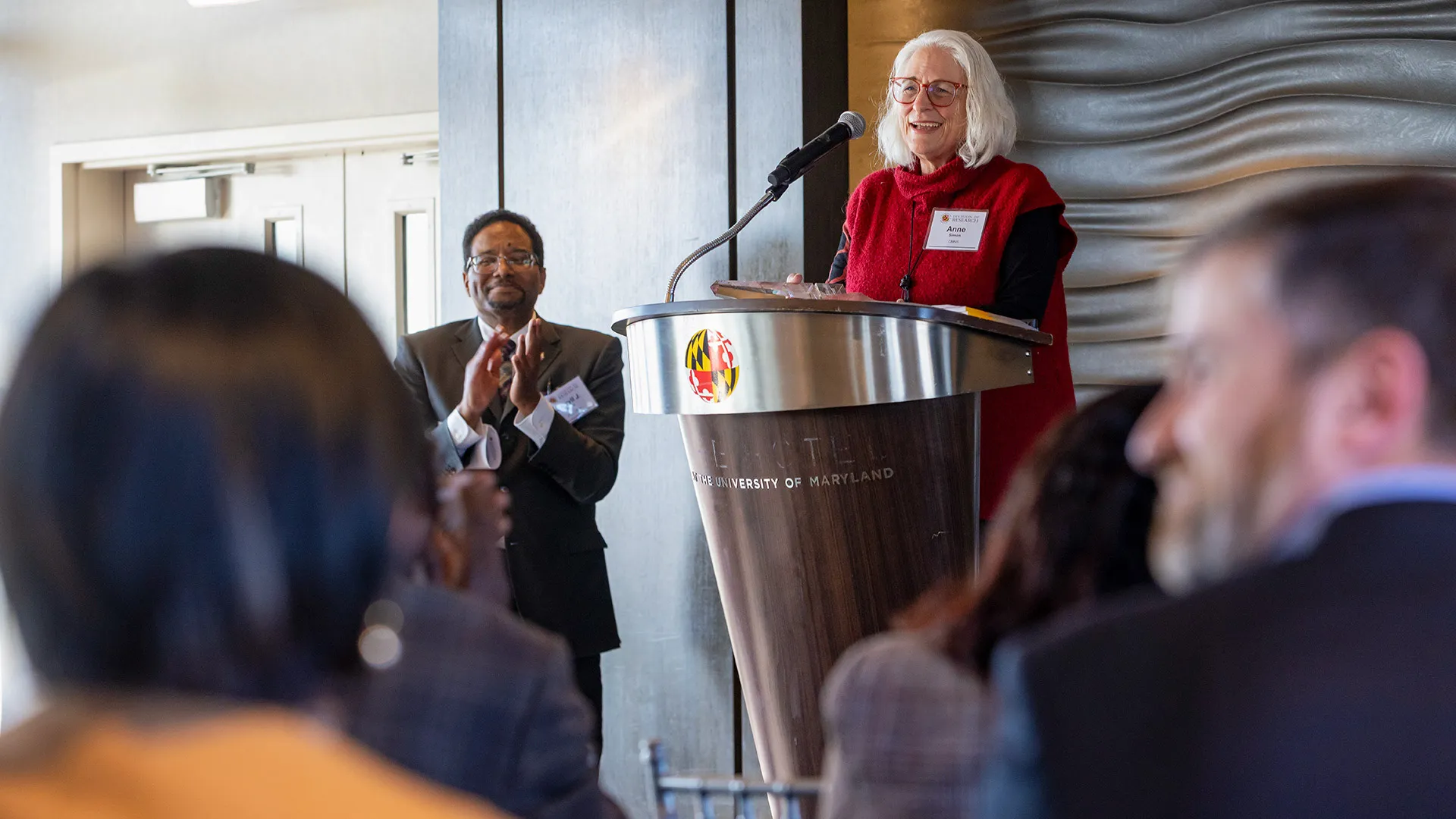
A University of Maryland scientist widely known for groundbreaking work with RNA plant viruses, which can threaten crops even as they offer intriguing new therapeutic possibilities, was honored with the inaugural President’s Impact Award at the 2026 Maryland Research Excellence Celebration on Thursday.
Anne Simon, professor of cell biology and molecular genetics, was recognized for her ability to combine the highest levels of academic excellence with a commitment to sharing her expertise to serve the public good.
“Professor Anne Simon exemplifies what it means to be a scholar who not only advances knowledge, but also shares it in ways that inspire and benefit society,” said President Darryll J. Pines.
Her research explores how plant viruses made of RNA—genetic material that carries cellular instructions and guides protein synthesis—are able to infect cells and reproduce and spread. Her work with the new “umbravirus-like” cohort opened the door to developing and using RNA viruses as vectors to deliver therapeutics into plants to mitigate plant diseases.
In 2019, she co-founded the company Silvec Biologics, with her brother, Rafael Simon, to use the technology to fight citrus greening disease, a bacterial infection that has destroyed most of Florida’s citrus crop since it was first documented in the United States in 2005, and is also decimating production elsewhere.
Beyond the lab, Simon is perhaps best known for her connection to the television series “The X-Files.” As a science adviser through all 11 seasons of the iconic show, Simon was able to shoehorn actual scientific principles into plots about believer Fox Mulder and skeptic Dana Scully’s FBI work with “unsolved paranormal cases.” Her book “The Real Science Behind the X-Files: Microbes, Meteorites and Mutants” makes the ideas behind the show accessible to both science enthusiasts and X-Files fans alike.
Simon has also shared her expertise through accessible social media platforms, such as Reddit. In a recent Ask Me Anything (AMA), she highlighted her research in plant virology and citrus greening, while explaining steps everyday people can take to help prevent the spread of these viruses to citrus and other plants.
“This has been just such a wonderful university, it has been incredibly supportive and I really just thank my lucky stars that I ended up here,” Simon told the audience after receiving the award. “I want to personally thank everybody, especially President Pines, for embracing an award like this and I’m so totally honored to be the inaugural recipient of it so thank you very, very much.”
Additional Honorees
Dozens of other UMD faculty were honored during the Maryland Research Excellence Celebration, held each year in the spring. The 2026 honorees were nominated by the deans of their schools and colleges for elevating the visibility and reputation of the University of Maryland research enterprise.
“Each year, the Maryland Research Excellence Celebration provides an opportunity to recognize faculty whose work is shaping their fields and making a difference beyond the university,” said Patrick O’Shea, vice president and chief research officer. “The scholars honored this year reflect the remarkable range of discovery and innovation at Maryland—from fundamental science and engineering to research that informs policy, education and public understanding.”
The College of Computer, Mathematical, and Natural Sciences winner was Tom Goldstein, Volpi-Cupal Endowed Professor of Computer Science, who is internationally recognized for his outstanding and transformative research in adversarial machine learning. His work bridges mathematical theory and practical implementation, shaping how modern AI systems are trained, optimized and secured. With more than 9,000 Google Scholar citations annually and an h-index exceeding 90, he ranks among the most highly cited scholars in his field.
Written by Silvana Montañola M.A. ’23