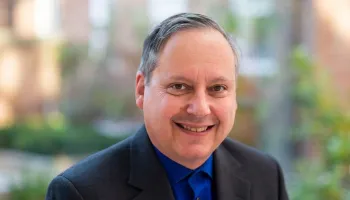
UMD Chemistry and Biochemistry Professor Lyle Isaacs and his team developed “molecular containers” that can trap anesthetic drugs and flush them from the body, speeding up patient recovery and improving hospital efficiency.
Every year, millions of patients undergoing surgery receive powerful drugs called neuromuscular blocking agents—medications that temporarily paralyze muscles to keep patients comfortable and help surgeons work safely. But when these drugs linger too long after surgery, they can cause complications for patients, from respiratory problems and residual paralysis to lingering cognitive side effects like grogginess.

To tackle this problem, University of Maryland Chemistry and Biochemistry Professor Lyle Isaacs designed tiny “molecular containers” called sulfated pillararenes, which work like a microscopic cleanup crew in the patient’s body to clear anesthetic drugs after surgery. Able to accelerate recovery time and enhance the care provided by anesthesiologists, the compound can reverse the major neuromuscular blockers currently used in operating rooms—something existing treatments cannot do.
“Sulfated pillararenes can hide neuromuscular blocking agent (NMBA) molecules within themselves, preventing these drugs from binding to a biological receptor and reacting with its target,” Isaacs explained. “In our lab, we have demonstrated that they can clear the container-drug complex from rodents, allowing the animals to regain normal functions faster.”
Isaacs’ sulfated pillararenes build on his two decades of research into molecular containers—hollow molecules that can trap other compounds inside them. They are built from aromatic rings (ring-shaped molecules that form the container’s walls) with ionic sulfate groups (charged chemical attachments), creating a cavity that’s perfectly sized to capture NMBA drugs.
Massive demand for NMBA reversal agents already exists. Merck’s drug Bridion, which reverses two common muscle relaxants called rocuronium and vecuronium, is widely used by anesthesiologists across the country and generates approximately $2 billion in sales annually. But it’s not a complete solution.
“The problem is that Bridion has a critical limitation—it doesn’t work against the third most popular neuromuscular blocker used in hospitals, a drug called cisatracurium,” Isaacs said. “But our compound binds strongly to all three types of NMBAs currently used in operating rooms.”
Isaacs noted that administering his molecular containers as an NMBA reversal agent has potential benefits that extend beyond just patient safety and welfare. Faster recovery means hospitals can streamline patient care.
“Patients have to be monitored in post-operative areas until the drugs wear off, and every extra minute increases hospital costs and limits how many surgeries doctors can perform,” Isaacs explained. “With a better reversal agent that can act more universally, hospitals can improve overall efficiency.”
The structural design of Isaacs’ sulfated pillararenes—including the size of the aromatic rings and the placement of sulfate groups—can be fine-tuned to target different drug compounds. This flexibility allows the containers to work across multiple drug types and also in various applications, including reversing drug overdose. The same principle that enables sulfated pillararenes to remove NMBAs could theoretically also sequester other substances across the board, from opioids to non-opioids to designer drugs, pulling them from the body and eliminating their effects.
“We’ve recently demonstrated that our Pillar[6]MaxQ (P6AS) molecule can act as an antidote for methamphetamine and fentanyl in animal studies, which really opens up opportunities for treating drug overdoses and abuse in humans,” Isaacs said. “There are other compounds that can be bound in the container and ‘turned off,’ such as the neuroblockers used in surgery.”
Isaacs’ research group continues to develop new containers, testing different structural combinations to find new applications for the molecules.

To take the designs to the next level, Isaacs co-founded Reversal Therapeutics, a biopharmaceutical company that exclusively licensed the technology from UMD.
Earlier this year, Reversal Therapeutics joined the Mtech Ventures incubator after raising $750,000 in its pre-seed round of funding, including a $300,000 TEDCO MII Company Formation award, $125,000 from the University of Maryland Discovery Fund and private investment.
The company plans to optimize the molecular containers for use as drug reversal agents and conduct pre-clinical studies to support eventual clinical trials in humans. If clinical trials prove successful, Isaacs believes this technology could improve outcomes for millions of surgical patients and open new avenues for treating drug overdoses—a growing public health crisis.
“This work is all built on a tremendous amount of basic, fundamental science done by my team,” said Isaacs, who also serves as the company’s chief scientific consultant. “I am excited to see our compounds heading toward clinical applications, where they have the potential to really make breakthroughs.”