The College of Computer, Mathematical, and Natural Sciences hosted a Reddit Ask-Me-Anything spotlighting research on snow remote sensing and modeling.
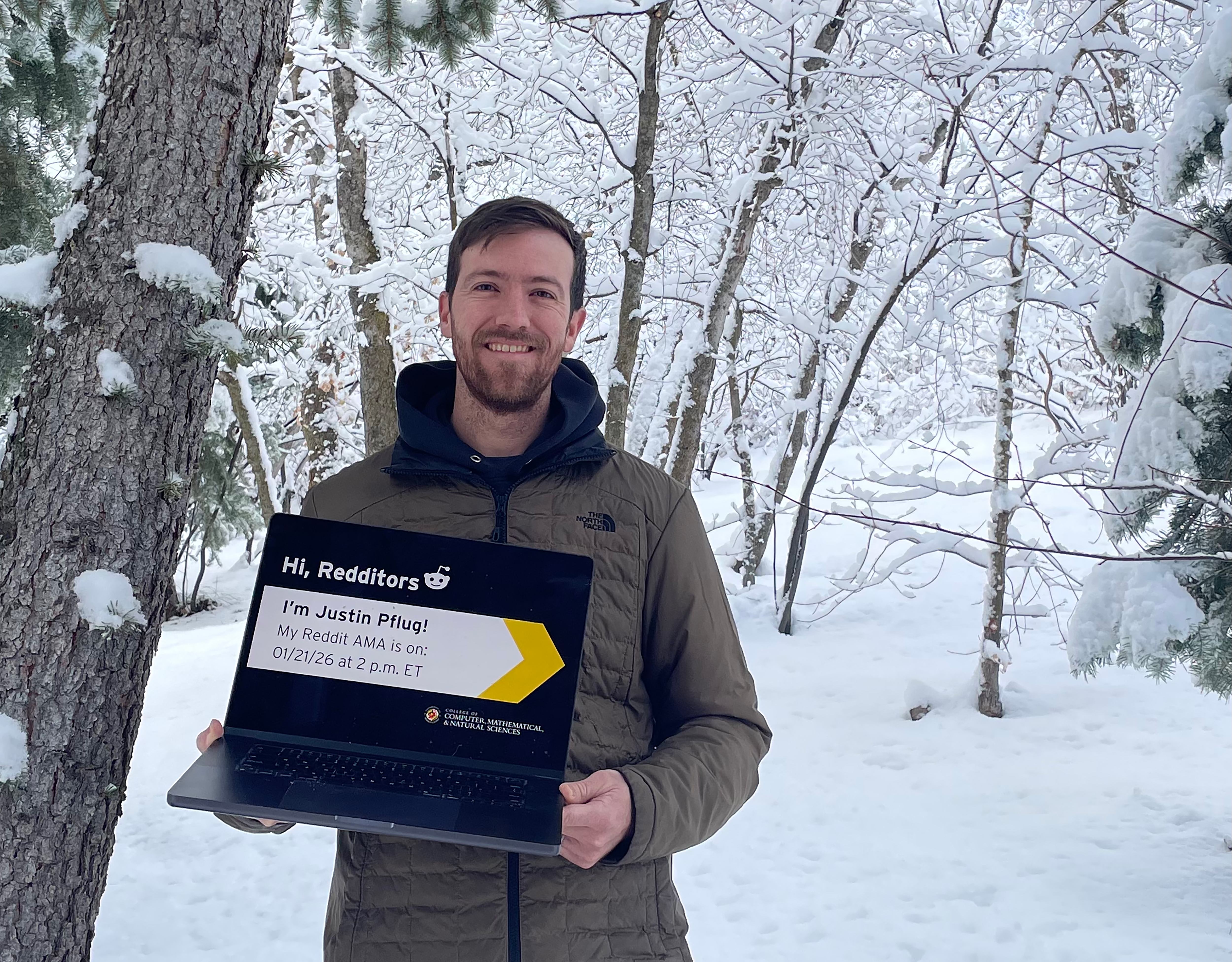
Justin Pflug, an associate research scientist with the University of Maryland Earth System Science Interdisciplinary Center (ESSIC) and NASA Goddard, participated in an Ask-Me-Anything (AMA) user-led discussion on Reddit to answer questions about snow science on January 21, 2026.
Seasonal snow plays a vital role in Earth’s climate and hydrologic systems, supplying freshwater to approximately 2 billion people and sustaining local ecosystems. The snow research, hydrology, and meteorology communities rely on remote sensing data from existing satellite constellations to assess the global distribution, volume and seasonal changes of snow water resources.
Pflug works with NASA snow science and modeling teams to develop new modeling and remote sensing approaches for seasonal snow, with a focus on combining observations and models in mountainous landscapes.
This Reddit AMA has been edited for length and clarity.
What ways do you use for remote sensing for estimating snow cover?
We look at snow from remote sensing in a bunch of different ways. Some sensors look at the visible snow cover, and we use that information, along with snow melt energy, to estimate the amount of water in the snow over time. There are also sensors that use microwave either emitted or directed at the Earth, and how snow attenuates that to estimate how much snow exists. Lidar is also used from both airborne and satellite sensors to measure the difference in elevation between snow-absent and snow-present periods to measure the depth of snow.
Finally, we are continuously looking at ways to design new sensors to measure snow, including ground, airborne and satellite platforms. If you're interested in learning more about how we've combined existing and future satellite models to get the best snow estimates, you can check out this lecture I gave.
Is there any application for remote sensing when it comes to avalanche forecasting?
I've had a number of projects focused on avalanches. Snow pits are a really great way to forecast avalanches because they allow you to look at the properties of the snowpack, including the structure of the layers, their density, the stability of the snowpack to certain impacts, etc. However, snow pits are only specific to points in space, and you sometimes need multiple snow pits to get a broader, better picture of the snow conditions.
From a remote sensing standpoint, it's challenging because the starting zones of avalanches are at scales smaller than most satellites can observe, and satellites don't observe the characteristics (listed above) of snow that make avalanches more and less likely. Observations from airborne platforms and some commercial satellites may be able to look at snow at scales comparable to the starting zones of avalanches. In this paper, the 3-meter resolution snow cover from commercial satellites was able to identify an avalanche in Colorado that, unfortunately, resulted in a fatality. However, these observations can only really determine snow quantity and whether an avalanche existed. That being said, models are widely used to estimate the conditions of the snowpack and whether the avalanche risk is high.
What are your thoughts on using machine learning methods vs. physically based models for satellite retrievals?
In short, I think there is a lot of merit to both machine learning and physically based models. From the physically based side, we can more directly compare what the sensor is seeing, including both the physics of the sensor and the snowpack it sees. That helps us understand how a change to the characteristics and amount of snow results in a change to the signal retrieved by the sensor. On the other hand, machine learning provides more flexibility for connecting snow properties and the retrieval from the satellite, which can improve upon physically based models, which often use overly simplified snow representations. However, how a machine learning approach comes to a solution is not always clear, and it's difficult to train models because a lack of snow data. For example, where reliable snow observations exist, they are typically only at points and are difficult to compare to the spatial footprint observed by the satellite. There is a middle ground where physically based equations can be embedded into ML approaches, which could offer the best of both worlds.
If you're interested, we recently showed how remotely sensed snow cover could be combined with machine learning approaches and simple inputs like temperature to estimate the global mass of snow.
Almost zero snowfall is being reported in the northern Himalayan states of India, like Uttarakhand and Himachal Pradesh. Is the snow shortfall a one-time issue? Or an indication of long-term climate change impact? And how drastically would it affect the rivers and their water content that feed the Gangetic plains?
At NASA, we do try to look at and estimate snow in High Mountain Asia. However, it's a tricky place to look at because we have so little snow validation data, and elevations and terrain are so extreme. I haven't looked at what is happening there this year, but it's also difficult to attribute snow conditions in any single year to climate change impacts. In this region in the future, we're expecting to see increases in temperature, transitions from snowfall to rainfall, and earlier snowmelt onset. This will start first at lower elevations, climbing up to higher elevations if temperatures continue to rise.
This sort of impact could result in more streamflow in rivers earlier in the year, but we would expect lower streamflow later on as snow disappears earlier and glaciers shrink. This could all be influenced by precipitation patterns, which are expected to become more erratic, with swings between more intense precipitation and longer dry spells. That being said, a lot of this region is at really high elevations that could continue to accumulate large amounts of snow even with higher temperatures. I'm not familiar with projections in this specific region, but we would expect all of the above impacts that I referenced to affect water supply, depending on how emissions continue or are altered moving forward.
On a slightly more whimsical note, how many words/names for different types of snow have you encountered, and which of these do you yourself use? And do you have any favourites?
In addition to having different languages reference snow differently, there are specific names for the types of snow grains. For example, there is a type of snow called hoar, which is faceted and has large cup-shaped crystals. Then there are clusters, which are more influenced by water presence and absence, that are more rounded. In short, individual snowflakes are changed by the conditions they encounter both by the conditions they encounter when they enter the atmosphere and after they have landed on the ground.
This is important for us, because the properties of the individual snowflakes influence how different remote sensing satellite observations view the snow. This has been a topic of research for a long time—some of the earliest looks at snowflakes and the conditions that caused them were investigated by an individual named "Snowflake Bentley."
Which countries will be most disadvantaged by melting snow, rising water levels and climate change? Is it true low lying islands nations like the Maldives and Tuvalu have less than 30 years left?
More than a sixth of the world's population relies on seasonal snow for water supply, so future snow conditions are important to understand. It's not a comprehensive list, but these 2021 and 2024 studies suggest that some of the most at-risk regions are the U.S. Southwest, western, central and northern Europe, the South American Andes, and coastal locations in general. I'm not an expert on sea level rise, but glacier and ice sheet melt certainly contribute.
How early before is it possible to accurately predict things like snowfall amounts? And what is considered "accurate" when using models to make predictions?
There are certainly some uncertainties when it comes to estimates of snowfall, precipitation amount and impacts.
From a snow standpoint, accuracy really depends on the application. For water resources, it may be important to understand daily total water supplies in a watershed to within 10%. But from an avalanche perspective, detailed representations of the snowpack structure and amount are more important. Meteorological and weather forecasting applications are not my expertise, but there is a lot of thought and care taken to both improve the accuracy of forecasts and the communication of the potential impacts for the safety of citizens who may be impacted by severe weather events.
In my everyday experience, snow at ski resorts today seems crustier and less good to ski on than the fluffy powder I remember skiing on in the 1990s. Selective memory, or is global ski snow really getting less... good?
As temperatures rise, more precipitation is falling as rain instead of snow, and snow is melting more frequently and earlier. The impacts of these changes are not felt equally in all locations and may impact some ski locations and resorts to different degrees. So yes, in a way, snow may be getting less ideal for skiing in many locations, though it varies year-to-year.