NIH data strategy czar Susan Gregurick (Ph.D. ’95, chemistry) brings her science success story to UMD as keynote speaker for the 2026 CMNS Doctoral Commencement Ceremony.
Throughout her career, from her years in academia and her work leading data-driven research programs at the U.S. Department of Energy to her current role as associate director for data science and director of the Office of Data Science Strategy at the National Institutes of Health (NIH), one thing about Susan Gregurick (Ph.D. ’95, chemistry) has never changed—she loves taking on big challenges.
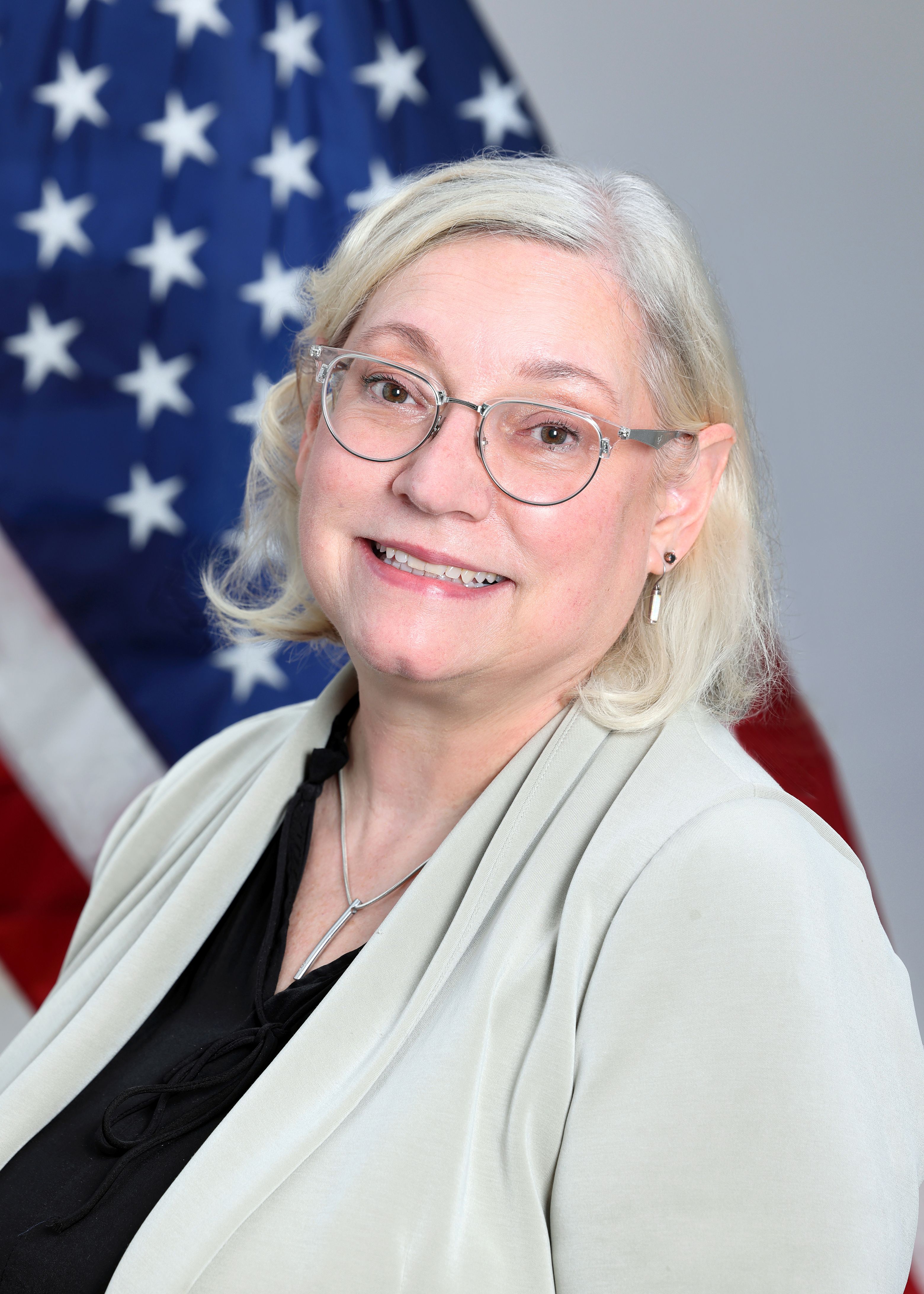
“I do love a good challenge. I find that without that driver to solve problems, I get a little unsettled and restless. I’m like a shark, I suppose, I have to keep moving,” Gregurick explained. “I am motivated by the mission of NIH, helping to solve problems that may eventually make their way into our healthcare system.”
At the NIH, Gregurick leads an ambitious effort to elevate the frontiers of data science, artificial intelligence (AI) and advanced computing to take biomedical and health research into the future.
“In data science, computing and even in the AI fields, I work across our institutes and offices to find where there's common ground and where we need to work together, for example, in databases and knowledge bases, or where we need more funding, like developing AI and generative AI capabilities within research,” she explained. “What I really like about working in government is that you have a lot of input into how science will look going forward. While the researchers are doing all the work and creating all the innovation, we’re trying to figure out what the next step is. What are the things we need to invest in now to be really impactful in the future?”
For Gregurick, the drive to push science forward goes all the way back to her years as a Ph.D. student in chemistry at the University of Maryland—and an inspiring Distinguished University Professor who taught her the value of research and collaboration.
“I have to just give all the credit to Millard Alexander, quite honestly. He was an amazing mentor,” she said. “He had the viewpoint that science moves forward through collaborations, and we would have a lot of discussions about understanding the interplay between theory, computation and experimental results. That really grounded me in the concept that science isn't done alone. Science is something that you do with other people. And that was foundational to how I’ve worked throughout my life.”
On May 19, 2026, Gregurick’s adventures in science will come full circle when she shares her success story and advice with this year’s graduates as the keynote speaker for the College of Computer, Mathematical, and Natural Sciences’ (CMNS) Doctoral Commencement Ceremony.
“They’re the next generation of scientists. I’m totally excited to talk to them,” she said. “I hope they’re ready to embrace life and the challenges ahead.”
Becoming a ‘card-carrying scientist’
Gregurick grew up in Flint, Michigan, and in a family of mostly educators and musicians, she didn’t fit the norm.
“I am the first card-carrying scientist in my family,” she noted.
Always fascinated by chemistry and mathematics, Gregurick earned her bachelor’s degree in 1987 from the University of Michigan. When she began graduate school at UMD, her research on the dynamics of small molecules with complex electronic structures led her to a biophysical postdoctoral project in the dynamics of large biological macromolecules. That eventually fostered an interest in large-scale data problems, which motivated her to learn more—and led to another life-changing development she never saw coming.
“One thing that was really wonderful was that UMD was very open to letting people explore their career path. I'm not sure every university is that flexible. I took quite a few classes in the Department of Physics, which gave me a foundation of physics and computational sciences,” said Gregurick, who is also grateful to have met her husband, Nicholas Phillips (Ph.D. ’99, physics), there in a quantum mechanics class.
Inspired by her professors, Gregurick also discovered a passion for teaching and mentoring.
“I have some really good memories from when I was a teaching assistant; I loved working with students,” she said. “And I loved learning, primarily from Millard and [Professor Emerita] Janice Reutt-Robey, about how to be a good mentor, how to work with students and how to teach.”
In spring 1995, Gregurick earned her Ph.D., married her UMD sweetheart the day after the commencement ceremony and began her career, teaching computational chemistry at the University of Maryland, Baltimore County, while her husband worked as a research scientist at NASA.
A few years later, inspired to take her experience with large-scale data problems to the next level, Gregurick landed a program director position at the U.S. Department of Energy. From there, she went on to become the division director for biophysics, biomedical technology, and computational biosciences at the NIH’s National Institute of General Medical Sciences, again taking on the challenges of data science and research.
“When I went to the Department of Energy, my job was to figure out how we would share data to address our mission in bioenergy across our national lab system, and all of the different ways to think about plant microbes and environmental interactions sucked me into this world of data science,” she recalled. “Then I went into health, where the human genome is not nearly as complex as the plant genome, but the challenges are equally challenging in terms of dealing with patient data, so it's been a really interesting and fascinating set of activities.”
‘If you want to go far, go together’
In her current role at the NIH, Gregurick doesn’t just lead data science strategies and initiatives; She also leads people, working at the intersection of data science, AI, advanced computing and research to forge collaborations that move science forward.
“I always wanted to be a leader of people, and my work at NIH gives me that opportunity. Honestly, I'm much better suited as a scientific administrator than a researcher, and after almost 18 years in government, I think that’s my sweet spot,” she explained. “Being an administrator allows me to see science on a higher plane that spans different fields, and I am inspired by what we are doing together to advance biomedical research by developing and utilizing tools and methods in the computational sciences. There is an African proverb, ‘If you want to go fast, go alone; If you want to go far, go together.’”
Looking ahead to her speech at this year’s CMNS Doctoral Commencement Ceremony, Gregurick is reflecting on her own graduation more than 30 years ago, and the pride she felt more recently, as she watched her son Andrew graduate from Maryland with a degree in chemistry in 2023. In both her life and her career, UMD has made an indelible impact.
“UMD 100% changed my life,” she said. “My experiences at UMD really changed my entire focus and the way that I look at life in a very positive way.”
As this year’s graduates move forward and take on the challenges ahead, Gregurick hopes they’ll remember the UMD experiences that helped pave their way and be inspired to give something back.
“Every scientist is challenged every day by a hundred things that they have to do, but quite honestly, the most important and impactful thing they can do is give back,” she said. “I hope that I will inspire them to do that.”