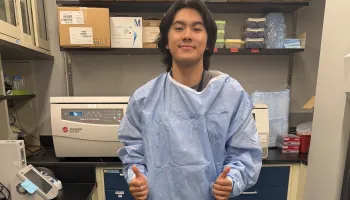
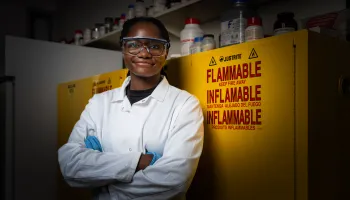
UMD Chemistry and Biochemistry Associate Professor Ling Hao is on a quest to decode the molecular changes that cause neurodegenerative conditions like Alzheimer’s and Parkinson’s diseases.

For Ling Hao, curiosity isn’t just an asset in scientific research—it’s a way of life that began long before she ever stepped into a laboratory. Growing up with parents who studied forestry and agriculture, she spent her childhood exploring forests and grasslands, learning the names of plants and playing with volumetric flasks filled with colored water.
Those early experiences planted the seeds of what would later become Hao’s philosophy as a scientist: be curious and enjoy the process of discovery, no matter how daunting the setbacks might be. Her childhood curiosity evolved into a systematic approach to one of medicine's greatest challenges—understanding how neurodegenerative diseases develop in the human brain.
Hao joined the University of Maryland's Department of Chemistry and Biochemistry as an associate professor in 2024 and hopes to instill that same philosophy in her students in the classroom and her state-of-the-art research lab in the new Chemistry Building.
“I love being at the forefront of training the next generation of researchers, whether they are members of my lab or students in my classroom,” Hao said. “But I also want them to learn not to fear failure and embrace the journey of discovering the what, why and how.”
Tracking chemical clues in our minds’ molecules
In her research, Hao works to unravel one of the brain’s most persistent mysteries: what molecular mechanisms trigger conditions like Alzheimer’s and Parkinson’s diseases.
“Despite decades of effort, most brain diseases are still incurable, largely because the brain is so complex, and we still don’t fully understand it,” she said. “My research group contributes to the effort by creating new chemistry tools and combining techniques from chemistry, cell biology and data science to understand how biomolecules—like proteins, lipids and neurotransmitters—regulate and work together in human neurons in the brain.”
The key to Hao’s work rests on two advanced technologies: mass spectrometry and human stem cell-derived neurons. Mass spectrometry is a technique that gives molecules electric charges in the gas phase, which are then separated and measured by mass-to-charge ratios, allowing scientists to detect and measure thousands of molecules at the same time. Hao develops cutting-edge chemistry methods based on this technique to precisely measure biomolecules and reveal what molecules are present, as well as their abundance, distribution, interactions and structures in biological systems.

“Although there are animal models you can use to study human diseases, those models aren’t always accurate analogs of the human brain,” Hao explained. “You can take skin cells from a human patient, reprogram them back into stem cells, and then differentiate them into human neurons—giving us live brain cells in a dish. This lets us test different stresses and genetic mutations in these cultured neurons to model human brain diseases.”
Hao’s work bridges a critical gap. While scientists have identified many genetic mutations that cause illnesses like Alzheimer’s and Parkinson’s, it’s unclear how these mutations influence neurons and specific molecular pathways. Unlike many other cells, neurons cannot regenerate; when a neuron dies, it’s gone forever. Hao’s goal is to identify the mechanisms that trigger this irreversible damage so that new treatments can be developed.
In a recent project, Hao’s team measured the half-lives of over 10,000 proteins in human neurons for the first time. To understand protein turnover inside neurons, they also studied lysosomes, the cell’s “trash disposal system,” and how lysosomes try to “eat” or recycle aggregated proteins in the brain.
“Protein aggregation is a hallmark of neurodegenerative diseases,” Hao explained. “If lysosomes are not effectively cleaning up the ‘messes,’ protein aggregation will accumulate, and neurons will be stressed out by cellular trash and eventually die off. Understanding these cellular processes in neurons will help us decipher how a patient develops dementia.”
Hao’s team also develops fundamental analytical chemistry methods and data analysis strategies to handle the large datasets generated by mass spectrometry-based omics studies. Several of their approaches for detecting contaminations and improving data quality have been adopted into commercial software platforms and training courses worldwide, offering best practices and practical guidelines for the research community.
A “new era” at UMD
Hao received her Ph.D. from the University of Wisconsin-Madison, where she gained expertise in mass spectrometry and analytical chemistry. She then pursued postdoctoral training in neurobiology at the National Institutes of Health’s National Institute of Neurological Disorders and Stroke (NIH/NINDS). At NIH, she gained expertise in neuroscience and stem cell-derived neuron technology before starting her own research group combining chemistry and neuroscience. Following five years at George Washington University as an assistant professor, she arrived at UMD ready for what she calls a “new era” of her work.
With her brand-new lab now fully equipped with new mass spectrometers, chemistry instruments and a cell culture room to grow human neurons, Hao feels better positioned than ever to tackle challenging questions—and to mentor the next generation of scientists. Her group now consists of five Ph.D. students, one postdoctoral fellow, as well as undergraduate and high school students. Several of her Ph.D. students have begun careers as scientists in the pharmaceutical industry since graduating, applying their training to advance drug development and improve human health.

In the classroom, Hao teaches analytical chemistry to both graduate and undergraduate students, where she strives to connect chemistry concepts with real-life applications and spark engaging discussions. In fall 2025, she taught CHEM 625: Separation Methods in Quantitative Analysis. In one of her lectures, students learned how supercritical CO2 extraction can be applied to make decaf coffee beans.
“Learning to measure molecules using different analytical chemistry instruments and techniques is highly valuable in real-world applications. Knowing how to design accurate, sensitive, reproducible and efficient experiments will serve students well in any research field they pursue in the future,” she noted.
Looking ahead, Hao envisions her group driving both fundamental advances in chemical measurement techniques and progress in precision medicine—unraveling brain diseases at the molecular level to enable more personalized therapies.
“Science is about uncovering new knowledge, but it also comes with plenty of setbacks—failed experiments, paper rejections and unfunded grants after lots of hard work. Those challenging moments are exactly what make each discovery so exciting and rewarding,” Hao said. “I’ve been fortunate to have remarkable mentors along my journey. I hope to inspire students to dive into science with curiosity and joy, and to enjoy the twists and turns of scientific discovery.”