Atmospheric and Oceanic Science Professor Ning Zeng improves commercially available atmospheric sensors to collect actionable, research-grade environmental data.
A gray plastic box roughly the size of a paperback book sits on Ning Zeng’s desk. Its clear top reveals wires connecting tiny devices to a circuit board. Plugged in and operating 24/7, it functions as an environmental sensor measuring carbon dioxide, temperature, airborne pollutants and more.
Zeng, a professor in the Department of Atmospheric and Oceanic Science at the University of Maryland, uses this unit mostly out of curiosity and as a demonstration for office visitors. But a larger fleet of devices—about 20 deployed in the Washington, D.C.-Maryland area, plus others in South America, Europe and Asia—is central to his research program, which he calls Smart and Engaging Network for Sensing the Environment (SENSE), addressing climate change and other environmental issues.
The 20 host sites in the so-called “mini-SENSE” network use the data as environmental indicators, providing a hyperlocal complement to existing air quality resources like Maryland’s 24 state-operated air monitoring stations. Eventually, Zeng hopes to place sensors more densely in cities. That would allow him to integrate the data with atmospheric models to figure out where pollution comes from—which is often not disclosed and hard to discern—and where it goes.
“We want to see how we can solve climate change with low-cost and practical technology,” Zeng said. “The idea is that in cities, where there are so many different polluting sources, from tailpipes to factories to home heating, a dense network of sensors could get detailed and actionable information for citizen engagement, education and research.”
This line of research began in 2012 as a class project for Zeng’s course, AOSC 475/675: “Carbon Cycle and Climate: Past, Present and Future.” A student wanted to test how carbon dioxide levels in Greenbelt, Md., changed with traffic during the day and week. Zeng sent them off with a sensor he used for class demonstrations, which cost only a few hundred dollars. When the student returned with data, Zeng was surprised that the sensor detected clear trends in carbon dioxide that correlated with peak rush-hour traffic and the work week.
“That made me realize that these cheap sensors can actually detect important signals,” Zeng said. “That was a major motivator for me to start working on this.”
Several undergraduate students went on to complete departmental honors thesis projects improving the accuracy and precision of affordable, commercially available sensors costing as little as $200 per unit. They eventually deployed an early version of the sensor box on the roof of the Atlantic Building at UMD, where it still collects data today.
Thanks to his promising initial results, Zeng received support from the National Institute of Standards and Technology and the National Oceanic and Atmospheric Administration, allowing him to recruit graduate students, government employees and outside contractors to join the effort, publish peer-reviewed articles and deploy more units.
The biggest improvements over the years came from devising “clever algorithms” to ensure the sensors provided reliable data, Zeng said. Temperature and humidity fluctuations affect sensor measurements, so Zeng’s team placed sensors to measure those conditions next to the air quality sensors and developed mathematical techniques to correct for environmental variation. They also calibrated sensors to account for “drift” in the sensor’s measurements, ensuring stable measurements over long periods.
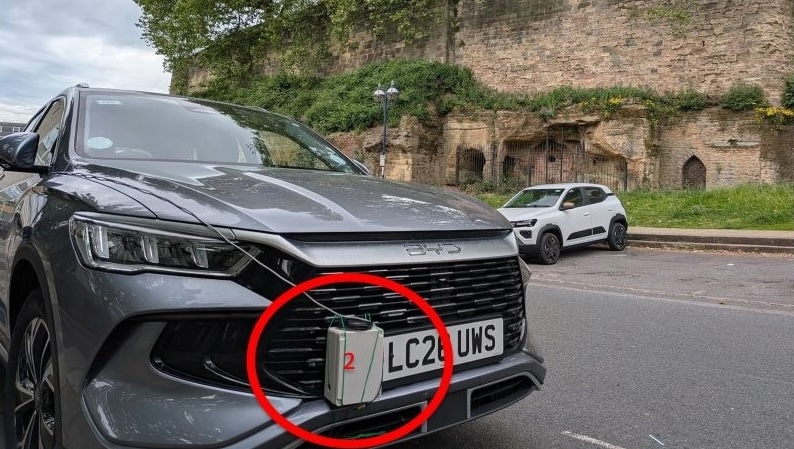
Additionally, his team significantly improved the hardware. They created models that can detect various compounds indoors or outdoors, connect to solar panels and last 15 years with little to no maintenance. Some of these models can also be attached to a bicycle or car. In fact, Zeng has had one operating continuously on his vehicle for years. He even took a sensor box on his summer vacation and attached it to his rental car to measure how pollutants changed across various urban and rural areas across Europe.
“No matter how densely sensors are distributed, they cannot cover every single square foot, so we developed a travel model,” Zeng said. “You can take it to areas of high interest—like on the beltway or downwind of a factory—to measure the very immediate environment.”
Zeng credits his UMD students and collaborators for the strides they’ve made in this atmospheric sensor research. Trained as a physicist, he began his career working on climate modeling. He learned most of the engineering and software development needed for his sensor research from others working on the project. Of particular importance was Cory Martin (M.S. '16, Ph.D. '18, atmospheric and oceanic science), Zeng said, who was instrumental in the project’s early days.
“From hardware to software, we’ve had help from undergraduate students to graduate students to working professionals,” Zeng said. “It's really been a myriad of components that have had significant contributions from students.”
Moving forward, Zeng is looking for new sites for his sensors. Ideally, he said, these would be on rooftops or towers where measurements are most scientifically useful—but street corners, backyards and garages can all provide useful information—and he encourages interested potential hosts to reach out to him. Eventually, he envisions a future where these devices are incorporated into weather stations and densely placed in major cities around the world to pinpoint pollution sources and flag environmental threats.
“Our goal is to make these instruments research-quality so that scientists can get data that they can actually use,” Zeng said, “but make them affordable enough so that an extended network of citizens will actually use them.”