Chemistry Ph.D. student Silas Frimpong redesigns porous materials atom by atom to pull pollutants from water and recover critical metals.

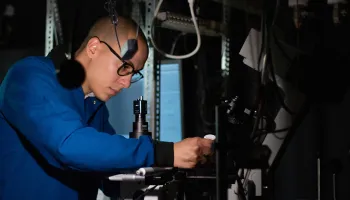
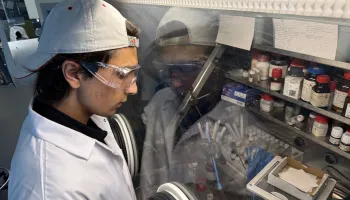
In his research at the University of Maryland, chemistry Ph.D. student Silas Frimpong aims to do two things: pull “forever chemicals”—known as per- and polyfluoroalkyl substances (PFAS)—out of drinking water and recover rare metals from old electronics. They may seem like two very separate challenges, but Frimpong has developed a single approach that can tackle both. He creates crystalline materials full of tiny pores that can trap and remove the targeted molecules.
Working with Chemistry and Biochemistry Assistant Professor Mercedes Taylor, Frimpong designs and develops these materials to pull specific contaminants and metals from water and other sources.
“Silas makes new chemical materials that are like sponges on the molecular level,” Taylor explained. “They are full of pores, or empty spaces, that can capture individual molecules inside.”
The key to Frimpong’s work is the selective quality of his chemical “sponges.” Instead of soaking up everything like the average kitchen sponge, Frimpong’s sponges can attract certain molecules and ignore others. By changing the chemistry inside the pores, they can be fine-tuned to capture toxic contaminants or valuable, recyclable metals.
Frimpong’s research earned him the Millard and Lee Alexander Fellowship in Chemistry, which was established by Distinguished University Professor Emeritus of Chemistry and Biochemistry Millard Alexander and his wife, Lee, for second-year Ph.D. students.
“The fellowship made me feel that my work has been recognized and that I’m on the right track,” Frimpong said. “This acknowledgment of my research gives me more motivation to do what I do.”
From tutoring in Ghana to learning in Maryland
Growing up in Ghana, Frimpong was always fascinated by science and how it could explain the world around him. His interest in chemistry ignited when he realized he had a knack for breaking down complicated science concepts for his peers.
“In high school, I noticed that many of my classmates found chemistry intimidating,” Frimpong recalled. “I tried helping them understand the more abstract concepts, and I saw that I was capable of helping them understand. I felt fulfilled helping them overcome their confusion, so I decided then that I wanted to study chemistry to the highest level, a Ph.D.—that way, I could help many more people become informed about the world.”
In 2022, after earning his bachelor’s and master’s degrees in chemistry in Ghana, Frimpong came to UMD, drawn to the environmental remediation work in Taylor’s lab.
His first major project took on a long-standing problem for materials scientists: customizing the inside of sponge-like materials used to filter out specific targets like PFAS, which can persist in the environment for decades and have been linked to immune system defects and certain cancers. Frimpong developed a simpler process to give the sponge pores a “taste” for specific molecules, designing a version that grabs onto PFAS and pulls them from water. Frimpong published his design in Small, a nanoscience and nanotechnology journal.

“It’s energy efficient and it’s sustainable, because you don’t have to use energy to purify it,” he said. “I see this sponge as becoming a membrane or filter in the future. You just have to let the water go through, and it removes these PFAS. It could mean clean, usable, drinkable water for people even in the poorest, resource-lacking areas.”
Frimpong is now applying the same strategy to capturing carbon dioxide for environmental applications and targeting critical metals such as cobalt and neodymium, which are essential for electric vehicles and semiconductors.
“Many of these metals are chemically similar and hard to separate, and few are recovered after use for recycling,” Frimpong explained. “Materials that capture and sort these metals could help recover them from e-waste and wastewater, giving industry a more sustainable supply while also keeping people from ingesting harmful substances.”
“All this could really make a difference for people around the world, both environmentally and economically,” Frimpong added.
For the future
Since arriving at UMD, Frimpong has met Nobel laureates and collaborated with researchers across the country.
“Being in Maryland let me access resources and networks in D.C., but it also let me explore the eastern U.S. and all it has to offer,” Frimpong explained. “The experiences I’ve had have made me a much more collaborative, open-minded person.”
He says UMD allowed him to explore opportunities that he could not have imagined, opening doors to new ideas and exciting possibilities for his future. Ultimately, he hopes to obtain a faculty position working at the intersection of chemistry and materials science.
“Silas enjoys training younger students as well as pursuing his own research, which has increased his positive impact on our field,” Taylor said. “As he enters his independent career as a scientist, I’m sure he will continue to combine his passion for environmental stewardship and sustainability with his skills in materials design as well.”