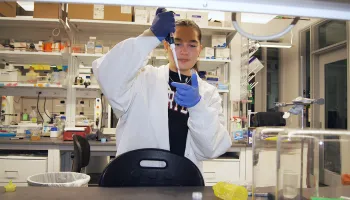
Thanuri Navarathna (B.S. '20, biological sciences) will study an endemic bacterial disease in Sri Lanka, bringing her public health training to the country where her family is from.

When Thanuri Navarathna (B.S. ’20, biological sciences) graduated from the University of Maryland, she walked straight into a pandemic. But she didn't panic; she got curious.
“By chance, I took an elective on the epidemiology of infectious disease right before everything shut down due to the COVID-19 pandemic,” she recalled. “For a long time, I had no idea what I specifically wanted to do with my degree. Seeing the pandemic play out in real time, the kind of event I had just spent a semester studying, made me realize that everything I was learning was incredibly relevant to events happening around the world. It made me realize that this field is what I wanted to dedicate my career towards.”
Thanks to that spark of inspiration, Navarathna honed her skills as a disease detective. After graduation, she moved to Texas and worked as a research technician at a Veterans Affairs Hospital infectious disease research lab. There, she investigated new methods to keep hospital environments free of dangerous pathogens and to track the spread of disease within a hospital environment, running studies on antibiotic resistance and sequencing genomes of microbial isolates. Navarathna also enrolled in a master’s program in public health, majoring in epidemiology, at UTHealth in Austin, where she learned that epidemiology was about more than counting cases.
“It’s also a framework for understanding how disease moves through populations, what makes people vulnerable and where systems fail them,” explained Navarathna, who most recently worked as the biological threat coordinator at the State Hygienic Laboratory at the University of Iowa, Iowa’s state public health reference lab. “Studying epidemiology contextualized the microbiological lab work I’ve been doing within the broader landscape of population health.”
This year, Navarathna will take her epidemiology work to the next level. She received a Fulbright U.S. Student Award to travel to Sri Lanka, where she will investigate leptospirosis—a neglected bacterial disease that infects a million people and kills up to 60,000 globally every year.
Navarathna said she picked Sri Lanka for her Fulbright fellowship because the country was close to her heart.
“In another world, I’d probably be living there and calling it home instead of the U.S.,” she explained. “My entire family is from Sri Lanka, and although I grew up an American my roots remain firmly in Sri Lanka. I speak the language, know the culture, and always wanted to give back to the people and community I come from. Now, I have the opportunity and skills to make a meaningful contribution to that community while also fully immersing myself in my culture in a way I never had the opportunity to do before.”
A community close to the heart
Leptospirosis doesn’t make headlines the way COVID-19 or Ebola do, but in Sri Lanka, it is a quietly devastating presence. The disease spreads through contact with water contaminated by the urine of infected animals—a particular hazard for people who work in rice paddies, gem mines, construction sites, canals or any occupation that puts them near contaminated water or soil. Symptoms range from minor flu-like fever and chills to severe organ failure and death. As a country with a significant agricultural sector and frequent monsoon flooding, Sri Lanka has one of the highest rates of the disease in the world.

In fall 2026, Navarathna will land in Sri Lanka to conduct a mixed-methods assessment on the surveillance, diagnosis, and prevention of leptospirosis.She will administer knowledge, attitudes and practices assessments, structured surveys used to evaluate how well a population understands a given health threat, to high-risk groups to gauge their awareness of leptospirosis: how it spreads, how to prevent it and what to do if they suspect they’ve been infected.
“Traditionally, rice farmers were seen as the main at-risk group,” Navarathna said. “But research has shown that it affects a much more diverse range of people than previously thought. I’ll be studying that expansion of impacted demographics.”
While in Sri Lanka, Navarathna also plans to conduct in-depth interviews with physicians, public health officials, and laboratory personnel, trace suspected cases through the laboratory testing process, and evaluate surveillance records to map the systemic barriers that keep leptospirosis underdiagnosed and underreported. Navarathna has already spent months working long-distance with researchers at the University of Sri Jayewardenapura in the capital city of Colombo and at the Sri Lankan Department of Health Services to develop a thorough research proposal.
“Although I’ve been involved in infectious disease research and epidemiological surveillance before, this will be my first time practicing public health research in the field,” Navarathna said. “That is what makes this opportunity so exciting and also a little intimidating—I can’t wait.”
Building connections between science and communities
Navarathna credits UMD’s National Scholarship Office with helping her shape her Fulbright application. Working with advisors who understood what the selection committees look for, she refined her research descriptions and personal essays through multiple rounds of feedback. A panel of UMD faculty members—some with subject-matter expertise, others with Fulbright experience—also reviewed her application before submission.
“They helped me figure out all the ins and outs of the process,” Navarathna said. “I had a lot of questions and uncertainties, but they were a great resource and kept me on track.”

Reid Compton, principal lecturer emeritus of biology and former director of the College Park Scholars’ Life Sciences program and an advisor during her time at UMD, isn’t surprised her efforts paid off. He watched her begin her studies at UMD with initial plans to pursue medicine and helped her navigate the uncertainties of switching to a new path when she decided medical school wasn’t for her.
“Thanuri had her moments of doubt, but I could see the passion,” Compton said. “She loved research as an undergrad and has succeeded at every stage in her professional development since graduating. She has taken what she learned at UMD and now uses it to advance science for the public good. The Fulbright is a continuation of that journey.”
For Navarathna, the opportunity to go to Sri Lanka to help solve one of its biggest infectious disease challenges is just the beginning. She hopes her findings on leptospirosis will reach beyond academic conferences and journal submissions, connecting with diaspora communities across the U.S. to foster dialogue on how they can support global health initiatives and contribute to stronger international understanding.
Longer term, Navarathna plans to pursue a Ph.D. in infectious disease and continue working at the intersection of lab research and global public health. She said her Fulbright research will further affirm her commitment to the career path she hopes to pursue.
“It’s thanks to UMD that I found my passion and have the foundational skills to try and make a difference, especially for people and communities that are often overlooked,” Navarathna said. “I want to better understand how work done in the lab actually translates into real-world impact. This is my chance to see that connection firsthand.”