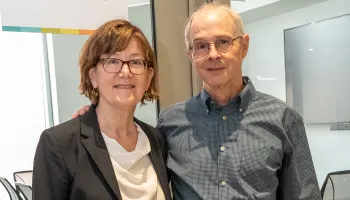
UMD senior Natalie Shin pursues her passion for chemistry and public health by investigating the molecular machinery that helps viruses infect cells.

The first time University of Maryland senior Natalie Shin walked into Associate Professor Jinwoo Lee’s lab in the Department of Chemistry and Biochemistry, she felt like a puzzle piece sliding into place. As a pre-med student pursuing a double degree in chemistry and public health, Shin was looking for a place to begin her journey to medical school, and Lee’s lab felt like an ideal place to start building her experience in medical-related research.
“It was the summer before my sophomore year,” Shin recalled. “I was looking for my first laboratory experience, which was something I initially was anxious about because I’d never done real research before. But after working in Dr. Lee’s lab for a while, I gradually got used to the flow of the work and really felt like I was thriving.”
Lee’s research group offered exactly what Shin was looking for. His lab studies viruses, including coronaviruses and arenaviruses (single-strand RNA diseases carried by rodents, such as Lassa virus), focusing on how viral proteins interact with the membranes of the cells they infect.
“You can think of it like how a cell is a house and its membrane is the walls and locked doors of that house,” Shin explained. “A virus is like a burglar with a set of protein lockpicks, so mapping out that toolkit is how we learn how to protect that house from being robbed. Stopping a virus’ entry into a cell means stopping an infection from occurring.”
Both coronaviruses and arenaviruses are seen as having significant potential to become the next pandemic, so, as an aspiring doctor, Shin had a vested interest in learning more about them and their public health implications.
“I’ve always been drawn to research that explores both the science of a disease and its impact on people and communities,” Shin said. “I joined his lab because I really liked how Dr. Lee’s work has direct implications in helping people. Thousands of people suffer from arenaviruses and coronaviruses on a global level, so really understanding how these diseases work can make a difference in how we improve health outcomes around the world.”
Classroom concepts to real research
When Shin first joined Lee’s lab, she was part of a team of undergraduate researchers working on coronavirus-related research. For her, much of the science was new and at first, everything felt overwhelming.
“I hadn’t taken biochemistry yet; I was still learning the language of proteins and molecular biology,” Shin recalled. “It was a struggle.”
But hands-on lab work gave her a foundation that later transformed how she experienced her coursework. With direct access to the lab's research materials, Shin was mentored by Lee and his graduate students—learning not only the science behind their research but also how to tackle complex content in an organized way.

By the time Shin took biochemistry courses, many of the concepts explained in the lectures and textbooks were no longer abstract.
“I realized, ‘Oh, I do this every day in the lab!’” Shin said. “It made it a lot easier to work through my homework and classwork.”
Shin’s experiences also gave her enough familiarity with the lab’s coronavirus research to eventually take on her own project. Her work builds on research by Daniel Birtles (Ph.D. ’23, biochemistry), who studied the same region of the coronavirus spike protein before graduating from UMD.
Shin focuses on the fusion domain, a small part of the spike protein that helps the virus enter a cell. For infection to occur, the viral and cellular membranes must come together and fuse. She investigates how different fatty molecules, or lipids, that make up cell membranes affect that process.
To do that, Shin uses tiny laboratory-made structures called nanodiscs that mimic organic cell membranes. By changing the types and amounts of lipids in those structures, she creates different environments for the viral protein, then uses a technique called fluorine-19 nuclear magnetic resonance to observe how the protein responds.
“These interactions can explain why some cellular environments are more favorable to viral fusion than others,” Shin explained. “This work also connected to the rest of the research being done at Dr. Lee’s lab. Coronaviruses and arenaviruses are different viruses, but they use related mechanisms to fuse with the membranes of their host cells. Studying them side by side can help us understand the common principles behind viral infection.”
Under Lee’s guidance, Shin hopes to complete her honors thesis, co-author a paper and present her findings at conferences. She hopes her research can help lay the groundwork for better vaccines and therapies to treat coronaviruses—resulting in better outcomes for millions of patients around the world.
“Natalie’s work will help us understand a fundamental step in viral infection,” Lee explained. “I see her making meaningful contributions to this area of research and carrying that scientific curiosity into her future career in medicine.”
As Shin prepares her medical school applications, she sees her passions for chemistry and public health coming together in one path to set the stage for her future career.
“Chemistry taught me how a disease works at the smallest scale, and public health has taught me how it affects entire communities,” she said. “As a doctor, I want to be able to see both—the molecule and the person. Being part of Dr. Lee’s lab showed me that the work we do as scientists really can reach patients.”