The PRobe far-Infrared Mission for Astrophysics (PRIMA) will peer through cosmic gas and dust to achieve a remarkably clear view of the universe.
NASA announced today that a proposal for a space probe co-developed by University of Maryland astronomers is advancing to the next stage of development. The PRobe far-Infrared Mission for Astrophysics (PRIMA) will measure far-infrared radiation at unprecedented sensitivity, paving the way to discoveries on planet formation, black hole and galaxy evolution, the origins of cosmic dust and more.
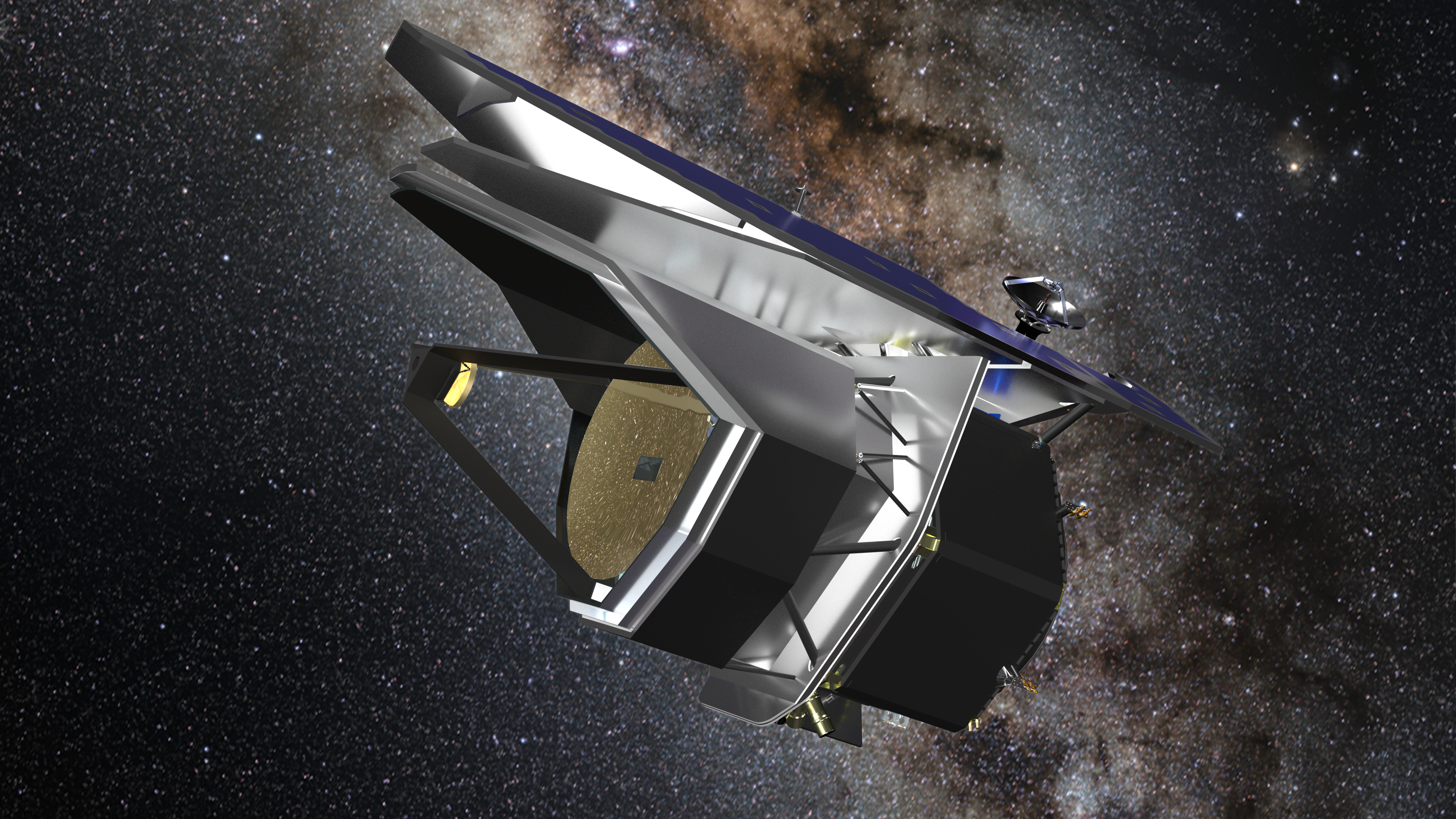
NASA selected PRIMA to move into Phase B, the stage of development that advances the preliminary design and technology development for the mission. The mission is subject to a confirmation review, based on technical, programmatic, and cost performance, to determine its readiness to begin implementation in Phase C. If confirmed, PRIMA’s project cost is capped at $1.2 billion, not including launch and other non-project costs. The observatory will be targeted to launch in 2033, for a planned five-year mission.
PRIMA is the first in a new class of NASA astrophysics missions, called Probe Explorers, within the agency’s longstanding Explorers Program. With a 5.9-foot telescope, PRIMA will help bridge the gap between existing infrared observatories, such as NASA’s James Webb Space Telescope, and radio telescopes. The NASA Jet Propulsion Laboratory (JPL) will manage the mission, with contributions from NASA's Goddard Space Flight Center, NASA’s Marshall Space Flight Center and international partners. UMD Astronomy Professor Alberto Bolatto is a co-investigator leading PRIMA research on galaxy evolution, and UMD Astronomy Professor Sylvain Veilleux is a science working group lead for the mission’s research on active galactic nuclei—black holes that are actively consuming matter.
“NASA’s selection of PRIMA is a landmark moment for astrophysics and University of Maryland astronomers,” said Amitabh Varshney, dean of the College of Computer, Mathematical, and Natural Sciences. “We are proud to support a bold mission that will empower scientists to make discoveries about our universe that we can scarcely imagine today.”
"PRIMA is a huge step forward,” added UMD Astronomy Chair Andrew Harris. “The results will enable Professors Bolatto and Veilleux and their students to make breakthrough discoveries in galaxy formation and evolution, increasing humanity's understanding of the universe while adding to Maryland's prominence in the field.”
Far-infrared radiation has been under-resourced in previous astronomy missions, said Bolatto, who is also a Joint Space-Science Institute Fellow. This wavelength range sits between those of two of the world’s premier telescopes—the Atacama Large Millimeter/submillimeter Array (ALMA) and the James Webb Space Telescope (JWST)—making PRIMA a valuable complement to existing observatories.
Measuring far-infrared radiation allows researchers to see through cosmic dust and gas in a way that current telescopes cannot, enabling them to observe the universe even when objects of interest are obscured. The last telescope capable of detecting far-infrared wavelengths was the Herschel Space Observatory, which was active from 2009 to 2013. At certain wavelengths, PRIMA can obtain observations up to six orders of magnitude faster for the same depth than its predecessor.
“It’s not often that you have a facility that comes online that is several orders of magnitude more capable than the previous facility,” said Veilleux, who is also a Joint Space-Science Institute Fellow. “Even a factor of 10 is rare. Several orders of magnitude is almost unheard of.”
“The potential is enormous because the sensitivity difference is very, very large,” Bolatto added. “The fact is we have capabilities that are way beyond what was available with Herschel, and because of that, the discovery space for the mission is gigantic.”
The team of investigators behind PRIMA will leverage the instrument to pursue three primary research areas. The first is on the origins of planets and their atmospheres. Investigators will study protoplanetary disks—spinning aggregations of gas and dust that surround young stars and serve as the birthplace of planets. By observing cold water vapor in these disks, PRIMA researchers will investigate the role of water in planetary formation. The telescope can also link the elemental composition of protoplanetary disks to exoplanet atmospheres to understand how and where planets form. This work could even reveal where Earth’s water came from—a mystery still not definitively answered.
Additionally, the researchers will test various theories of galaxy evolution by surveying hundreds of black holes and their star-forming galaxies from the past 10 billion years. PRIMA will measure and link the rate at which these black holes consume matter and the rate at which their galaxies produce stars—an impossible task without sensitive far-infrared detection.
“We will have a more coherent and more complete picture of these galaxies,” said Veilleux, who, as science working group lead, gauges community interest in PRIMA research on active galactic nuclei. “Things that we weren't able to even think about observing will be within our reach.”
Finally, the team will research the origins of cosmic dust. PRIMA has the sensitivity and wavelength range to track the rise and evolution of dust and metals across cosmic history and into the present day. So, the PRIMA investigators will study how different elements—including those that are essential for life on Earth, such as carbon, oxygen and nitrogen—first formed and scattered across the universe.
These scientific endeavors are possible thanks to technological development in the past decade. The PRIMA proposal calls for a telescope that will reach even colder temperatures than JWST—about 4.5 K, or -450 degrees Fahrenheit—to remove background noise and achieve high sensitivity. The proposed instrument includes a wide-field camera, a fast-mapping spectrograph to characterize chemical compositions, state-of-the-art kinetic inductance detectors to measure far-infrared radiation, and a high-resolution spectrometer to detect water in protoplanetary disks and galactic winds caused by supermassive black holes.
Researchers in the field are eager to capitalize on these cutting-edge capabilities, Veilleux said. PRIMA’s science meetings, which were open to the broader astronomy community, reached maximum physical capacity, forcing attendees to participate online. Because 75% of PRIMA’s observation time will be available to outside scientists not involved in the instrument’s development, Veilleux expects the overwhelming interest in PRIMA to translate into competition for telescope time that rivals that for JWST.
“I’ve been amazed by the response of the U.S. community and European community,” he said. “They are genuinely interested in PRIMA and the gains that will come with it.”
Bolatto, who has spent the past few years engaging with scientists about their research ideas using PRIMA, is most excited for the discoveries that he and his peers haven’t even imagined. History shows that the greatest discoveries from major telescopes weren’t planned or anticipated, he explained, but made through organic exploration during the scientific enterprise.
“I’m most excited about the things I don’t yet know,” Bolatto said. “I am elated to be part of the future of astronomy—to produce an instrument that is going to be an enormous tool for the astronomy community to move humanity’s knowledge forward.”