Every year, the College of Computer, Mathematical, and Natural Sciences (CMNS) Alumni Network offers awards to help undergraduates defray the costs of conducting research, attending conferences or interning over the summer.
Read below how this year’s award recipients are furthering their career development with funding from the CMNS Alumni Network Endowed Undergraduate Awards program.
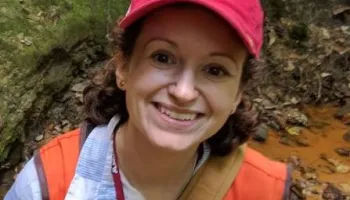
Kamirah Billups
Senior geology major Kamirah Billups’ passion for the Earth grew from curiosity to a calling during a research internship at Carnegie Science in Washington, D.C. In this internship, she studied subduction zones and learned how gaps in preparation lead to preventable loss in vulnerable communities.
“I want to use my love for internal Earth processes to protect families and ensure that scientific knowledge is shared with the people who need it most,” Billups said.
Billups used her award funding to attend a geology field course at Bowling Green State University in Ohio.
“This funding is an investment in my potential,” Billups said. “It allows me to finally step into the landscapes I've only seen on paper, giving me the chance to gain the hands-on skills I need to become a leader in geology.”
Sasa Maricic
This summer, senior physics and astronomy double-degree student Sasa Maricic will present her research on cosmic ray physics at the 46th COSPAR (Committee on Space Research) Scientific Assembly in Florence, Italy. Her work focuses on tracing cosmic rays back to their sources—one of the great unsolved puzzles in astrophysics.
“Receiving this award allows me to attend COSPAR in Italy, which would otherwise have been inaccessible,” Maricic said. “I’m excited to present my work, engage with researchers from around the world and better understand active areas of study—ultimately helping me make informed decisions about graduate school.”
Maricic plans to attend graduate school and work toward a Ph.D., with the ultimate goal of becoming a research professor and continuing her work in high-energy astrophysics.
“I would like to explore cosmic ray acceleration, turbulence and supernovae more deeply, as well as advance modeling of potential cosmic ray sources,” Maricic said. “I hope to contribute to a deeper understanding of these energetic processes while mentoring the next generation of researchers.”
Riya Mehrotra
“From first learning about the powerhouse of the cell in middle school to understanding actin and myosin interactions in evolutionary biology, I have been continuously intrigued by the workings of the human body,” said junior biological sciences major Riya Mehrotra.
Mehrotra is using her award funding for transportation to Boston, where she is conducting data analysis with Harvard Neurology Associate Professor Vetrivelan Ramalingam to ascertain the role of melanin-concentrating hormone (MCH) neurons in rapid eye movement (REM) sleep.
Mehrotra will also be working at the Middlesex Digestive Health & Endoscopy Center and volunteering in the Emergency Department of UMass Memorial Health to continue her growth on the pre-medical track.
Samantha Otazo
Senior physics and electrical engineering double-degree student Samantha Otazo plans to pursue a Ph.D. in condensed matter physics after graduating next year. She says her biggest inspiration is her dad, who studied engineering physics at Queen's University and completed his master's degree in photonics at McGill University before entering the telecommunications industry.
In UMD Physics Professor Johnpierre Paglione’s lab, Otazo has conducted crystal growth, transport measurement and spectroscopy experiments—even traveling to the American Physical Society’s Global Physics Summit in March to present a talk. This summer, Otazo is working with University of British Columbia Physics and Astronomy Associate Professor Alannah Hallas to synthesize a high-entropy version of a material previously studied by Paglione’s group.
“I am excited to bring back new experimental techniques to expand my own group's capacity for high-entropy synthesis and gain an additional publication,” Otazo said. “This award is particularly meaningful because it directly supports me and my potential as an aspiring researcher.”
Raghav Thind
Since becoming a senior computer science major at UMD, Raghav Thind has been drawn to research and development. He is using this award funding to attend the prestigious Summer@EPFL program, a three-month summer research fellowship hosted by the Swiss Federal Technology Institute of Lausanne in Switzerland.
“Not only will this award impact my outcome this summer, but it will also play an important role in helping me to continue developing as a research scientist and make me capable of contributing to impactful, real-world innovation,” Thind said.
After graduation next year, Thind plans to pursue a Ph.D. to become a research scientist “at the forefront of technological innovation.”
Nghia Truong
Junior computer science and mathematics double-degree student Nghia Truong used his award funding to travel to present his first-author paper at the 2026 IEEE International Conference on Acoustics, Speech, and Signal Processing in Barcelona.
This summer, Truong will continue his research with UMD Mathematics Associate Professor Yun Yang on the theoretical foundations of transformer attention and its connections to kernel methods. He will also participate in a Research Experience for Undergraduates (REU) with Computer Science Professor Jordan Boyd-Graber focused on building a multimedia quiz system that challenges artificial intelligence systems.
“As an international student conducting research without a stipend, this scholarship has made a significant difference by helping alleviate financial burdens,” Truong said. “Beyond that, it is deeply encouraging and motivates me to continue pursuing research with dedication and purpose.”
After graduation, Truong hopes to pursue a Ph.D. in mathematics and machine learning theory and looks forward to making meaningful scientific contributions and mentoring the next generation of students.
Priya Tyagi
Receiving a total hip replacement at age 17 due to slipped capital femoral epiphysis inspired senior computer science major Priya Tyagi to pursue computational solutions to biological problems.
Tyagi is using her award funding to continue her research in Bioengineering Assistant Professor Alexander Xu’s Spatial Biology Lab. Her project examines whether atomic force microscopy tissue measurements could be replaced by computational predictions trained on imaging data—thereby saving both time and money. Tyagi is focusing on the pipeline’s image processing, feature engineering and machine learning components to accelerate this research.
After graduation, Tyagi plans to pursue an M.D.-Ph.D. in computational biology.
“The goal is to become a physician-scientist,” Tyagi said. “I am interested in using computational approaches to uncover medical mysteries about diseases that clinical practice alone cannot address, and eventually translating those discoveries into clinical interventions.”
Are you interested in supporting undergraduate students in their professional development and research activities? Consider donating to the CMNS Alumni Association Chapter Current Use Fund for Student Support.