Paik (M.S. ’05, Ph.D. ’07, physics) helps researchers use the company’s increasingly powerful machines to solve challenging problems.
If you use a leading quantum computer today, you probably have Hanhee Paik (M.S. ’05, Ph.D. ’07, physics) to thank.
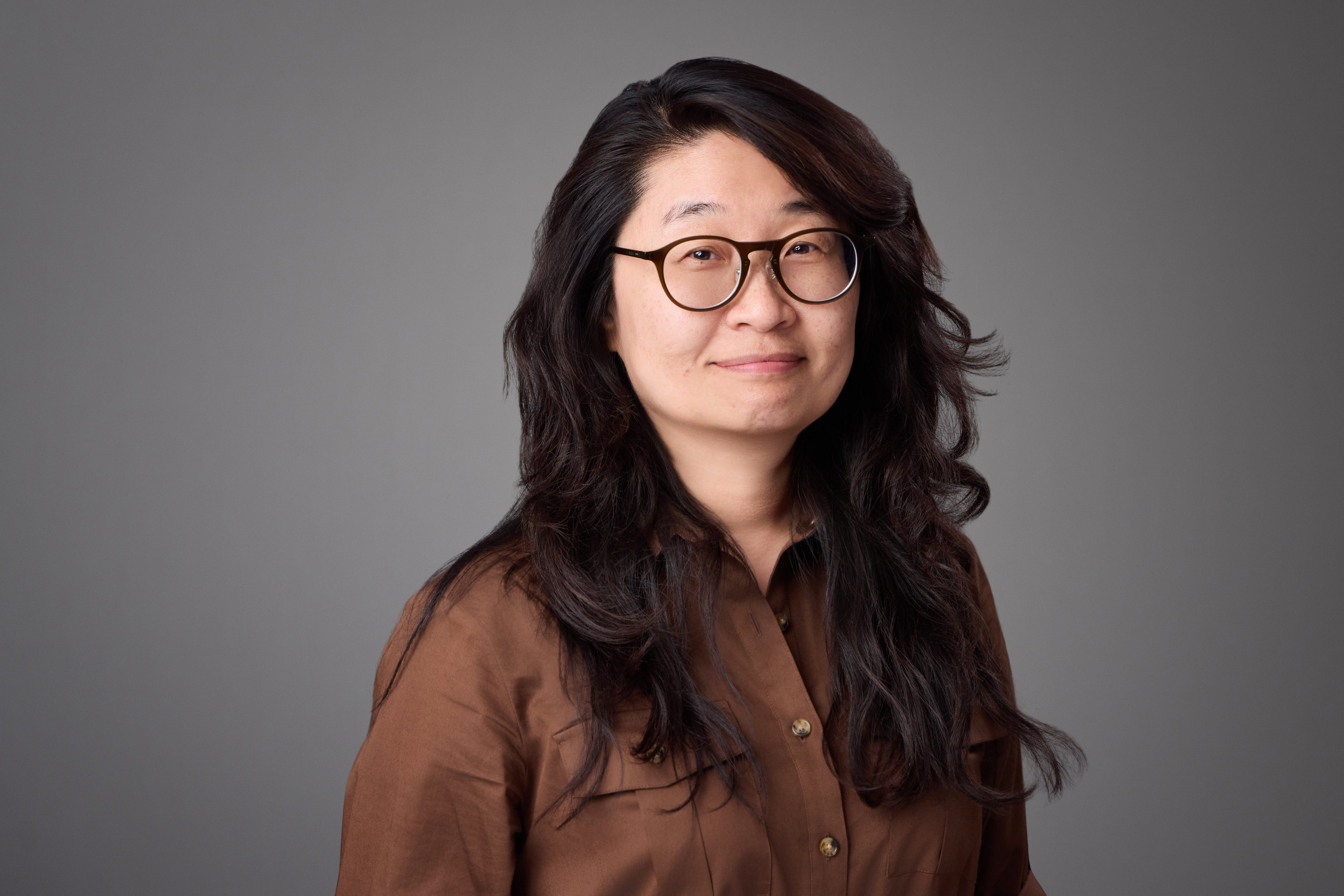
The University of Maryland alum helped pioneer the transmon, a superconducting qubit that many quantum computing companies use today. For the past two decades, she’s been a quantum computing physicist, working on quantum processors and systems development—including helping build IBM’s first 16-qubit quantum computer in 2017.
Now, as IBM’s superconducting quantum computers have surpassed 100 qubits, Paik leads initiatives to help researchers find impactful ways to use them. In March 2025, she became a director of IBM’s Quantum Algorithm Centers and Academic Collaboration Program at IBM Research, where she works with universities and research institutions around the world to develop new ways to use quantum computers to solve challenging computational problems. These scientific algorithms and applications are already yielding breakthroughs that seemed impossible a decade ago.
“The IBM Quantum team's mission is to build a useful quantum computer. This year, IBM announced three examples of quantum advantage we achieved with our partners, which show the current state-of-the-art quantum computing systems solving some scientific problems faster, cheaper or easier.” Paik said. “For certain scientific computations, quantum computers are already useful right now.”
From superconductivity to quantum computers
When Paik first arrived at UMD from South Korea, she didn’t plan to study quantum physics. She came to research superconductivity with Physics Professors Emeriti Frederick Wellstood and Christopher Lobb.
Around that time, Wellstood and Lobb began researching how to use superconductors to build qubits—the basic unit of computation for quantum computers. Quantum computers process information using quantum properties—like the ability to exist in a “superposition” of multiple states, or “entanglement,” where two or more qubits become deeply interconnected so that each qubit state cannot be described independently—making them powerful.
Paik became interested in the work, and her dissertation at UMD tackled a central challenge in the field called decoherence—a process in which the outside environment causes qubits to lose their quantum properties. For quantum computers to be useful, coherence is key: The longer qubits can maintain their quantum states, the more time users have to perform calculations. Paik’s Ph.D. research at UMD developed new designs and materials to improve coherence time for superconducting qubits.
She continued that work as a postdoctoral researcher at the Laboratory for Physical Sciences and Yale University. At Yale, she helped improve the coherence of the transmon qubit—which was a superconducting qubit with one of the longest coherence times at the time but still too short for useful quantum computation.
Paik’s research revealed that transmons decohered quickly because they lost energy to surfaces and interfaces. She engineered a new transmon qubit architecture that lessened this energy loss by tweaking where energy is stored and improved transmon coherence times 100-fold. That qubit architecture became—and remains—the standard for quantum computers built by major companies, including IBM.
“That was the jumping-out-of-the-box moment for quantum computing,” Paik said. “That design is still the canonical design that everyone uses for transmons today.”
Building a ‘useful’ quantum computer at IBM
Shortly after her postdoctoral appointment ended at Yale, Paik joined IBM in 2014 as a senior research scientist, where she continued transmon qubit research. She helped construct the company’s first 16-qubit computer in 2017. Named ibm_albatross, this was the first superconducting quantum processor of more than 10 qubits.
As quantum computers grew larger and more powerful, Paik saw another challenge emerging: to discover algorithms for the use of quantum computers.
“I’d been building quantum computers for almost my entire career, and now that they were becoming more and more useful for addressing scientific problems, I thought I’d really like to try using them,” Paik said. “Even if you build one of the best computers in the world, if no one knows how to use it—if you don’t have algorithms to use your computing system in the best way—it’s not very useful.”
So, Paik joined the office of then-vice president of IBM Quantum and quantum algorithms expert Jay Gambetta as chief of staff, supporting the technical and business side of his operations. She further developed her business skills as a technical business development executive in 2023 and then moved to Japan for an assignment to organize the IBM Quantum Japan team in 2024 before assuming her current role in Chicago.
Progress has surged since then. This year, researchers at Cleveland Clinic, IBM and RIKEN successfully modeled a 12,635-atom protein complex—the largest ever simulated by quantum computers—using a hybrid approach of integrated quantum and high-performance computing (HPC). Known as quantum-centric supercomputing, this new computing architecture allows each form of computing to perform the tasks it does best. The researchers say it’s a promising advancement that will allow breakthroughs in many practical problems such as drug discovery, and for Paik, it signals an exciting future integrating quantum and HPC.
“That’s what’s most exciting to me at the moment,” Paik said. “It’s quantum-centric supercomputing and its potential to solve many of the most challenging computational problems that are currently intractable.”
As Paik helps to advance IBM’s quantum technology and business toward that future, she’s tapping back into lessons from UMD. For her, the most cherished learnings from graduate school weren’t technical skills, but values. She credits her Ph.D. advisors for modeling persistence, thoroughness and sincerity—qualities she brings to her own work and mentorship.
“I learned a lot from both Fred and Chris that helped me become a good scientist,” Paik said. “I am living their legacy, trying to represent what I learned from them.”
She also seeks to recreate the sense of community she experienced at UMD, where students could interact freely and casually with researchers at the forefront of physics. She still remembers Nobel Laureate William Phillips having lunch with students after Joint Quantum Institute seminars—making a connection that left a lasting impression.
“At UMD, people were so nice and supportive. They provided unwavering support to help young students unleash their full potential.” Paik said. “That sense of community is really important to experience at an early age—especially as a student. It sets your view on life. I treasure those values and want to live them out.”