Astronomy postdoctoral researcher Erini Lambrides’ research on black hole formation earned her a coveted spot on Scientific American’s Young American Scientists list.
Growing up in Brooklyn, New York, astrophysicist Erini Lambrides didn't want to study the stars. She wanted to be one.
Lambrides dreamed of becoming an actor. She attended the Fiorello H. LaGuardia High School of Music & Art and Performing Arts—one of the country’s premier arts schools—where she performed in shows alongside future stars, including musician Azealia Banks and actor Zazie Beetz.
For young Lambrides, who could see only four stars from her bedroom window, outer space was the last thing on her mind—until she read Stephen Hawking's “A Brief History of Time” her junior year of high school.
"The book blew my mind. I was completely hyperfocused and obsessed with learning more,” she said.
Later, when watching “Top Gun,” Lambrides noticed the astrophysicist character, Charlie Blackwood, and decided she wanted to research outer space. Now, she is living her dream.
Today, Lambrides is a postdoctoral fellow at NASA's Goddard Space Flight Center and the University of Maryland Department of Astronomy, where she studies how supermassive black holes form, grow and shape galaxies. Outside the lab, she spearheads programs that create pathways for students from all walks of life to become astrophysicists. Her work earned her a spot this summer on Scientific American's Young American Scientists list, which recognized 28 leading early-career researchers.
“If you're trying to understand how galaxies came to be, why they look the way they do and why they have the properties they do, then you really need to understand what big black holes are doing,” Lambrides said. “And the relationship between big black holes and their galaxies—that begins in the early universe.”
Researching little red dots
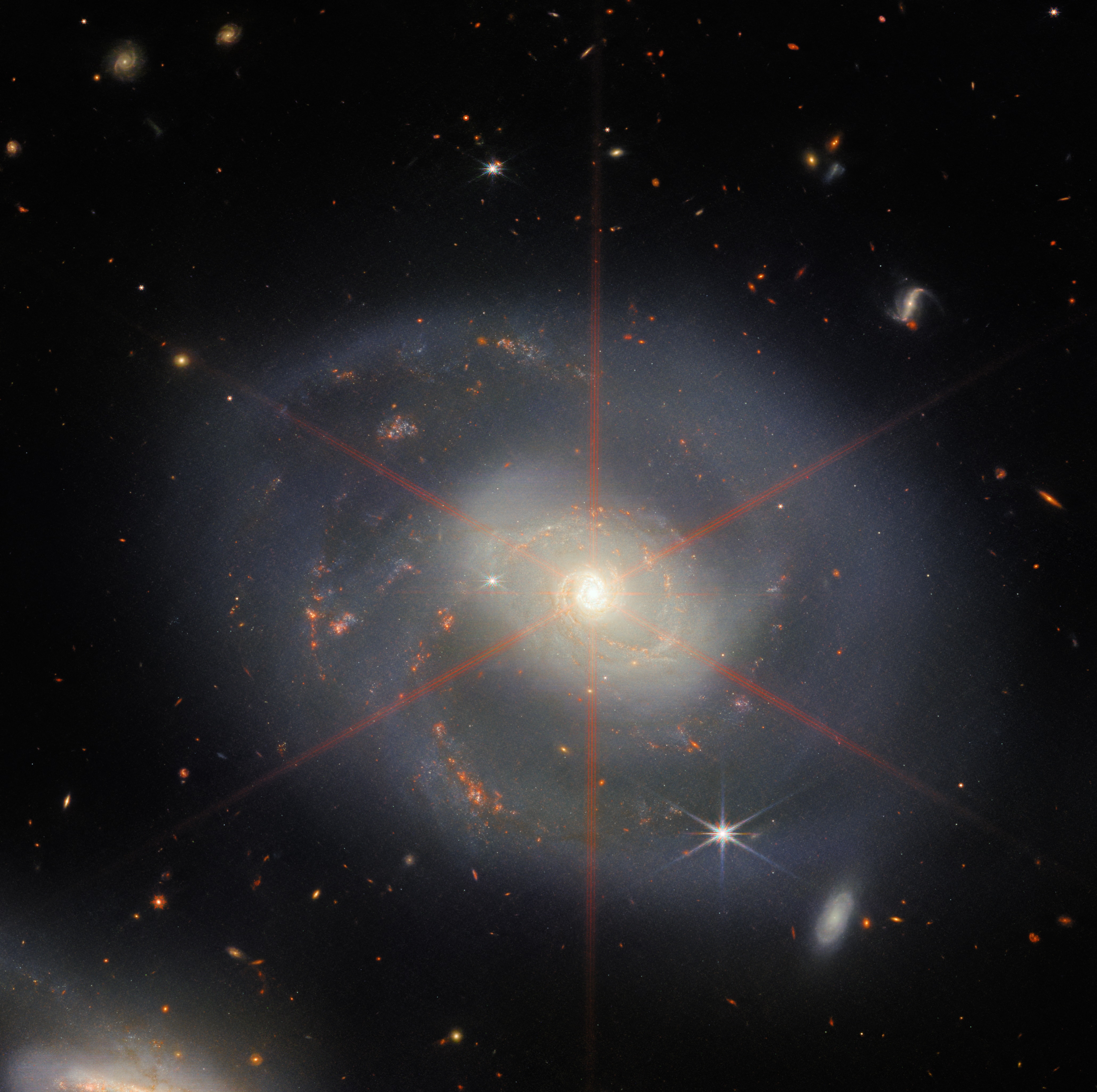
At UMD and NASA, Lambrides studies a phenomenon called “little red dots”—small, red objects that appear in large numbers during the first billion years of the universe. They are among the most surprising discoveries made by the James Webb Space Telescope since its launch in 2021.
The identity of little red dots is hotly debated—many scientists thought they were star-forming galaxies—but mounting evidence, including two recent papers co-authored by Lambrides in Nature Astronomy, suggests that they are growing supermassive black holes.
This work challenges existing theories of galaxy formation and the early universe, which struggle to explain the massive number of little red dots detected by JWST.
"The early universe space is the wild, wild west, especially with little red dots,” Lambrides said. "It's kind of a renaissance right now, changing how we think about the first billion years of our universe.”
Widening the astronomy tent
For Lambrides, studying the world on such grand scales puts life into perspective. Her work constantly reminds her that she’s part of something unfathomably large—that humans are “on a rock traveling thousands of miles through the void of space, inconsequential to the exploding of stars and the growing and formation of black holes in the grander universe,” she said.
“Our individual lives are only here for a short time on Earth,” Lambrides added. “So we should be thinking about the collective, the bigger picture and the things we can do today that will help generations tomorrow.”
To that end, Lambrides is dedicated to improving her field of study for future generations. She works tirelessly to level the playing field for students who want to become astrophysicists—especially aspiring scientists without strong connections, resources or mentoring networks. Recently, she founded NASA-PEER, a post-baccalaureate research program and mentorship network that helps recent graduates who want to pursue careers in astronomy but weren't admitted to graduate school on their first attempt.
The 12 to 20 students who enroll in the yearlong program conduct research full-time alongside NASA scientists. They also receive training to deliver compelling research presentations, write persuasive personal statements and build clear scientific visualizations.
The results have been striking. This year—the program’s third—about 90% of the program participants who applied to graduate school were admitted, compared with what Lambrides estimates to be a less-than-10% acceptance rate nationwide.
"These kids give me life,” Lambrides said. “It gives me purpose seeing their growth and watching them fight for their dreams.”
Now, as Lambrides seeks a faculty position, she wants to continue building a version of astronomy that welcomes everyone—from the students who come through NASA-PEER to a New York City girl who can only see four stars from her bedroom window.
“You can do kick-ass science and care about the culture in astronomy, and you don’t need to compromise one for the other,” she said. "I’ll try to build a future of astronomy that includes every person, regardless of background, identity or station in life—and I will fight like heck to get there.”