
News
News
Filter by
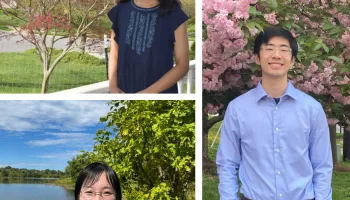
Three University Medal Finalists Embody Terp Spirit
CMNS seniors will leave a lasting mark through through their service and achievements.

UMD Astronomer Leads Study that Finds Water, and a New Mystery, in Rare Main Belt Comet
Research scientist Michael Kelley offered a theory that could explain Comet 238P/Read’s conspicuous lack of carbon dioxide.
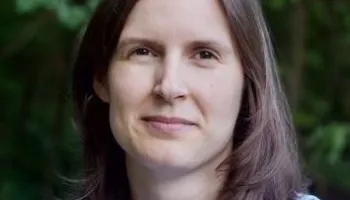
Finding the Future of Medicine
Stephanie Galanie (B.S. ’10, biochemistry; B.S. ’10, biological sciences) shares how her years at UMD shaped her path to success in synthetic biology and analytical chemistry.
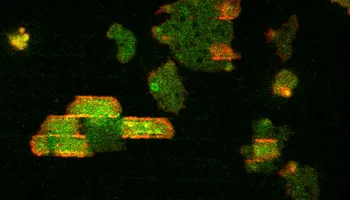
Insight into How Cells Get Signals from Physical Senses Could Lead to New Disease Treatments
UMD-led study opens door to understanding cell’s sense of touch.

Researchers Measure the Light Emitted by a Sub-Neptune Planet’s Atmosphere for the First Time
UMD astronomer Eliza Kempton says exoplanet GJ 1214b is too hot to be habitable but likely contains water vapor.
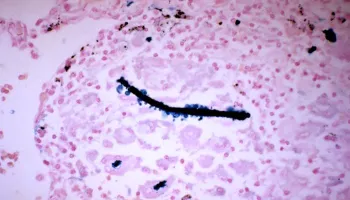
Size and Shape Matter: New Research Sheds Light on How Mesothelioma Develops
UMD-led study suggests that the mechanism responsible for how immune cells “sense” harmful particles like asbestos fibers may play a role in how cancers develop in humans.

Geology’s Laurent Montési Awarded Fulbright Scholarship to Study Tectonics in Norway
Geology Professor Laurent Montési hopes to apply his knowledge of Earth’s tectonic and volcanic activity to Venus and planets beyond.
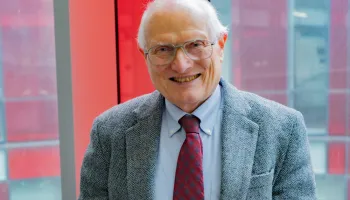
UMD Quantum Physicist Elected to National Academy of Sciences
Julienne pioneered the field of ultracold matter.
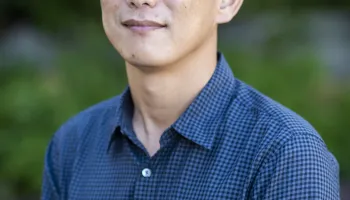
Preparing for the Next Pandemic
NSF CAREER awardee Jinwoo Lee looks forward to continuing his investigations into the Lassa virus and other infectious diseases when he moves into the new Chemistry Building.
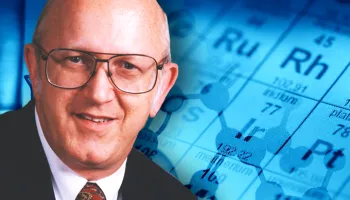
Former Department Chair Names Seminar Room in New Chemistry Building
The Mike and Jan Doyle Seminar Room will be located on the first floor of the new wing.
College’s 2023 Undergraduate Commencement Ceremony Speakers Announced
Serial tech entrepreneur Zeki Mokhtarzada (B.S. ’01, computer science and mathematics) will be the keynote speaker and Junyi “Julie” Liu (B.S. ’22, biological sciences) will be the student speaker.
UMD Leads New $20M NSF Institute for Trustworthy AI in Law and Society
The institute will take a holistic approach, integrating broader participation in artificial intelligence design, new technology development, and more informed governance of AI-infused systems.