The College of Computer, Mathematical, and Natural Sciences hosted a Reddit Ask-Me-Anything spotlighting research on decoding the microscopic world.
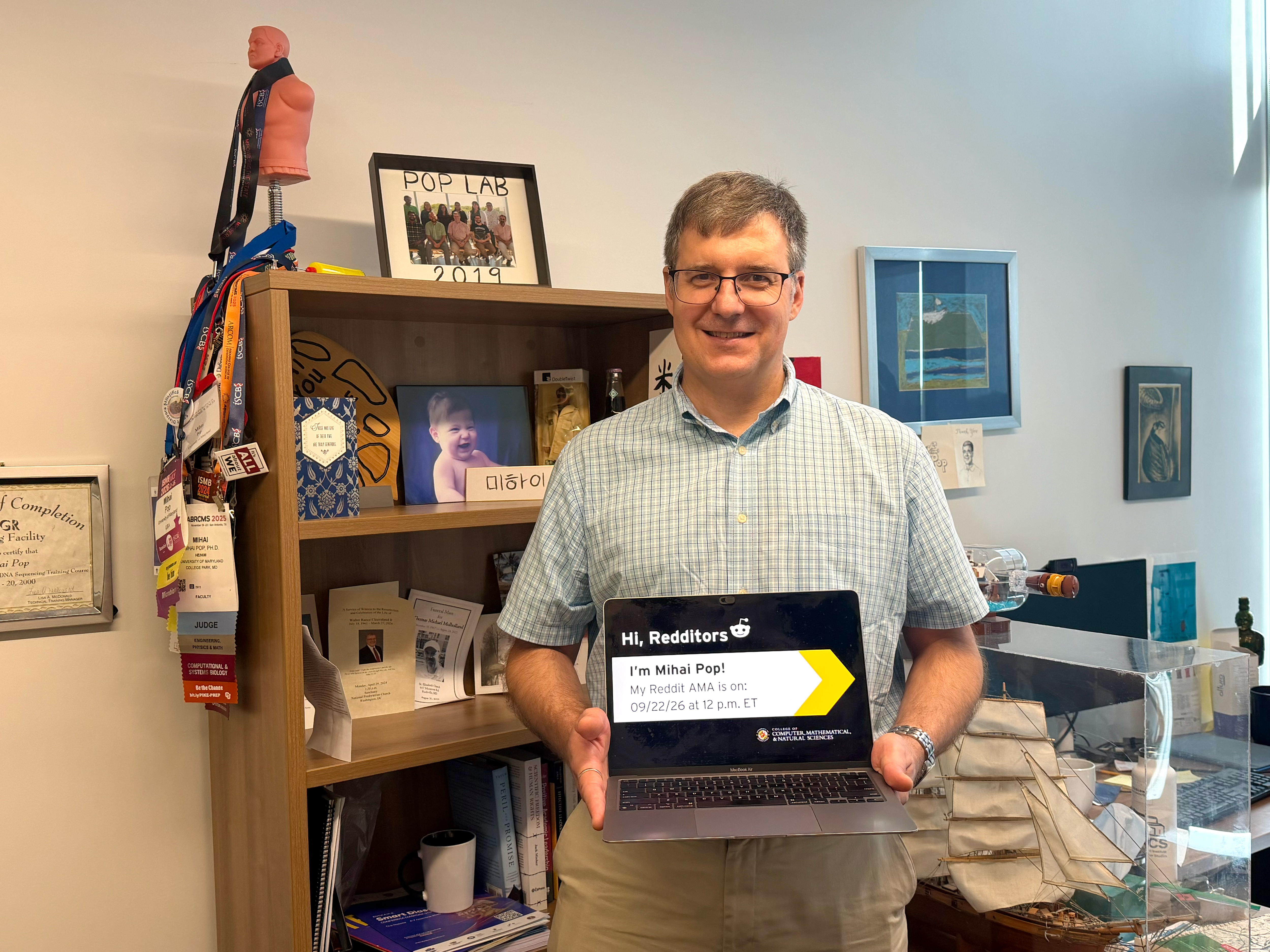
University of Maryland Computer Science Professor Mihai Pop participated in an Ask-Me-Anything (AMA) user-led discussion on Reddit to answer questions about mapping the microbiome on September 22, 2026.
Pop’s research primarily focuses on developing computational algorithms to analyze biological data generated by high-throughput experimental techniques. His lab has developed software tools that are widely used in the field of metagenomics—the computational analysis of the microbial communities inhabiting our world and our bodies. He has also been an active participant in several multinational projects, including the Human Microbiome Project and the GEMS study of diarrheal disease.
Marcus Fedarko (B.S. ‘18, computer science), a postdoctoral fellow in Pop’s group, joined him to answer questions.
This Reddit AMA has been edited for length and clarity.
Are you able to differentiate between ‘good’ and ‘bad’ bacteria in the gut? If so, how?
(Pop) It all depends on the context—there are not necessarily 'good' or 'bad' bacteria. Some bacteria may be fine in a healthy person but not in a person who is immunocompromised or in someone with inflammatory bowel disease. Also, there are bacteria that infants have that might cause problems in older adults, such as C.difficile. Many babies have it in their guts without any problems, but in older adults, it can cause severe colitis (particularly after antibiotic treatment).
In terms of differentiating these, it can be hard. We all have E.coli in our guts, but our strains may be different from the ones we might get from a bad bag of lettuce. And the difference might be just a couple of genes. Figuring out which one it is may require deep (and likely costly) analysis.
The field of dentistry is very interested in better understanding the microbiome. We do some genetic testing, but it is expensive and limited in scope. Could your research help solve this? Also, has genetic data in biofilms been correlated with metabolic data?
(Pop) The hope is that sequencing will give us hints as to what the correct targets are for cheaper assays. I personally find the oral cavity particularly interesting for studying the interactions between microbes and between the microbiome and its host.
Usefully linking metabolic data to genetic data is still very much an open research question. I think the metabolomics assays are also quite expensive.
(Fedarko) At least for the kind of DNA-sequencing-based methods we often work with—with the goal of studying what microbes are in a sample generally—there are a variety of experiments you can do at pretty different price points.
The cheaper end would be things like marker gene sequencing, where you only consider a single region of the genome (e.g., the 16S rRNA gene in bacteria/archaea)—it looks like you should be able to sequence a sample at closer to $100 using this kind of method (see Cornell’s website). But if you want to profile different types of microbes, or see parts of the genome outside of these marker genes, then you will probably need more expensive methods, such as metagenomics.
Could you conduct a ‘census’ of the microbiome that would help predict illness? Could you create a home kit that is part of your toilet and gives you a weekly readout so you can see what your diet and exercise do to your microbiome?
(Pop) In short—today, no. We don't yet understand sufficiently how the microbiome interacts with our body to contribute to illness or health. There is certainly interest in developing such capabilities as you describe, but for now they remain a distant goal.
(Fedarko) Regarding the toilet part of your question, there are actually some companies out there that are trying to do this! One example I am familiar with is the startup BiomeSense (during graduate school, I was a colleague of some of their current employees).
What is the current state of the study of the microbiome in our body in general and the state of computational analysis of that subject specifically?
(Pop) I think we now have a better understanding that the microbiome is very complex, as is its impact on our bodies. However, there are already some microbiome-related interventions that are making a difference in medical practice, such as fecal transplants for the treatment of C. difficile infections or fiber treatments to support immune therapies for melanoma. In terms of computation, we've gotten really good at figuring out which types of organisms are present in a sample, but there is still a long way to go toward understanding the strain-level diversity, as well as the functions microbes may perform.
How large would you say this bioinformatics and/or microbiome research community is?
(Pop) In terms of the people who are developing new computational methods, it is probably not a huge community—but it is a collaborative and supportive one, even across continents! In terms of people researching the microbiome, that is a much larger community. This spans human health, animal health, agriculture, fermentation, environment, etc. The microbiome really is everywhere!
(Fedarko) This past summer in D.C., we had the Intelligent Systems in Molecular Biology Conference, where we met a lot of people working on both sequencing data analysis and microbiome research. Although many people are working on similar problems, they tend to approach them from different angles. For example, using tools to study the microbiome versus developing algorithms in isolation to make them faster.
How did you find yourself pursuing this research direction? Was it a new field when you started?
(Pop) I worked at The Institute for Genomic Research (TIGR) right as DNA sequencing technologies were becoming mature enough to analyze entire microbiomes. That perspective inspired me to make this one of the core areas of research. The field itself was already pretty mature pre-sequencing; in fact, microbiomes were discovered in the 17th century with the first microscopes. Working in this field made me realize that many of the computational tools could not handle the complexity of microbiome data, which led to wonderful opportunities for new research.
(Fedarko) I got started with bioinformatics research in 2016, as a computer science undergrad at UMD in Mihai’s lab. I was so stressed out about not knowing enough biology! I spent a lot of time trying to catch up on everything I don’t know—which is funny, because I met a lot of people in grad school who came into bioinformatics from a biology perspective and had the opposite experience. Sometimes I wonder if everyone is just “catching up” in different ways.
Also, fun fact about microscopes (like Mihai mentioned)! Although the first microscopes were designed in the 17th century, the field of microbiome science dates back even earlier than that.
As cited in one of my grad school reports, Marcus Terentius Varro wrote in the first century B.C.E. about “certain minute creatures which cannot be seen by the eyes, which float in the air and enter the body through the mouth and nose and there cause serious diseases."
What are the surprising things that you have found out in this research?
(Pop) When we were studying the gut microbiome of children with diarrhea in the developing world, one thing we found surprising was the interactions between viruses and bacteria that made infection worse. People usually think of treating viruses and bacteria separately, and this suggests that in some cases, it may make sense to treat them together (i.e., perhaps giving antibiotics for a viral infection).
(Fedarko) One of the findings from the Human Microbiome Project has always fascinated me—that many outwardly healthy people have very different microbiome compositions, but fairly similar “metabolic pathways.” (See Figure 2 of their paper for an illustration of this.) There are a lot of questions about how to measure "function" in the microbiome, but at least this measurement suggests that function may be somewhat stable across different people's microbiomes.
This implies that there isn’t a single “healthy microbiome”! And that has a lot of implications for how we can use the microbiome to study and improve human health.
With the popularity of probiotic supplements and foods, have either of you seen any data that supports these as having an impact on your established gut microbiome?
(Pop) I think the jury is still out on whether the probiotics establish themselves or whether the potential health benefits are derived solely from the changes they induce in the food they ferment. For example, sourdough bread contains no live bacteria, but has a number of properties (including a longer shelf life) because the wheat was transformed by bacterial fermentation.
How much microbiome symbiosis/collaboration/improvement can we expect to happen as a result of being in proximity to roommates, spouses or relatives?
(Pop) There's a fair amount of evidence that we do exchange microbes with the people (and animals) we live with. At this point, I don't think we can say whether those exchanges are helpful, harmful or neutral. The microbiome of the built environment is a very active area of research.
When working with autopsy samples, there is often a lag between death and tissue collection—a period that presumably changes microbiome composition. How can one distinguish between the original composition and populations that bloomed during this lag?
(Pop) I think the lag between sample collection and processing is a key problem for microbiome studies in general. I am not convinced that we can computationally reverse the microbiome changes that occur during this lag. It is thus critical to carefully control the timing of collection and processing to obtain consistent results.
(Fedarko) There is some work I'm aware of on trying to correct for fecal blooms computationally, but I am not sure if this generalizes to other contexts.
I'm currently in my first postdoc applying my Ph.D. niche to a new field. Were there key things you did during your postdoc that helped you get to the prominent place you hold in the field today?
(Pop) I got where I am by being curious about new fields and questions and by taking advice. A big part of my success was the fact that I tried to help biologists solve the problems they cared about, rather than being too focused on my own interests. In the end, it turns out that working "for" biologists also helped me better understand my own interests. Being at the boundary of disciplines is a very rewarding place, as it creates opportunities for new ideas and impact.
Do you practice good microbiome health habits? If so, what are they?
(Pop) With the caveat that we don't really have an evidence base for what healthy microbiome habits are, I do try to eat a balanced diet with plenty of fiber. I even bake my own bread to avoid the many additives. And as a good Romanian, I make sure sauerkraut is part of my diet (the good fermented kind).
(Fedarko) I try to eat a lot of veggies and follow a balanced diet, but I don't really consciously think about the microbiome when I am doing so.
Do you plan to incorporate RNA sequencing or some form of pathway analysis into your approach? How do you ensure that your reference datasets are accurate enough to not misidentify closely related strains of bacteria?
(Pop) When it comes to RNA sequencing, I am worried that there is too much variability and bias in the data (at least for complex microbiomes).
We have been thinking for a while about the best way to identify strains within communities, and it's not just the quality of the reference that matters, but also the way in which you interpret the results. For example, we showed that looking at more than just a top hit is a better approach if you really want to know what's in a sample.
(Fedarko) Having longer sequences from your sample will help with getting better classifications. If we have only short gene sequences, then it might be hard to identify microbes below the genus level. But if we have sequences that are on the order of thousands, tens of thousands or greater, then we can see more and more of the underlying genomes and get better and better classifications of them.
What parts of our bodies are you primarily studying and decoding?
(Pop) Most of the data we get is from stool microbiomes, but we are more interested in the computational questions the data pose and have looked at many other types of data (including bacterial mats from hot springs). One of the students in my lab is looking at bacteria in deep-sea sponges.
(Fedarko) Sometimes we focus on the computational questions, and the data is used to prove a point. In grad school, a fun project I worked on had hundreds of samples from different body sites in mackerel, as well as seawater samples.