Findings from a real-time brain wave study could help virtual and augmented reality designers detect and reduce dizziness, nausea and other symptoms.
For years, developers of virtual reality (VR) and augmented reality (AR) technologies have worked to address an unwanted side effect many users experience: cybersickness, a type of motion sickness triggered by moving digital content.
In a new study published on September 25, 2026, in the journal Virtual Reality, University of Maryland scientists used electroencephalography (EEG) to identify changes in brain wave activity while participants viewed virtual content designed to induce cybersickness. The findings offer real-time signals that could help designers detect and reduce cybersickness symptoms as they occur.
“VR and AR technologies aren’t just for gaming anymore. They’re used in healthcare, teaching, job training, building design and even to plan surgeries, but their effectiveness is compromised by cybersickness,” said the study’s first author Mattie Johnson, a UMD computer science Ph.D. student. “Our results show that EEG could complement traditional symptom questionnaires and support VR and AR systems that respond to cybersickness in real time.”
The new study, led by UMD Computer Science Professor Amitabh Varshney, was conducted in collaboration with the Food and Drug Administration and Sony Group Corporation. The researchers focused on cybersickness associated with the vergence-accommodation conflict (VAC)—a mismatch between where the eyes converge to view an object and the distance at which they focus.
Cybersickness can cause nausea, dizziness, sweating, blurred vision, disorientation and more. In previous studies, 65.2% of VR users reported experiencing cybersickness, including 23.9% who reported severe symptoms. Researchers traditionally assess cybersickness with the Simulator Sickness Questionnaire (SSQ), a 16-question survey developed in 1993 to evaluate U.S. military fighter pilots’ experiences while using flight simulators. While the questionnaire remains useful, it relies on participants’ reports after an immersive experience and does not provide continuous measurements during exposure.
“A lot of people use the questionnaire in VR studies, but it’s a subjective way to measure,” said paper co-author Sujal Bista, director of the Immersive Visualization Center at the University of Maryland Institute for Health Computing (UM-IHC). “It also doesn’t allow for continuous data collection from the user. We needed a better way to measure in real time.”
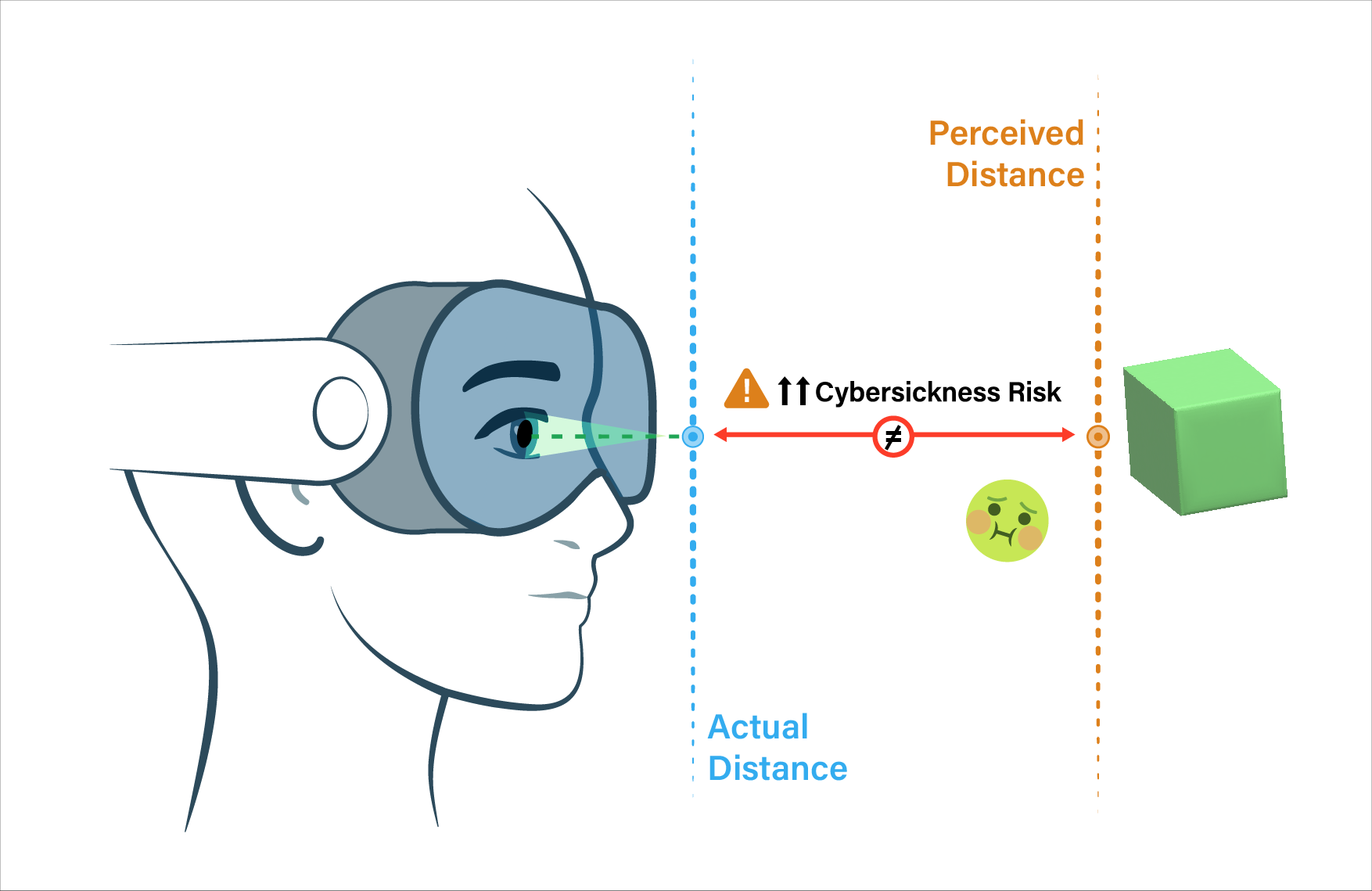
In the real world, these two distances generally correspond. In many VR and AR displays, however, the eyes may converge on a virtual object that appears near or far while focusing on a display set at a fixed focal plane. This mismatch is an inherent challenge for many immersive displays and is believed to contribute to visual discomfort and cybersickness.
“We showed in an earlier study that EEG can be a reliable indicator of vection-induced cybersickness, which occurs when a virtual environment creates an illusion of self-motion while the user’s physical body remains completely still,” said Varshney, who also has a joint appointment in the University of Maryland Institute for Advanced Computer Studies. “This new study expands those findings to a second type of cybersickness and provides an important foundation for making immersive technologies more comfortable and accessible.”
The researchers recruited 40 participants and recorded their brain activity using a 64-electrode EEG system while they wore a Meta Quest 2 headset and experienced an immersive environment that induced VAC. Participants completed the SSQ after exposure so the researchers could compare self-reported symptoms with the EEG data.
The EEG recordings showed changes in activity across several brain wave frequency bands during cybersickness.
“In the frontal lobe, we found a statistically significant decrease in high brain wave frequencies during cybersickness, and in the occipital lobe we saw a statistically significant decrease in low brain wave frequencies,” Johnson explained. “These changes in what we call EEG clusters could be useful predictors of a cybersickness experience.”
For scientists, predicting cybersickness is just the first step.
“Ultimately we want to inform technology to mitigate symptoms in real time, improving user comfort and productivity over extended periods of immersion,” Johnson said.
One possible approach would involve communication between an EEG-monitoring device and a VR headset. If the EEG system detected a pattern associated with emerging cybersickness, the headset could adjust the virtual scene—for example, by bringing the displayed content closer to the headset’s focal plane and reducing the vergence-accommodation conflict.
Some headset technologies already aim to reduce cybersickness by providing multiple focal planes or otherwise addressing the vergence-accommodation mismatch. Consistent real-time physiological signals could help researchers evaluate and improve those approaches. Johnson and her co-authors also plan to investigate eye-tracking data, which could provide another objective measure while helping distinguish brain activity from eye-related artifacts in EEG recordings.
“We’d like there to be a cybersickness index that combines data from different physiological measures,” Bista said. “The SSQ still has its uses, but now we have the tools to go from asking participants how they’re feeling to asking the brain and body what’s really going on.”
###
UM-IHC researchers Barbara Brawn, Jonathan Heagerty and Sida Li also co-authored the paper.
The paper, “Quantifying and characterizing vergence-accommodation-conflict-induced cybersickness in immersive environments,” was published in Virtual Reality on Sept. 25, 2026.
This research was supported by the Center for Medical Innovations in Extended Reality (U.S. National Science Foundation Award No. 2137229). This article does not necessarily reflect the views of these organizations.