The College of Computer, Mathematical, and Natural Sciences hosted a Reddit Ask-Me-Anything spotlighting research on petrology.
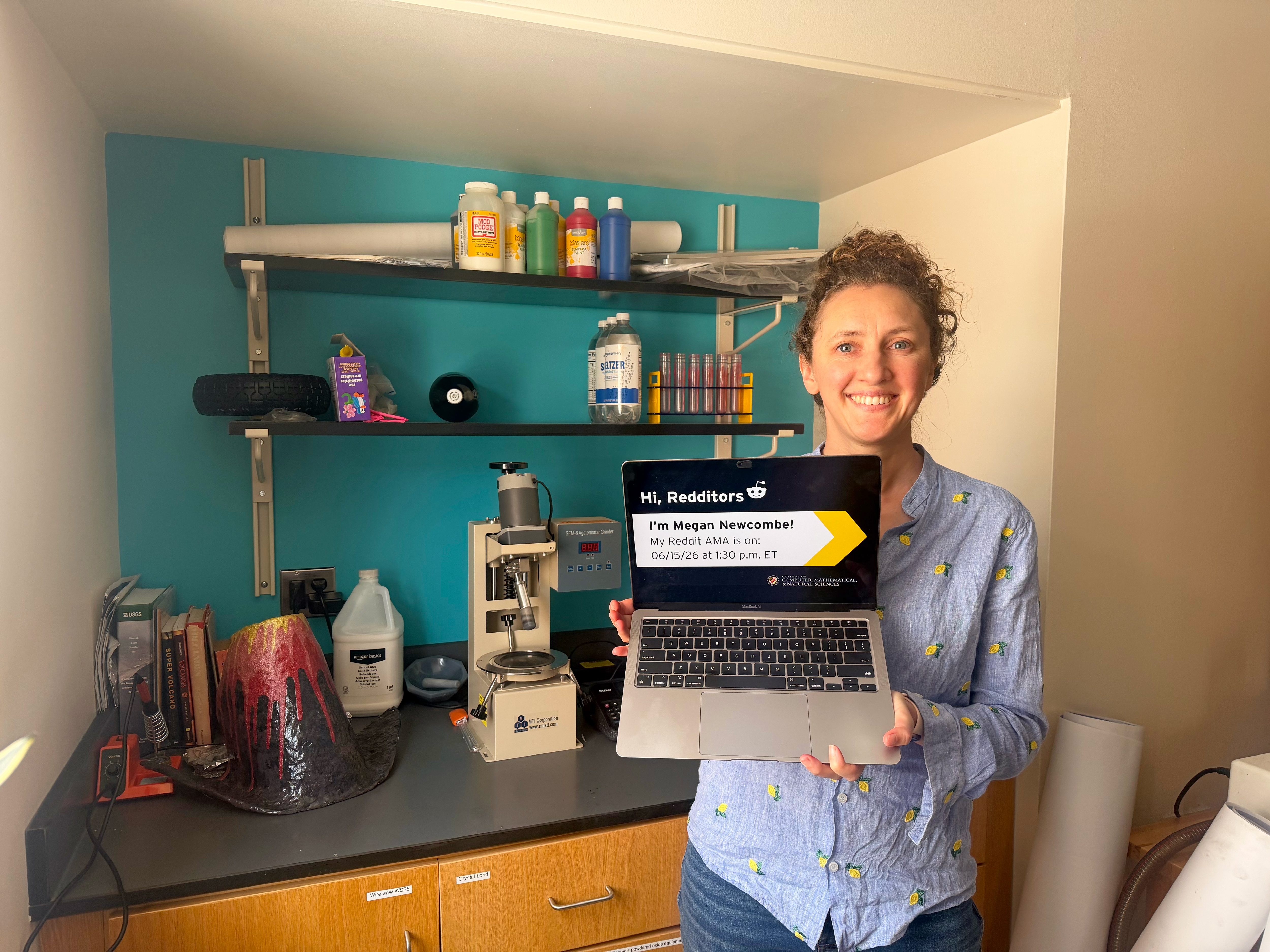
University of Maryland Geological, Environmental, and Planetary Sciences Associate Professor Megan Newcombe participated in an Ask-Me-Anything (AMA) user-led discussion on Reddit to answer questions about volcanoes and petrology on June 15, 2026.
Understanding volcanoes is important for unlocking the history of our planet, as well as advancing public safety and climate science. Newcombe’s research combines experimental petrology, numerical modeling, and state-of-the-art geochemical analyses to study volcanoes on Earth, the Moon and Mars.
Part of Newcombe’s research is investigating what makes some volcanic eruptions gentle while others are explosive. Her lab acts like a team of forensic scientists using "crystal clocks" (based on diffusion of different elements in volcanic crystals) to calculate how fast magma rises to the surface. They also measure the compositions of microscopic droplets of magma trapped within crystals to work out how much gas the magma contained before it erupted.
This Reddit AMA has been edited for length and clarity.
Does a volcanic eruption on a body like the Moon or Mars, which both have very little atmosphere, change the way the lava would flow across the landscape?
Lava flows on the Moon produced giant valleys and lava tubes. Lava tubes on the Moon are much bigger than lava tubes on Earth, probably in part because of the lower gravity on the Moon. The lack of atmosphere on the Moon limits heat loss by air convection; heat loss from lunar lavas is mostly limited to radiation. This keeps lava flows hotter for longer on the Moon.
I know that if Yellowstone ever goes up again, it will be massive. Isn’t it due soon?
Yellowstone has erupted three times in the past 2.1 million years, giving it an approximate repeat time of 700,000 years. These eruptions are extraordinarily rare, and it's highly unlikely we will experience a super-eruption in our lifetimes. Yellowstone is carefully monitored by the Yellowstone Volcano Observatory, and any eruption would be preceded by signs of volcanic unrest. Globally, the return period for super-eruptions is estimated to be 17,000 years. The impacts of a super-eruption would be very significant, so the work done by scientists at volcano observatories is very important and well worth our investment.
Which planet would grant you the best chance of survival if you found yourself near the base of an erupting volcano?
Gravity and atmosphere have a big impact on eruptive style. We have observed eruptions on Io that had plumes that reached about 400 km above the planetary surface. For reference, the 2022 eruption of Hunga Tonga-Hunga Ha'apai had Earth's highest plume height on record, at 58 km.
Is there a known planet which would lend itself to particularly vicious volcanoes?
Fortunately, most of the terrestrial planets are considered volcanically inactive these days. I wouldn't want to be on the surface of Venus, for volcanic and other reasons. Io also seems pretty dangerous. I advise you to stay on Earth—that's probably your best chance!
Do you ever use models that involve more Earth-like volcanism (mid-upper crustal melt regions, hydrous magmas)?
The melting of planetary mantles is vital for producing magma on Earth and other planets. Other planets have different mantle compositions, pressures of melting and/or melting temperatures, which can result in differences in the magma produced. It can be challenging to use models that were designed for Earth magmas to constrain melting and crystallization processes on other planets.
One way to get around this is to do experiments in the lab. We can recreate the compositions of planetary mantles and magmas, and we can see which minerals are stable under different pressure and temperature conditions. These experiments help us to refine our models and better understand volcanism on other planets. I was involved in a study that used modeling to constrain the pressure of crystallization and water content of Martian magma. We were trying to constrain the formation conditions of a rock called Jake_M that was analyzed by the Curiosity Rover.
What are your thoughts on the new-ish research about the origin of life on Earth being facilitated or only possible because of tectonics/volcanism in the presence of liquid water, and do you think that signs of volcanism in an exoplanet's atmosphere would be a reasonably good proxy in answering the question of whether or not extraterrestrial life exists?
In response to your origin of life question, volcanoes are vital for putting water and carbon dioxide into planetary atmospheres. Depending on the pressure conditions at the surface of the planet, volcanic atmospheres can result in the precipitation of oceans on planetary surfaces. The presence of liquid water on the surface of a planet is considered to be important for habitability. You can have volcanism without producing liquid water. For example, Io (one of Jupiter's moons) is the most volcanically active body in our solar system, but it is a very hostile place.
What are the most sensitive parameters for your FE model(s), and how do you quantify uncertainty?
I don't personally work on eruption forecasting, but my understanding is that for a single volcano, we can estimate the probability of an eruption occurring in any given year by mapping the past deposits of the volcano and working out how frequently that volcano has erupted in the past. These kinds of models are probably more accurate for frequently erupting volcanoes, and the uncertainties increase for the larger eruptions that occur less frequently. This 2018 paper estimates that the return period for super-eruptions (which erupt 1,000 Gt or more of material) is 17,000 years.
How do we determine the VEI ratings of volcanoes that erupted centuries/millennia ago?
This is a really interesting question, because we have very limited information about past eruptions that weren't observed. One thing we can do is map the ash layers and lava flows from past eruptions and calculate the volume of material that was erupted. This volume is one way of determining the Volcanic Explosivity Index (VEI). This can be challenging, especially if deposits are covered by later eruptions or eroded away, so the record of past explosions may not be complete.
If there are volcanoes on the Moon, does that mean there is also magma? Would it still be called lava as it leaves the core of the Moon and comes to the surface?
We think that the lunar mantle melted to produce magma, and that magma erupted in fire fountains and vast lava flows. Just like on Earth, we call it magma when it's below the ground and lava when it's above the ground. Strictly speaking, magma on Earth is produced by melting the upper mantle, rather than the core. But heat loss from the core is likely important for causing mantle plumes that rise up and melt to form magma beneath places like Hawaii.
How has the technology for detecting volcanic activity improved over time? Are there any major improvements on the horizon?
An exciting new development is the use of telemetry, which allows for continuous data streaming from volcanoes in remote places. Check out the AVERT Project at Columbia University, led by my postdoc advisor, Terry Plank.
What are the career prospects for an aspiring volcanologist in the current job market?
Volcanologists can work for organizations like volcano observatories; in the U.S., we have five. These observatories are responsible for monitoring volcanoes and assessing the likelihood of future eruptions. Volcanologists also work at universities and in museums (like the Smithsonian Department of Mineral Sciences, for example). There are also some international jobs with the USGS Volcano Disaster Assistance Program. Other industries that sometimes hire volcanologists include mining, oil/gas and glass fabrication.
The career options for people who are trained in volcanology are very diverse. As a volcanologist, you build skills in analytical lab work, numerical modeling, mineralogy (including critical minerals that are vital for the energy transition) and so much more. I like this webpage that shows job opportunities for volcanologists outside of academia. This AGI job board also shows some interesting positions currently open.
Can you expound on the crystallization of magma and how that process works to help you figure out how fast the magma is moving?
Magma comes from melting the Earth's mantle, and the melt that is generated in the mantle migrates to the Earth's crust, where it cools and crystallizes. Some of the crystals that form contain trace amounts of water in their structure. As magma rises through the crust, it loses its water into bubbles; in response to this degassing process, the water that dissolved in the crystals begins to diffuse from the crystal into the surrounding magma.
If the magma moves very rapidly, there is very little time for this diffusion to happen, so the crystal retains a lot of the water it initially dissolved. However, if the magma moves slowly, there is plenty of time for water to diffuse out of the crystals, so they are dry on eruption. We measure concentrations and gradients of water in crystals to constrain how long the magma took to travel from its source region to the surface. You can find a diagram of this process and some of our related publications here.
What is the coolest volcano in the solar system and why?
My personal favorite type of volcano in the solar system would be the lunar fire fountain eruptions, because we have samples of them and they are very beautiful. They erupted small droplets of glass that have all kinds of different colors. I made some of my own lunar yellow glass beads as part of my Ph.D. work, which you can read more about on my lab's website.
When is the next major volcano that will significantly reduce food production on the planet?
It's not possible to predict which volcano will erupt next, but what scientists can do to forecast eruptions is to set up monitoring equipment and watch for signs of what we call 'volcanic unrest.' This could be seismicity (small earthquakes associated with magma moving around and fracturing the rock around it), or a change in the composition of gases coming out of the volcano, or motion of the ground that indicates that the volcanic edifice (the cone) is inflating. We can also assess the likelihood of a volcano erupting based on the frequency of its past eruptions.
Several eruptions in the recent past have had significant impacts on agriculture. For example, in the U.S., the 1980 eruption of Mt. St. Helens resulted in timber and agricultural losses of ~$1.1 billion.
How does the origin of Earth’s water relate to volcanism? I was under the impression that it came from asteroids, comets, etc., colliding with Earth.
You're absolutely right that Earth's water came from asteroids and potentially comets. Part of my research is to analyze water in meteorites to work out which kinds of asteroidal or cometary materials could be responsible for delivering Earth's water (see my answer above). The link between my work on volcanism and my work on the origin of Earth's water is that water is critically important for driving volcanic eruptions on Earth.
Volcanoes work a little bit like a bottle of Coke, where the Coke is pressurized until you take the cap off—then the pressure is released, and in response, bubbles form in the Coke. The bubbles in Coke are made of carbon dioxide. A similar process happens in magma. Magma has water and carbon dioxide dissolved in it when it's underground and under pressure. As it rises to the surface, the water and the carbon dioxide form bubbles because they prefer to be in the vapor phase when they're at low pressure. The bubbles are buoyant, and they force the magma upwards. Ultimately, those bubbles are what make the volcano explode when the magma reaches the surface.
How do you study volcanoes on the Moon and Mars?
There is a range of techniques we can use. For the Moon, we are lucky to have the Apollo-era samples, and any researcher can apply to NASA to work on these. In addition, we have rovers on Mars, so we can explore planetary volcanoes with rovers. These rovers are capable of analyzing samples, taking great images, and even collecting samples to retrieve later.
Personally, I study volcanoes on the Moon by making lunar volcanic rocks in the lab. I have furnaces in my lab, and we are capable of heating lunar-composition volcanic rocks up to ~1600 degrees Celsius. We can change the composition of the furnace atmosphere by mixing hydrogen and carbon monoxide gases in precise ratios that mimic the composition of lunar volcanic gases. My student, Cosmo Sikes, is studying a lunar volcanic eruption called the "Sinus Aestuum" deposit—it is thought to be the largest fire fountain eruption on the Moon. Cosmo uses spectroscopy to learn about the composition and the minerals present in this deposit, and then he goes back into the lab and tries to recreate the conditions that led to that eruption. You can read about his recent publication here.
Could you expand on what your research covers in regards to the sources and fluxes of volatiles in planetary interiors?
My work on the sources and fluxes of volatiles in planetary interiors has focused on analyzing volatiles like water in meteorites that represent the asteroidal building blocks of the Earth and other planets. We are trying to learn which kinds of asteroids could have been responsible for delivering water to the growing terrestrial planets. Our results suggest that water is very efficiently lost during heating and melting of planetary building blocks. This means that water was likely delivered via materials that accreted after 2 million years from the formation of the solar system, when heating from radioactive decay was less intense.