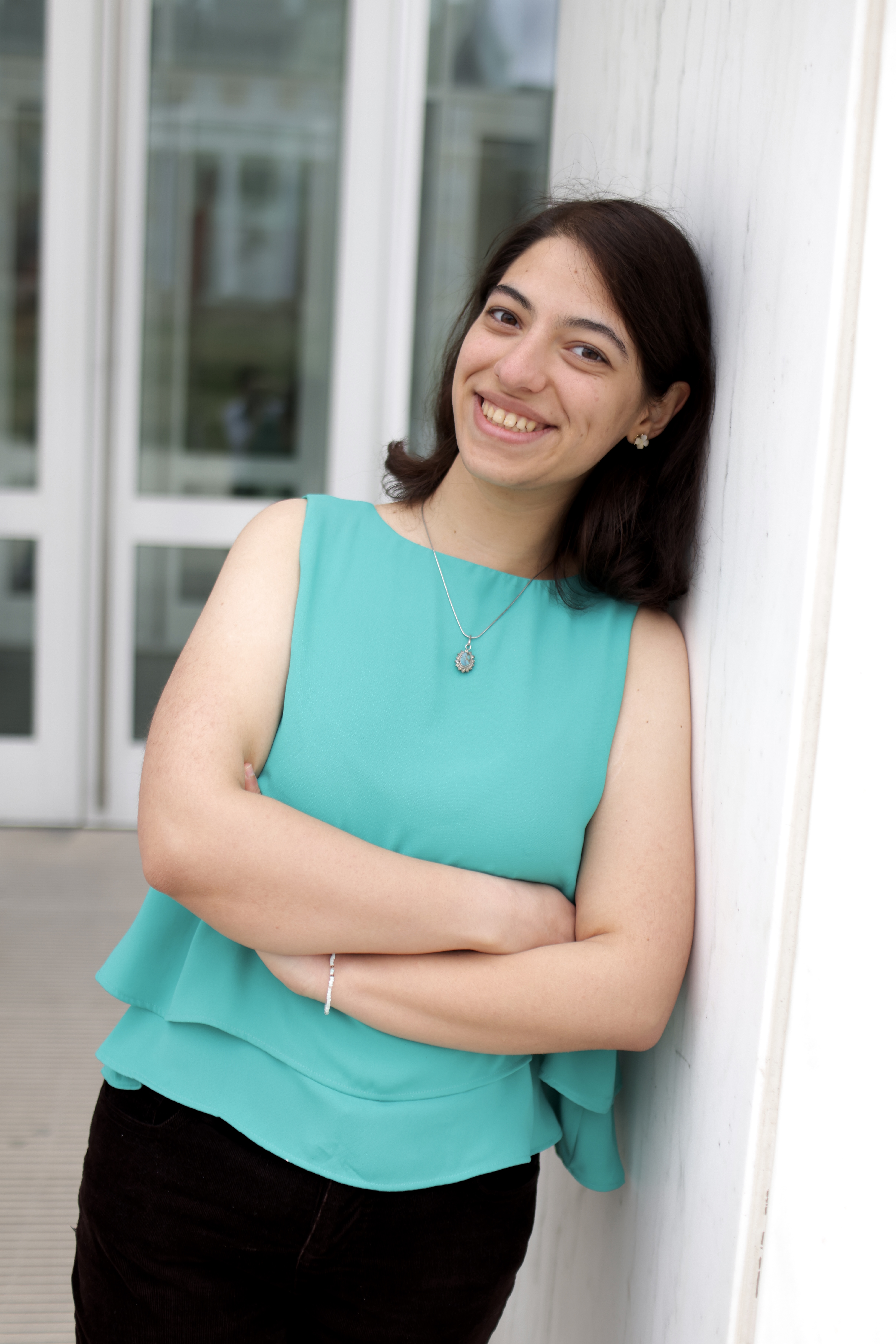
The senior computer science and music double major never performed publicly before coming to UMD. Now, she’s eyeing a career as a professional opera singer.
Unlike most music majors at the University of Maryland, Yasmine Tajeddin had never performed in front of a crowd before arriving on campus. She never had vocal lessons, took a music class in high school or sang in a choir. That’s because in Iran, where she grew up, women can’t sing in public.
“If I wanted to major in something like music, I would need to go outside my country,” she said. So, during her senior year of high school, she decided to audition for the UMD School of Music.
One reason Tajeddin was drawn to Maryland was family support—her aunt lives in the state. The other reason was the university’s strong computer science program. Now a senior double-majoring in music and computer science, Tajeddin is just as gifted as a coder as she is a singer. And while most people might find her pairing of majors unusual, Tajeddin sees a common thread: a love of languages, both sung and programmed.
“I’ve always had a passion for languages,” Tajeddin said. “Whatever I'm doing in the future, it has to be language-related.”
Tajeddin’s interest in the French language was what spurred her to listen to her first opera as a young girl. She connected with the songs emotionally because she spoke fluently and understood the meaning behind the words. Her interest in music stuck, and she began practicing opera singing in her room by listening closely to recordings and memorizing songs in different languages on her own.
As Tajeddin honed her vocal craft in high school, her passion for languages manifested in another interest: computer science.
“Computer science is cool because it’s a language but in a different format,” she said. “It’s not speaking a language, but a language that comes from your logic and your brain.”
She’s developed programming skills at UMD, both through coursework and as a teaching assistant. She credits her computer science professors—especially Computer Science Professor William Gasarch—for her successes and achievements. Now, she’s assisting in instruction herself as a TA for CMSC 351: “Algorithms,” and in past semesters, has been a TA for CMSC 250: “Discrete Structures” and a grader for MATH 140H: “Calculus I Honors.”
Tajeddin is also involved in scientific research. In 2023, she worked with Atmospheric and Oceanic Science Professor Ning Zeng, applying her programming expertise to a project aimed at reducing greenhouse gases by burying woody biomass. As part of that research, she helped design a miniature wood vault with sensors to monitor methane, carbon dioxide, temperature and humidity. She also researched the 2023 Canadian wildfires, assessing the environmental impact of small particulate matter that polluted the air through billows of smoke. This summer, she will be part of UMD’s Research Experience for Undergraduates in Combinatorics, Algorithms, and AI for Real Problems in the Department of Computer Science, working on natural language processing.
“This research is language-related, so I’m really excited about it,” she said.
Balancing science with music has been demanding. Tajeddin’s two majors have no overlapping course requirements. Plus, without extensive musical training, she had to catch up with her classmates who spent high school performing in choirs and orchestras. Between private vocal lessons, practice, choir and participating in the Gamer Symphony Orchestra, Tajeddin practices for about 10 hours per week. Some days, she leaves for class at 7:30 a.m. and doesn’t get home from rehearsal until 10 p.m.
“Maybe that would be too much for someone who has been doing opera their whole life. But for me, I had zero experience with formal vocal training, so I had a lot to catch up on,” she said.
Even the physical distance is a challenge. The School of Music is on the western edge of campus, while the Brendan Iribe Center for Computer Science and Engineering is a mile away on the eastern margin.
“That’s why I had to get a bike,” Tajeddin said. “There’s no way I could get between classes without it.”
Music Professor Emerita Delores Ziegler offered Tajeddin her bike—something Tajeddin graciously accepted because it reminded her of one of the first professors who believed in her musical potential.
Still, she’s made good use of her commute time. She practices while riding between classes—sometimes working on her vocal technique, pronunciation, memorization or simply studying the meaning of songs by listening to other vocalists' performances.
That hard work has paid off—and the rewards came quickly. In spring 2024, just months after arriving on campus, Tajeddin was offered a highly coveted role singing in the University of Maryland choir with the Baltimore Symphony Orchestra. They performed “Carmina Burana,” a famous opera song by Carl Orff that plays in countless movie soundtracks and commercials. The group rehearsed for half a semester and performed at the Joseph Meyerhoff Symphony Hall in Baltimore, the Strathmore Music Center in Bethesda and the Clarice Smith Performing Arts Center at UMD. For Tajeddin, it was a life-changing experience.
“When I walked on stage for the first time, and I saw this whole orchestra and this amazing venue, it hit me,” she said. “I was like, ‘Oh my god. My first experience with a symphony orchestra wasn’t from the audience—it was from the stage.”
Tajeddin still has one more semester before she graduates. She wants to become a professional opera singer, but through her TA experiences, she learned that she loves teaching, too. So, she’s considering going to graduate school to become a college professor in music or computer science—or maybe even both. To Tajeddin, it's all just language—and whether it’s Java or Japanese, she’s committed to mastering as many as she can.
###
Select recordings of Tajeddin’s performances at UMD can be viewed here.