When chemistry Ph.D. candidate Manny Bazan-Bergamino isn’t playing his clarinet, you can find him developing “molecular containers” that flush drugs out of the body.
Manny Bazan-Bergamino won’t let a Ph.D. pull him away from his clarinet—or his favorite sports team.
Seven years after graduating with a bachelor’s degree in chemistry from Johns Hopkins University, he still drives 45 minutes from College Park to Baltimore nearly every spring weekend to play with the pep band at his alma mater’s lacrosse games.
Bazan-Bergamino has spent the past half-decade at the University of Maryland, where he is a Ph.D. candidate in chemistry, researching molecules that could be used to flush dangerous drugs from the human body. But dedicated as he is to his research at Maryland, he has not once considered playing for UMD’s band.
“In lacrosse, Maryland and Hopkins are rivals, so I could not do that,” he said.
For Bazan-Bergamino, band has been a constant through life’s challenges—from immigrating to a new country, enduring tough academic classes and conducting dissertation research. As he prepares to defend his dissertation in the 2026-27 academic year, he’s navigating a sparse job market and lamenting the idea of leaving a musical community that he’s cultivated for more than a decade. But, as they always have, his love for his craft—and the people he met through it—carries him forward.
To the old passions and the new
Bazan-Bergamino’s family immigrated to Long Island, New York, from Lima, Peru, when he was 10 years old. It was the middle of the school year, and not many activities welcomed new students—but he found a way to join the band and learned to play the clarinet. He’s been playing ever since.
In college, music became a critical outlet for creativity and a source of community. Bazan-Bergamino joined Johns Hopkins’ pep band days after he arrived and met some of his closest friends by playing with the group. The band played at football games in the fall, but it was the spring lacrosse games where Bazan-Bergamino was most excited to perform.
“I fell in love with lacrosse,” he said. “I just kept going for the love of the music and the game.”
Somewhere between the clarinet and lacrosse, Bazan-Bergamino found a calling for chemistry. From his first class as a high school freshman, he loved how the field challenged him to solve puzzles using rules and pattern recognition—a skill he says is important for music, too.
He entered college as a chemistry major. And while he had initially planned to attend medical school, he left that path after struggling through a biochemistry premedical requirement in his sophomore year. Shortly after, he joined a chemistry research lab for a summer research opportunity—and the rest is history.
Molecular containers: from Febreze to fentanyl
After earning his bachelor’s degree from Hopkins and a master’s degree in chemistry from Stony Brook University, Bazan-Bergamino enrolled at UMD to study molecular containers under the supervision of Chemistry and Biochemistry Professor Lyle Isaacs.
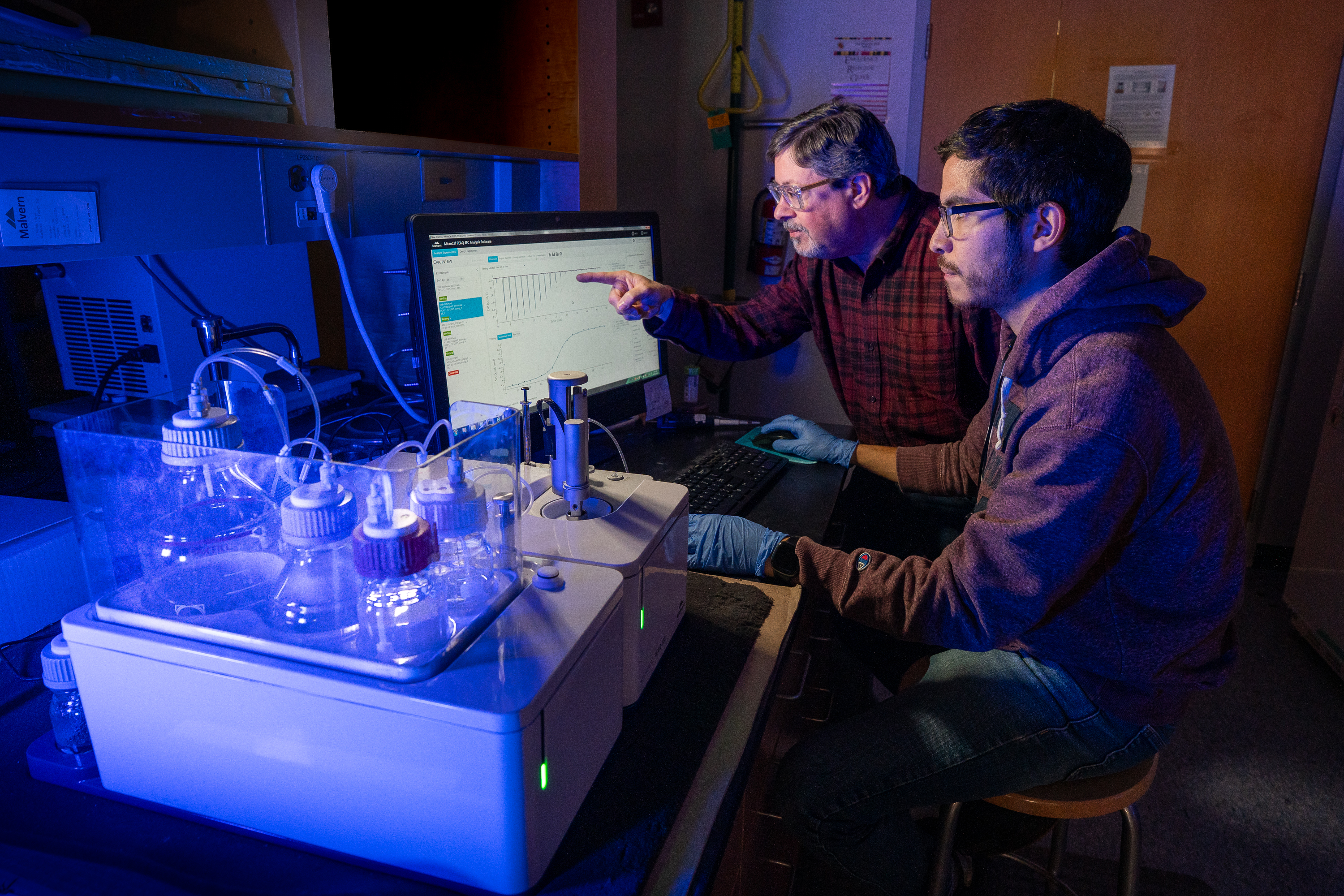
Molecular containers are large molecules that encapsulate smaller ones, and they have widespread applications. They’re how Febreze captures and removes foul odors. Bazan-Bergamino applies the same principles to remove unwanted drugs from the human body.
One branch of Bazan-Bergamino’s research deals with removing anesthetic drugs called neuromuscular blocking agents (NMBAs) from the body. These potent medications temporarily paralyze muscles, allowing surgeons to work more safely. Millions of patients take NMBAs each year, but if the drugs linger in the body too long after an operation, they can cause medical complications, such as difficulty breathing.
A 2024 study co-led by Bazan-Bergamino showed that a molecule called Pillar[6]MaxQ successfully neutralizes and removes NMBAs in rats. The paper reported that the molecule binds more tightly to the drug than the current leading treatment, sugammadex, which Merck makes under the name BRIDION.
Pillar[6]MaxQ could also help to prevent overdose from drugs like fentanyl, methamphetamine, PCP, ecstasy and mephedrone, per other published findings from the lab.
Bazan-Bergamino is now studying other molecules that could rival or even outperform Pillar[6]MaxQ at removing certain drugs. After graduation, he’s considering sharpening his skills in synthetic organic chemistry, which he studied for his master’s degree. Much to the chagrin of his sophomore-year self, he might even pivot into biochemistry.
Wherever his path takes him, he knows one thing for sure: Moving on brings change—in both research and community.
“I fear that as I finish this Ph.D., next year, I might be somewhere else,” he said. “And I won’t get to play in the pep band for a twelfth year in a row.”