Working on a giant subatomic particle detector at the South Pole helped UMD physics Ph.D. student Rachel Procter-Murphy discover a new side of herself.
It took one week, five flights and a slow ride on a six-wheeled bus for Rachel Procter-Murphy to arrive at her dream destination: the South Pole.
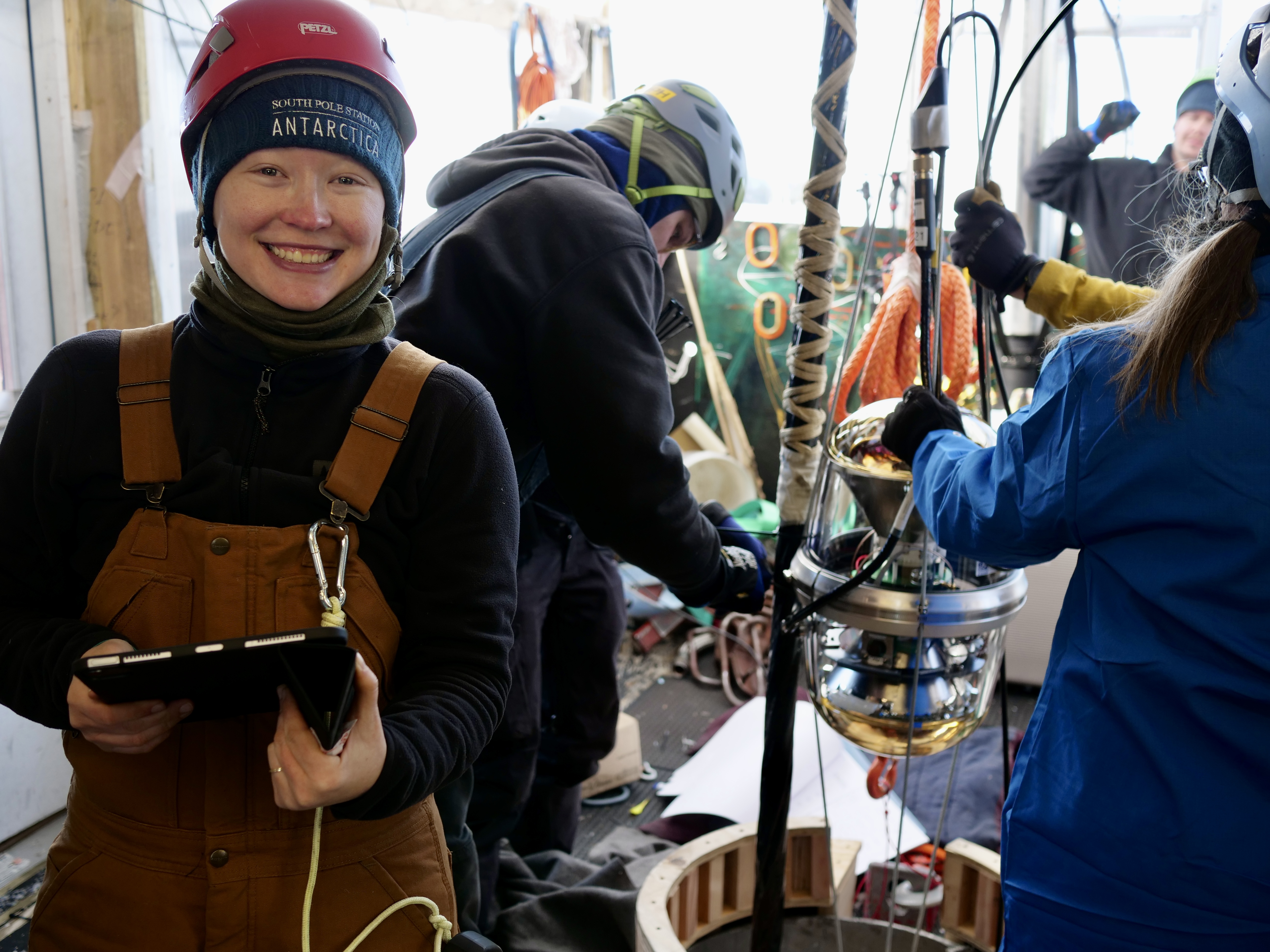
Last fall, the University of Maryland physics Ph.D. student went to Antarctica for two months in search of neutrinos—super-abundant but hard-to-detect subatomic particles created by violent events like exploding stars and radioactive decay. She was most excited to be in the presence of IceCube, a neutrino observatory outfitted with thousands of optical sensors suspended deep within the ice and spanning 35.3 billion cubic feet (about the volume of the Empire State Building 946 times over).
“It was an incredible opportunity to work with technology that very few people get to experience,” Procter-Murphy said. “I felt like I’d won the lottery.”
Pinpointing the invisible
Procter-Murphy’s Ph.D. research focuses not just on finding neutrinos in space but also figuring out where they’re coming from.
“Trying to pinpoint things that are virtually invisible has its challenges,” she noted.
Neutrinos have little mass, no electrical charge and don’t interact with much in the universe—they aren’t bent by magnetic fields or interrupted by dust clouds—so they streak through the Earth (and our bodies) in a straight line, mostly unnoticed. Despite their abundance, scientists can only detect them on the rare occasion that they interact with something—like ice.
“The South Pole is a great place to detect neutrinos because the ice target is so big and the ice is so clear, dark and mostly stable,” Procter-Murphy explained. When a rare neutrino collides with an atom in the ice, “it creates charged particles that emit a faint blue glow known as Cherenkov radiation. That light is what IceCube’s sensors detect.”
But neutrinos aren’t the only bits from afar being blasted out of the sky.
“Cosmic rays interact with the atmosphere and produce a lot of particles that also interact with the detector,” Procter-Murphy said. “And they send thousands per second, while the astrophysical neutrinos only occur around once every two weeks. So, there’s a lot of background noise that we’re trying to mitigate.”
Parsing through those mixed signals, Procter-Murphy worked with IceCube data to search for the particles' origins by scouring “catalogs of astrophysical sources,” enabling her to narrow down what might be producing these neutrinos—an effort that helps serve an even more ambitious aim.
“Neutrinos aren’t going to cure cancer or solve hunger, but there’s value in adding detail to the big picture of how the universe works,” she said. “Understanding these major forces could help explain the existence of stars and planets and even the reason living things like us are made of matter.”
Hands-on education
Procter-Murphy’s main goal while at the South Pole was to help install an upgrade to IceCube. The observatory is made up of a hexagonal lattice of more than 85 cables or “strings,” each equipped with 60 digital optical modules (DOMs) that are suspended in the ice at depths between 4,760 and 8,200 feet. A rush of water kept hot by massive car-wash heaters lets installers drill down into the ice and unspool the DOM-laden strings into place. The ice then refreezes around the instruments, becoming part of the observatory.
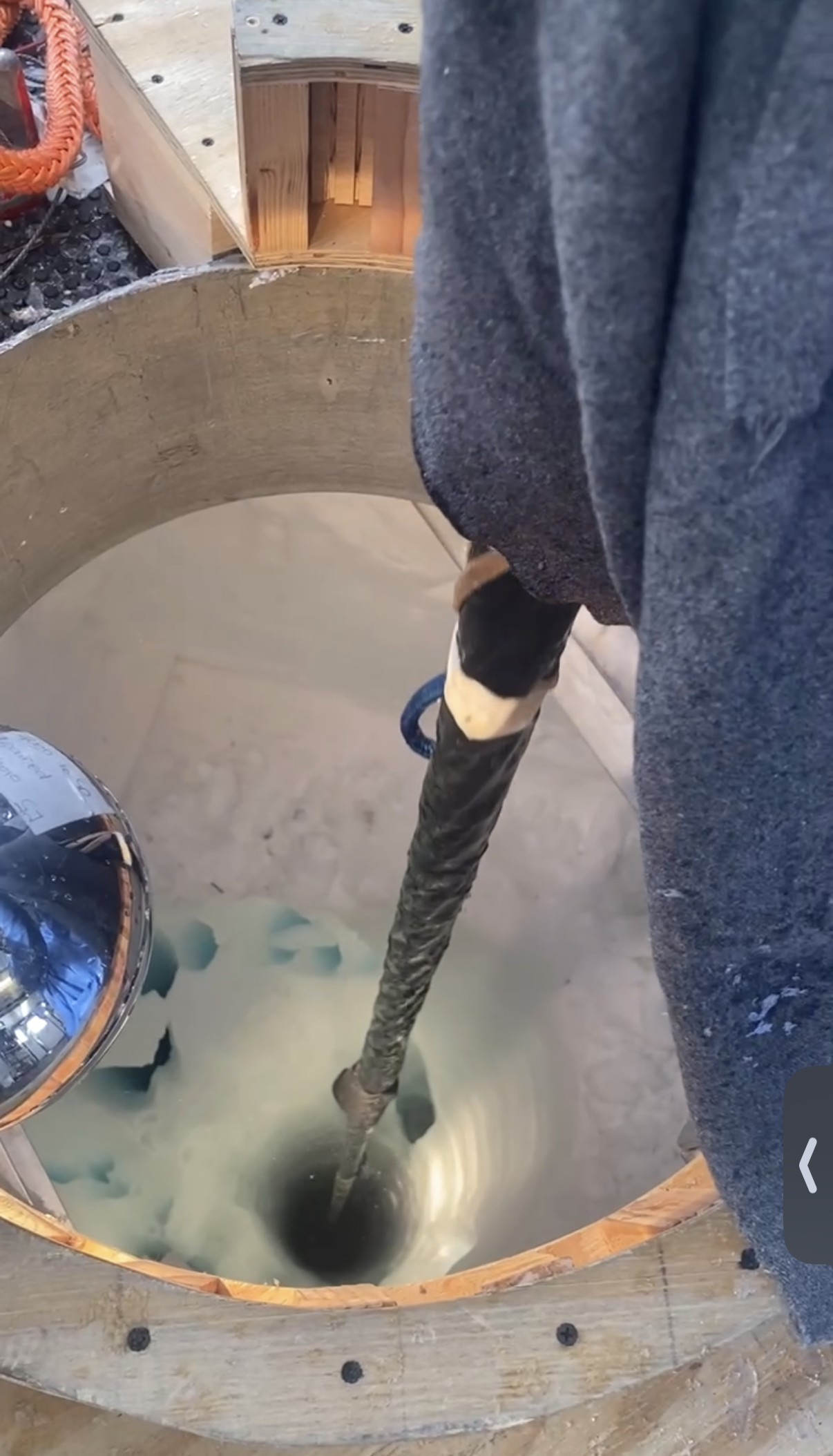
“We installed five new strings, which had me at times standing over a huge hole in a glacier, with space heaters around me and cold air constantly blowing in my face from the hole as I’m monitoring these giant cables and tapping away on an iPad—it was a bit surreal,” she recalled. “Not your typical graduate school experience.”
But as noted by her advisor, Physics Professor and Chair Kara Hoffman, Procter-Murphy is not your typical graduate student.
“Rachel isn’t afraid to pursue what she wants,” Hoffman said. “Beds at the Pole are limited, with many of them occupied by the essential personnel who keep the station running and operate the heavy construction machinery. There's a lot of competition for the slots designated for scientists."
To get one of those slots, "she was a great advocate for herself, did the training and rose to the necessary level to be a good colleague on the ice,” Hoffman said. "What that means is being willing and able to do everything from scrub toilets to survey, drill and do high-level data analysis. Rachel stepped up and people praised her for filling so many gaps. Not everyone could have done what she did.”
Eyes on the skies
Working on IceCube was something Procter-Murphy feels she was destined to do.
“As a kid, I wanted to be an astronaut,” she said. “I was obsessed with space. I wanted to know about black holes, how things behave deep in the universe, science-y things like that.”
So, she zeroed in on physics, with astrophysics as her dream career.
“When I first interviewed at UMD, I remember Professor Hoffman saying she felt that students did their best work on things they were passionate about,” Procter-Murphy said. “For me, that meant trying to get to the Pole.”
As that trip became a reality, Procter-Murphy faced a slew of medical tests to ensure she could handle the difficult conditions, then the grueling days of travel ending in a mild sense of panic as she struggled to carry her own bag in the thin air at 10,000 feet.
But once she acclimated to the conditions, Procter-Murphy dove into her work and thrived.
“The two-month experience made me a more confident, capable person,” she said. “And I was surprised how much I enjoyed the installation. Now I can see adding an engineering aspect to whatever I do next.”
Warm memories
Procter-Murphy credits much of her Antarctic success to the people around her.
“I was part of such a supportive group who thought I had good ideas and was worth listening to,” she said. “That helped me to grow and changed how I saw myself.”
Among her most memorable moments: working with IceCube for the first time, scribbling her own name in the logbook signed by the original observatory installers and sledding down a giant glacier.
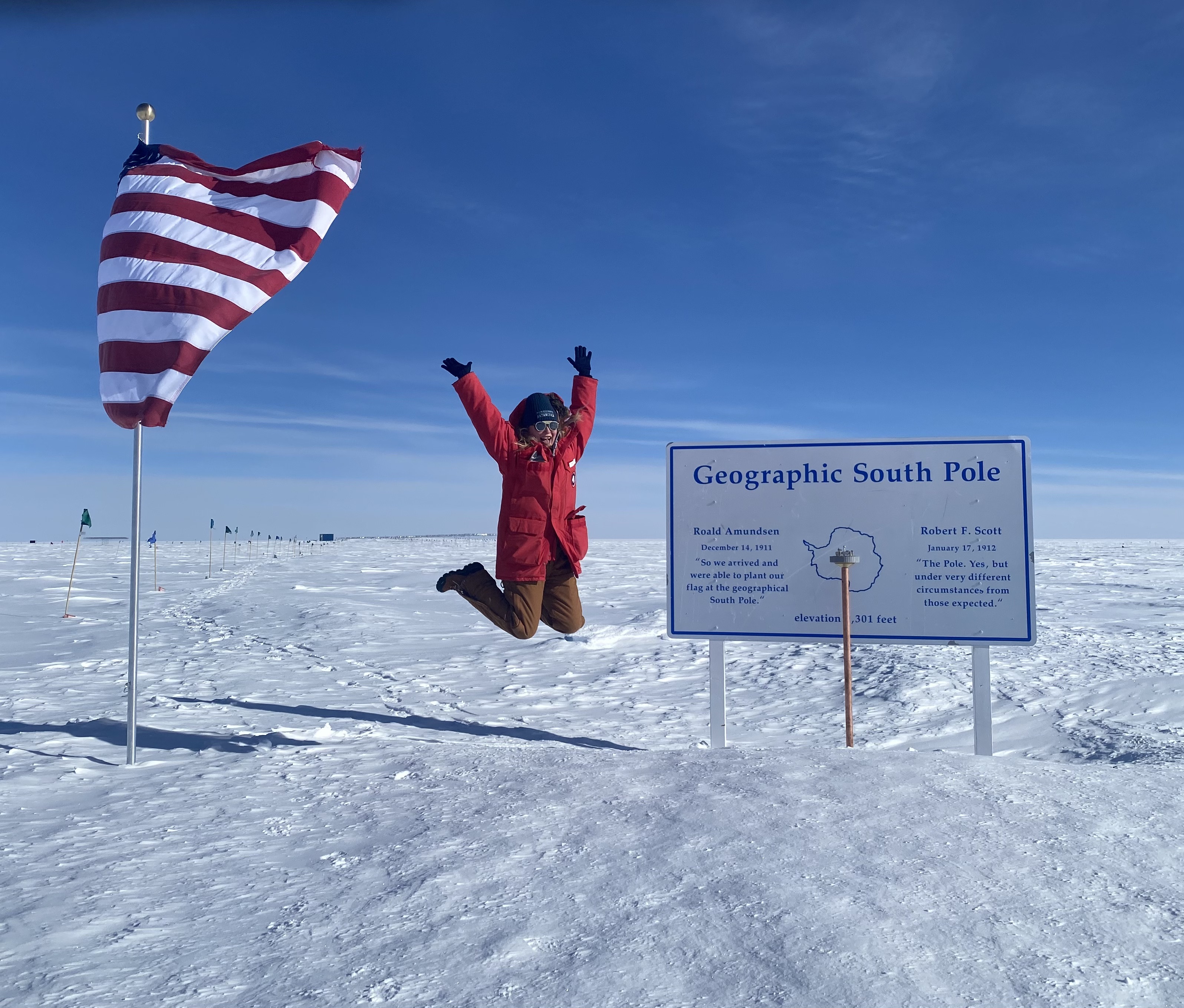
Oh, and standing at the end of the world.
“The end of the world is what people call the place beyond the research station and defunct buildings, where snow management ends,” she explained. “It feels like the edge of nothingness, just flat ice and open space under this eerie glow as far as you can see. It’s a view I’ll never forget.”