Davoudi will receive up to $2.5 million to explore how the universe works using cutting-edge tools such as quantum computing and sensing.
University of Maryland Associate Professor of Physics Zohreh Davoudi is one of eight academics around the globe named a 2026 Schmidt Polymath.

Founded in 2021, the Schmidt Sciences Polymath Program recognizes risky, cross-disciplinary work undertaken by researchers who push the boundaries of their fields to achieve scientific breakthroughs. Davoudi and the other awardees will each receive up to $2.5 million over five years to support their research.
“The flexibility and freedom offered by this award is a dream come true,” Davoudi said. “It allows one to explore the wildest ideas and not be afraid of crossing traditional boundaries set within institutions and funding agencies.”
To date, the Polymath award has been awarded to 43 researchers at 31 institutions across nine countries.
“We are elated to hear of this prestigious and well-deserved acknowledgment of Dr. Davoudi’s considerable talent,” said Kara Hoffman, chair of UMD’s Department of Physics. “We are proud of her accomplishments and look forward to hearing about the many findings that this generous award will enable.”
Since joining UMD in 2017, Davoudi has worked at the intersection of nuclear physics, particle physics, and computer science. Her research explores how to build the universe from the bottom up: physicists have a good description of nature’s basic ingredients, but translating those fundamental equations into concrete predictions—about the structure of an atomic nucleus or the matter inside a neutron star—is enormously difficult.
“Most researchers specialize in one or a few tools to close that gap,” Davoudi said. “But my approach has always been that I would pick any means that would help me solve these problems.”
Davoudi began her career as a pure theorist, working through equations with analytical methods. Her results showed how real-world quantities—the fusion reactions that power the sun and a rare nuclear decay that would prove our current theory of physics incomplete—could be extracted from numerical calculations. Then, Davoudi moved on to results obtained from supercomputers, helping to produce some of the first calculations of nuclear interactions, reactions and structure derived from first principles. But she concluded that even these large, powerful computing machines would never be enough.
“No matter how large these computers are, eventually they will come to a point where they can’t solve certain problems for us,” Davoudi said.
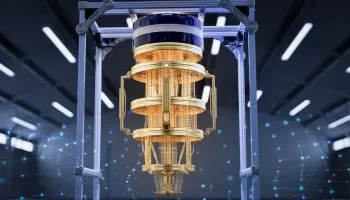
That realization led her to quantum computing. Unlike classical computers, which store information as simple on/off switches, quantum computers exploit the strange rules of quantum mechanics to process certain types of problems far more efficiently. Davoudi is now considered a pioneer in the subfield that applies quantum computing to nuclear and particle physics.
When physicists try to simulate how large numbers of subatomic particles interact and evolve, the amount of information involved grows faster than any classical computer can handle. That bottleneck affects research connected to some of the world's leading facilities, including the Large Hadron Collider and the Relativistic Heavy Ion Collider, where particles are smashed together at extreme energies to reveal the fundamental nature of matter. Davoudi's work is building the tools to run those simulations on quantum computers instead.
“I develop theoretical foundations, quantum algorithms, and experimental proposals for simulating quantum systems that increasingly resemble the subatomic systems we ultimately like to simulate. This endeavor has put me in the sphere of several amazing theoretical and experimental researchers from across physics, computer sciences, and engineering at the UMD and beyond, and turned my research into an exciting multidisciplinary journey,” Davoudi said.
For Davoudi, the Polymath award will help support her next ventures into uncharted territory. She plans to bring tools she has never used before—quantum sensing and artificial intelligence—into her research, and to apply her existing expertise to fields she has not yet explored, including cosmology and even bioscience.
Davoudi sees a hidden thread connecting some of the most extreme environments in science, from the universe in its earliest moments to collisions inside particle accelerators to even the chemistry of living cells. At each scale, quantum mechanics governs the underlying physics. But at some point, those quantum effects give way to the ordinary rules of classical physics. Davoudi believes that this transition holds untapped scientific potential.
“Can we trace the ‘quantumness’ in these systems? Can we leverage it to discover new phenomena and new applications?" Davoudi said. “New simulation and sensing strategies can reach far beyond what scientists consider possible today, and artificial intelligence could accelerate that process beyond our imagination. It’s exciting to think about these directions and discover both answers and new questions in the process.”
The Polymath award will allow Davoudi to build new collaborations with scientists in quantum sensing, artificial intelligence, cosmology and beyond, and to launch new activities alongside the talent this award will support.
“I’m not an expert in any of these fields. But I am an expert in nuclear and particle physics and its intersections with quantum information science. And I am passionate about seeking answers from many different angles. That’s what I bring to the table,” Davoudi said. “I am grateful to Schmidt Sciences for placing their trust in researchers like me to explore freely in pursuit of science.”