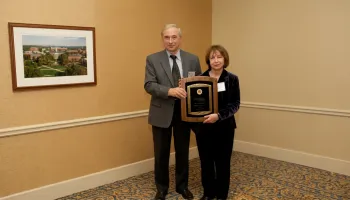
Nigam, a leading scholar in climate dynamics, earned the highest academic honor bestowed by the University of Maryland.
University of Maryland Atmospheric and Oceanic Science Chair Sumant Nigam was named a 2026 Distinguished University Professor. The title of Distinguished University Professor is the highest academic honor bestowed by the university.
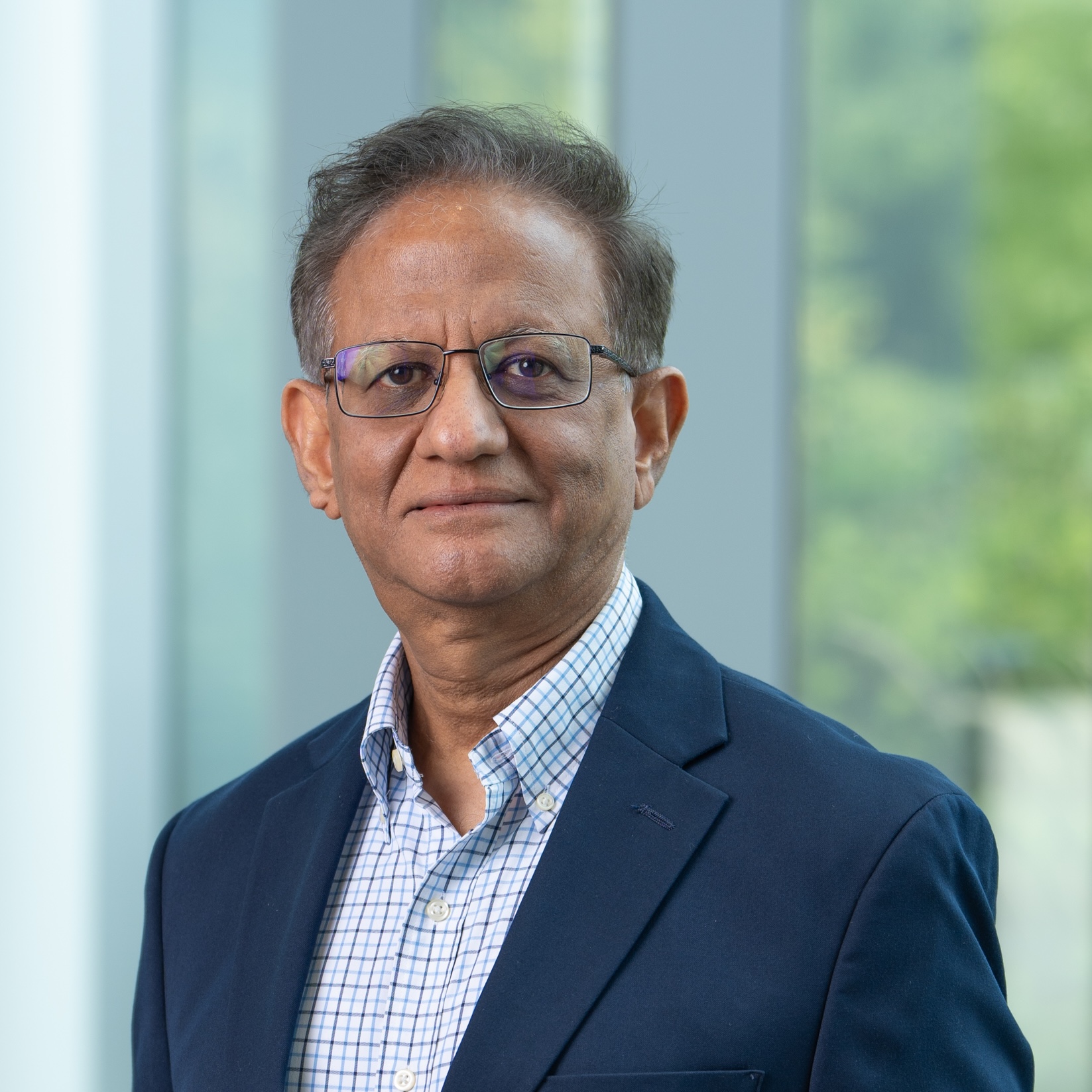
Nigam, who also holds a joint appointment in the Earth System Science Interdisciplinary Center, joins more than 60 colleagues in the College of Computer, Mathematical, and Natural Sciences (CMNS) who have earned the distinction since 1980. He will be honored on September 9, 2026, at UMD's Faculty & Staff Convocation.
“It’s amazing to be named a Distinguished University Professor,” said Nigam, who is also a fellow of the American Meteorological Society and the Royal Meteorological Society. “I’m a little bit surprised, but I feel both honored and privileged.”
Distinguished University Professors are faculty members who have been recognized nationally and internationally for the importance of their scholarly achievements. They are selected each year by UMD’s president, along with a committee composed of the provost and seven faculty members—including several Distinguished University Professors—from diverse disciplines.
“Sumant Nigam has made lasting contributions to climate science and exemplifies the excellence of our faculty in CMNS,” said CMNS Dean Amitabh Varshney. “His selection as a Distinguished University Professor reflects the significance of his scholarship and his impact on the university and beyond.”
Since receiving his doctoral degree in 1984 from Princeton University’s Geophysical Fluid Dynamics Program, working in the Climate Dynamics Group led by future Nobel laureate Syukuro Manabe, Nigam has become a leading scholar in climate dynamics. He combines foundational physical principles and real-world observations to assess and improve climate models. Leveraging high-resolution, observations-constrained representations of atmospheric and oceanic states, Nigam’s work identifies physical processes that climate models misrepresent or ignore, thereby improving the models’ ability to simulate and predict climate variations.
His most-cited contribution to the field is the pioneering Lindzen-Nigam model. Developed while he was a postdoctoral researcher at the Massachusetts Institute of Technology, it is now a textbook framework for understanding how tropical oceans and the atmosphere interact, especially in the central and eastern basins, affecting sea surface temperatures and near-surface winds.
More recently, Nigam published impactful work documenting decadal-to-centennial changes in regional climate, including the expansion of the Sahara Desert in the 20th century. His work also explained how oceanic and atmospheric processes impact distant hydroclimates—for instance, showing that sea surface temperatures in the Atlantic Ocean contributed to the 1930s Dust Bowl drought over the Great Plains.
Nigam’s research continues to yield widespread societal benefit. Each spring for the past 10 years, his lab group has issued seasonal forecasts of the El Niño-Southern Oscillation—a climate pattern involving sea surface temperature changes in the tropical Pacific Ocean—and the South Asian summer monsoon. He provides this information to the Indian government, which then uses it to inform its official monsoon forecasts.
Additionally, Nigam is the director of the Maryland Mesonet—a statewide network of 47 towers across 21 counties and Baltimore City, equipped with meteorological instruments to improve the accuracy of weather forecasting and emergency preparedness. Mesonet data are transmitted to the National Weather Service in near real-time and are simultaneously available to local and state emergency management personnel, enabling them to warn Maryland citizens of severe weather, such as tornadoes.
“We are not driven just by the intellectual excitement of innovative science and discovery,” Nigam said. “We also use our findings to develop societally relevant products and predictions.”
Now, as global climate patterns continue to shift, Nigam is focused on climate change attribution—a body of research that estimates the contribution of anthropogenic warming versus multidecadal natural variability in generating regional hydroclimate variations.
As he enters this next phase of his career, Nigam is grateful to have the support and endorsement of his colleagues at UMD, his academic home since 1987.
“I’m grateful to have this recognition of being a Distinguished University Professor,” Nigam said. “It’s a peer evaluation, so I feel humbled that these people who have accomplished so much thought highly enough of me to bring me into their fold.”