UMD researchers reconstructed the first-ever timeline of a rare form of methane, exploring whether it could be used to assess future climate progress.
For the first time, an international team of researchers, including scientists from the University of Maryland and Utrecht University in the Netherlands, reconstructed the concentration of clumped methane—rare methane molecules with two heavy atoms clustered together—in air from the past.
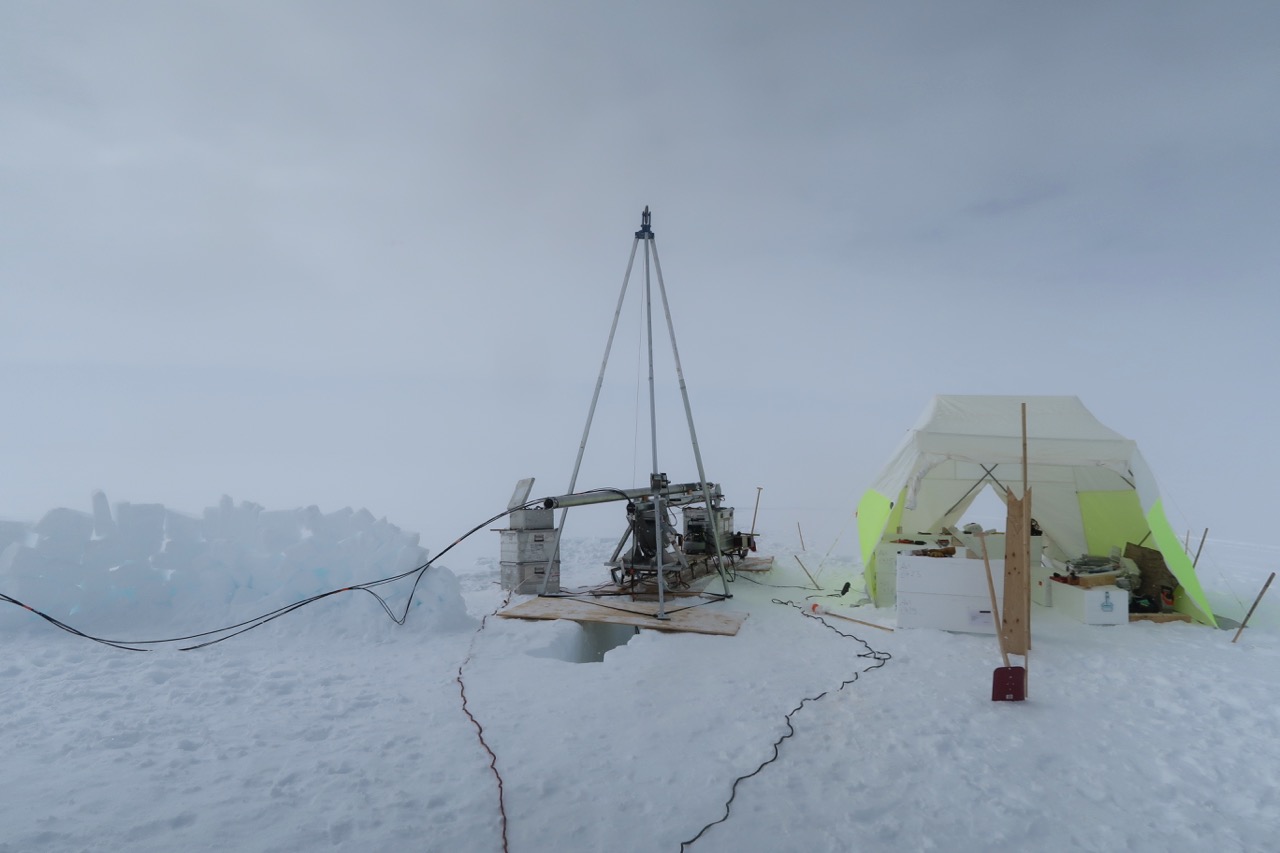
The scientists analyzed air that was roughly 40 years old, preserved in compacted snow called firn in Greenland. The findings provide new insights into how atmospheric methane concentrations have undergone unprecedented change since the Industrial Revolution—and could offer a new metric for monitoring climate progress in the future. The results were published July 15, 2026, in the journal Science Advances.
“This is the first-ever reconstruction of atmospheric clumped methane’s history,” said the study’s co-lead author and UMD graduate, Jiayang Sun (Ph.D. ’25, geology).
Methane is the second most important greenhouse gas after carbon dioxide, responsible for around 30% of global warming to date. It forms naturally in wetlands, rice paddies, landfills and agricultural systems, and is also released from fossil fuels such as coal, oil and natural gas. Because the clumped-isotope signal reflects the balance between methane emitted and removed from the atmosphere, researchers can use it to estimate how much methane was released from natural versus human-made sources.
“There's always debate about whether the methane concentration increase in the atmosphere is caused by more fossil fuel-related emissions, biogenic emissions, wildfires or something changing the atmospheric sink reactions,” Sun said. “That’s why we want to add more diagnostic parameters like clumped methane.”
The researchers' measurements and analyses showed that the concentration of clumped methane isotopes changed significantly over the past few decades. The clumped isotope signal reached an extreme value in the 1990s, linked to accelerating emissions during industrialization. The team also forecasted the unique trajectories of clumped methane through 2100 if humans reduce, halt or even reverse methane emissions—providing a potential metric to assess climate mitigation efforts in the future.
“One goal of this project is to look at historical methane to see if there is a signal that we can use to monitor changes in the past methane cycle,” said study co-author James Farquhar, a Distinguished University Professor in the Department of Geological, Environmental, and Planetary Sciences at UMD. “If we could see a signal, then we could argue that we should make measurements of clumped methane today and moving into the future.”
To understand how methane sources and removal have changed over time, the researchers needed access to air from the past. And not just a little: Analyzing clumped methane isotopes requires as much as a thousand liters of air.
That old air can be found in firn, a layer of dense snow between the surface and the underlying glacial ice, where air sometimes remains trapped for up to 70 years. At the East Greenland Ice-Core Project research station, researchers from Utrecht University collected the air samples by drilling deep into the snow and pumping the air out with specialized equipment.
The amount of air was still on the low end for achieving the best precision with the instrument used in Utrecht. But a high-resolution instrument at UMD called the Panorama could make the same measurements using less air.
Now, the team is testing additional historical air samples, hoping to find signals they can use to monitor climate change today and in the future.
“I think there will be more information from additional measurements of past methane,” Farquhar said. “The step beyond that is to see if we can use this approach for measuring methane today and into the future.
###
This article was adapted from text provided by Utrecht University.
In addition to Sun and Farquhar, the paper’s UMD co-authors include Geological, Environmental, and Planetary Sciences Assistant Research Scientist Mojhgan A. Haghnegahdar.
The paper, “Anthropogenic perturbations to atmospheric methane reflected in Greenland firn air clumped isotope measurements,” was published in Science Advances on July 15, 2026.
Research reported in this release was supported by the Netherlands Earth System Science Center, with funding from the European Union (EU) Horizon 2020 Research and Innovation Program under the Marie Skłodowska-Curie Actions (847504); the EU Horizon Europe Research and Innovation Program under HORIZON-CL5-2022-D1-02 (101081430–ISOMET); the U.S. National Science Foundation (MRI 1725766); the NOAA Cooperative Institute for Satellite Earth System Studies (NA19NES4320002-T1-01 and NA24NESX432C0001-T1-01); and the French National Centre for Scientific Research National Institute of Sciences of the Universe Fluid Envelopes and the Environment Program. The East Greenland Ice-Core Project is directed and organized by the Centre for Ice and Climate at the Niels Bohr Institute, University of Copenhagen. It is also supported by the A.P. Møller Foundation, the University of Copenhagen, the U.S. National Science Foundation, the Alfred Wegener Institute, the Helmholtz Centre for Polar and Marine Research, the National Institute of Polar Research and Arctic Challenge for Sustainability, the University of Bergen, the Trond Mohn Foundation, the Swiss National Science Foundation, the French Polar Institute Paul-Emile Victor, the Institute for Geosciences and Environmental Research, the University of Manitoba, the Chinese Academy of Sciences, and Beijing Normal University. This article does not necessarily reflect the views of these organizations.