Unlikely bird keeper Sara Hallager (B.S. ’89, zoology) took flight at the Smithsonian’s National Zoo and Conservation Biology Institute, becoming curator of birds and a devotee to their protection.
Sara Hallager (B.S. ’89, zoology) was never into birds.
“I was always a mammal person,” she said. “I really wanted to work with seals and sea lions.”
After high school, Hallager didn’t immediately attend college. Instead, she began volunteering at the Smithsonian’s National Zoo and Conservation Biology Institute in Washington, D.C., helping to care for animals rejected by or separated from their mothers. Later, she was employed in the zoo’s veterinary department, a great foot in the door.
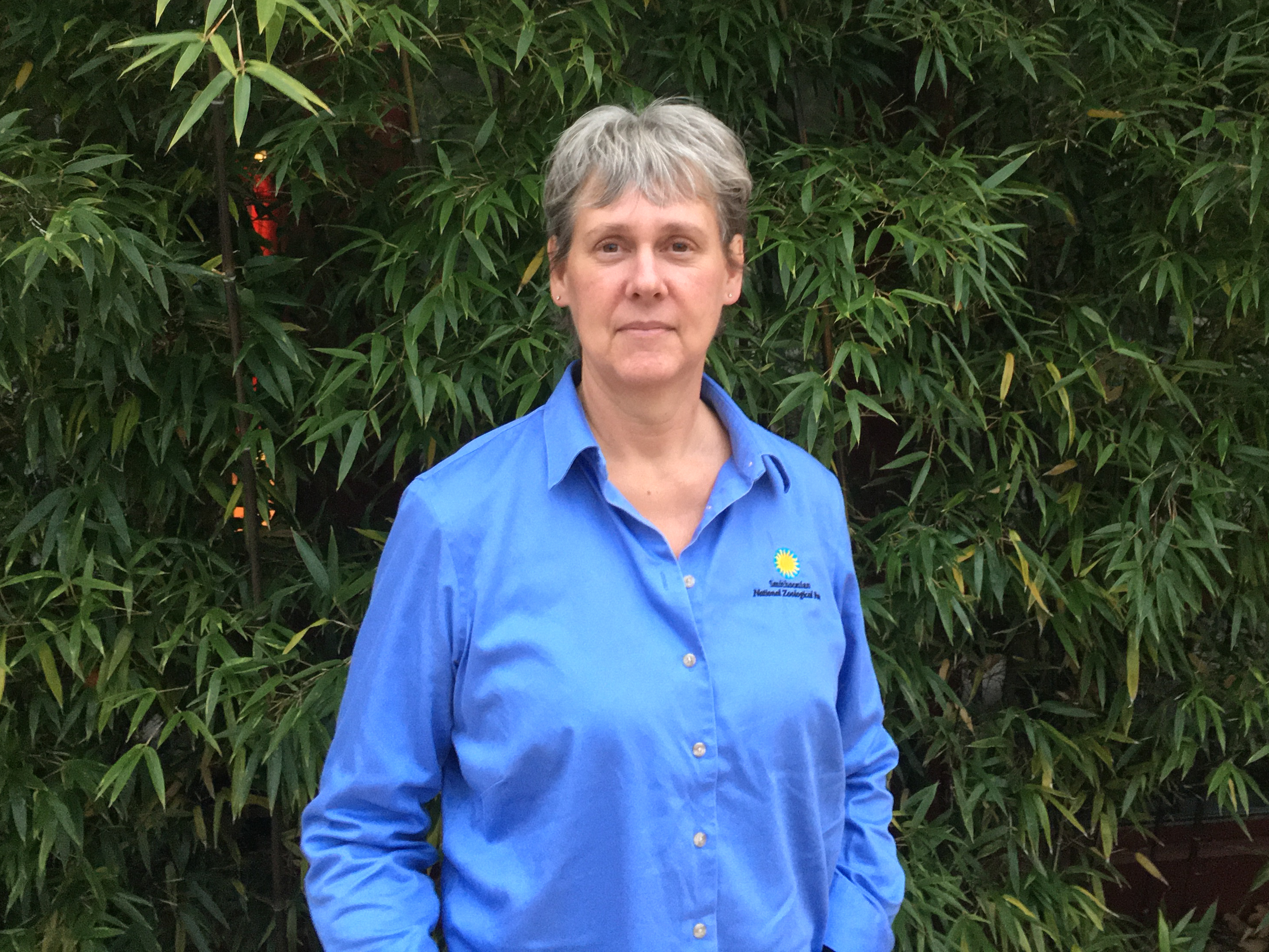
When her dream job finally opened—a rare opportunity to care for seals and other pinnipeds (marine mammals with front and rear flippers that live in the ocean but can come ashore for long periods)—Hallager applied but lost out to a more senior animal keeper. Instead, she landed a position in the zoo’s bird house, and she soon realized she’d found her niche.
“I sort of got ‘stuck’ with birds,” Hallager said. “But when I started that job, something happened that completely surprised me: I totally fell in love with them. And I’ve been busy with birds ever since.”
That adds up to nearly 40 years among feathered friends in the zoo’s aviary, the last decade of which Hallager has been flying high as the curator of birds.
Finding her wings
From a very young age, Hallager knew she wanted a hands-on career with animals, preferably in a zoo. As she got older, getting a college degree became part of the plan. Living in nearby Takoma Park, she applied to the University of Maryland.
“It’s a little silly, but deciding on a major, I thought, ‘zoos, zoology, that must be the degree for me,” she said.
Already married to a fellow zoo employee and working at the zoo part-time, “I didn’t have the traditional on-campus UMD experience,” she recalled, “and I remember struggling in courses like chemistry and physics.”
But there was one science class that became a quick favorite.
“I took ornithology with [Biology Professor Emeritus] Gerald Borgia, which I liked a lot, and eventually I managed to get my degree,” she said.
After graduating, Hallager remained at the zoo as a bird keeper for a decade before advancing to assistant curator and, finally, to curator of birds in 2014. Initially, she focused on the “big birds,” including flamingos and kori bustards—what she calls “a giant roadrunner on steroids.” But a major renovation of the 1920s building housing the aviary had a huge impact on her work.
“We could have rebuilt the bird house and filled it with parrots, toucans, owls, penguins and all the rest,” she recalled. “But we ended up choosing to focus on North American birds—specifically Western Hemisphere birds—and the story of migration. Suddenly, I was dealing with tiny songbirds weighing eight grams and shorebirds and ducks, and thinking about migration corridors and conservation, and I loved it. It was transformational for me—life-changing and career-changing.”
During the renovation from fall 2018 to March 2023, the team worked closely with the Smithsonian Migratory Bird Center to develop the house’s overarching conservation theme. About the same time, an important paper was published documenting the drastic decline of birds in North America—estimating as many as 3 billion birds lost over 50 years.
“Out of that stunning study came these seven simple actions people can do to help birds, and we were happy it was information we were already planning to interpret in the new house—actions like drinking Bird Friendly® coffee, making your windows bird-friendly, planting native plants, keeping your cats indoors and not using pesticides,” she said.
Conservation can feel overwhelming sometimes, she noted, and it can be hard to remain hopeful under the cloud of habitat loss, illegal bird trafficking and other major threats.
“We’re fortunate that with birds, there are many actions people can take that truly make a difference,” she said. “That’s long been part of our message.”
For zoogoers, Hallager admitted that compared with mammals, birds can be a hard sell.
“You hear comments from visitors like, ‘Where are the real animals?’” she said. “But the bird house is beautiful, and right now it’s super lively. The songbirds are breeding, there are ducklings in the waterfowl aviary and all that activity makes it a special place.”
Bird is still the word
As a curator for many years now, Hallager is involved in studies and care planning, but she spends more time than she’d like in meetings and managing staff, budgets and paperwork.
“The higher up you go in zoo work, the less animal care you actually do,” she said.
So, she jumps at every opportunity to get back to nurturing the birds that she loves.
“Take this morning: I started my day feeding a little duckling that just hatched,” she said. “We also have a greater rhea chick that we have to run four times a day so his legs grow strong. I love helping with those cases.”
Ironically, perhaps, Hallager isn’t a big birdwatcher; she and her husband have a cat “which of course stays indoors,” she said. The rest of her animal time comes on the job, which has its pluses and minuses.
“It’s a hard job emotionally,” Hallager admitted. “Other than parrots, birds generally don’t live that long. You get attached to these birds just like someone working with elephants or big cats or other ‘charismatic megafauna.’ I never thought I’d become so emotionally attached to birds, but I have.”
And after almost four decades in the aviary, she sees birds for what they really are.
“They’re smart. They’ve got personalities. They’re resilient and adaptable. They’re amazing creatures,” she said. “I still feel very fortunate to be among them.”