
News

News
Filter by

Kollár Receives National Science Foundation CAREER Award
JQI Fellow Alicia Kollár received the prestigious award for a proposal aimed at developing a new window into the physics of particles interacting inside of materials and performing educational outreach.

Konstantina Trivisa to Continue as Director of UMD’s Institute for Physical Science and Technology
She served as IPST director for the past year and as associate director from 2014 to 2020.
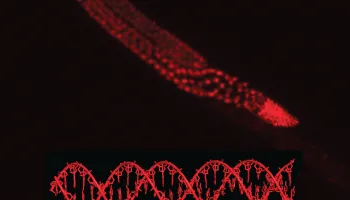
Match Matters: The Right Combination of Parents Can Turn A Gene Off Indefinitely
UMD scientists discover that mating can cause epigenetic changes in nematode worms that last for 300 generations.

Rising Greenhouse Gases Pose Continued Threat to Arctic Ozone Layer
New study shows climate change is increasing ozone depletion over the Arctic.

A new industry hub founded on microscopic atoms could generate massive returns for the D.C. region.

Five Biological Sciences Majors Receive University Medal Honors
Sherry Fan was named University Medalist, and Jackson Devadas, Meron Haile, Kyeisha Laurence and Veeraj Shah were named University Medalist Finalists.

Triple Galaxy Merger Sends Mixed Signals
UMD astronomer finds three merging galaxies that offer insights into black hole mergers and galaxy formation.

Senior Linden Yuan Awarded Competitive Defense Fellowship
Yuan will take the fellowship to the University of Illinois, where he will pursue a Ph.D. in electrical and computer engineering.

Leena Pade is a Cosmos Scholar with Chemistry in Her Blood
How this Ph.D. student went from visiting her father at work to working in his industry.

For Theoretical Chemist Pratyush Tiwary, It’s All About Perspective
The assistant professor balances his life of high-level theory with down-to-Earth human connections.

UMD Grad Students to Showcase Their Insect Knowledge at National Entomology Games
Terp team placed second in the region and earned a spot at the national competition this fall.

JQI Researchers Generate Tunable Twin Particles of Light
JQI researchers and their colleagues describe a new way to make entangled twin particles of light and to tune their properties using a method conveniently housed on a chip, a potential boon for quantum technologies that require a reliable source of well-tailored photon pairs.