Exploring Space
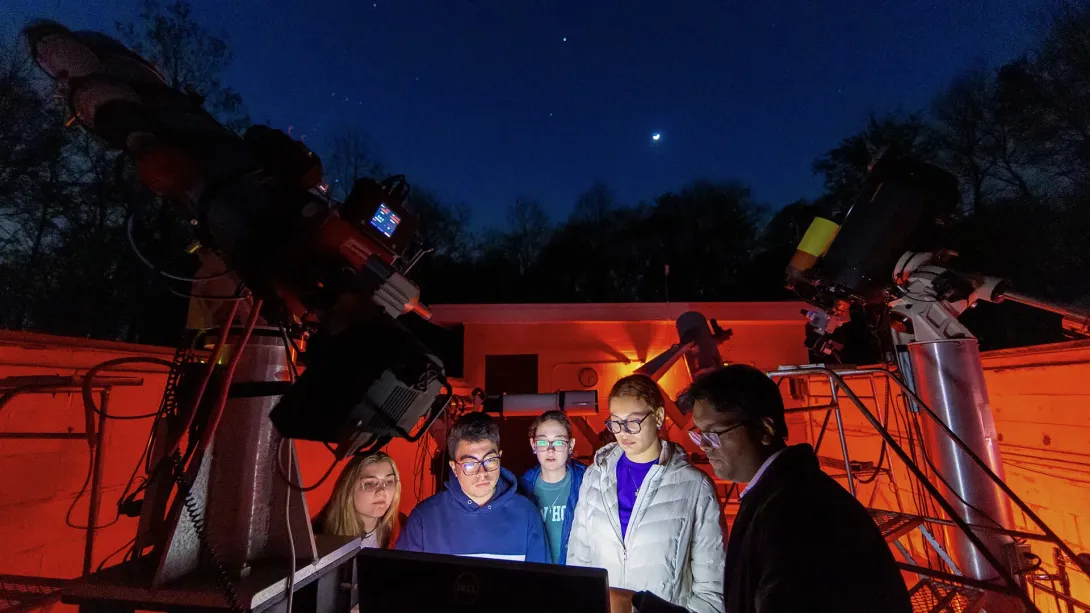
CMNS astronomers, physicists, atmospheric scientists and geologists are answering fundamental questions about the mysteries of the universe.
SUPPORT SPACE EXPLORATION
Research Communities
Center for Research and Exploration in Space Science & Technology II (CRESST II)
The Center for Research and Exploration in Space Science and Technology II (CRESST II) is a collaboration between NASA Goddard Space Flight Center (GSFC) and the University of Maryland, College Park; University of Maryland, Baltimore County; Catholic University of America; Howard University; and Southeastern Universities Research Association. The overall goal of CRESST II is to support and enhance research and technology in the space sciences in support of NASA's strategic science mission objectives. CRESST II also seeks to encourage the engagement of a diverse population of students and Ph.D. scientists in NASA's space science programs. Learn more about CRESST II.
Earth System Science Interdisciplinary Center (ESSIC)
By fostering close integration within the university community and among federal partners at NASA and NOAA, ESSIC serves as a unique collaboration hub within the national Earth system science research community. Explore ESSIC
Joint Space-Science Institute (JSI)
The Joint Space-Science Institute is a research partnership between the Astronomy and Physics departments at the University of Maryland and NASA Goddard Space Flight Center. JSI was created in 2010 to foster interdisciplinary collaborations between astronomers, physicists and astrophysicists in fields related to the study of strong gravity in black holes, high-energy astrophysics and astroparticle physics, cosmology and gravitational waves. Learn about JSI.
Small Bodies Node
The Small Bodies Node (SBN), a part of NASA's Planetary Data System, specializes in the archiving, cataloging, and distributing of scientific data sets relevant to asteroids, comets and interplanetary dust. Explore SBN.