
News
News
Filter by
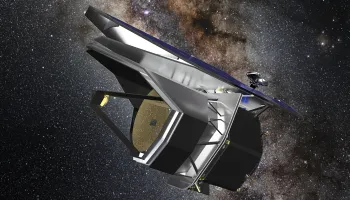
Two UMD Astronomers on PRIMA Team Selected for New Class of NASA Astrophysics Missions
The PRobe far-Infrared Mission for Astrophysics (PRIMA) will peer through cosmic gas and dust to achieve a remarkably clear view of the universe.
Celebrating National Postdoc Appreciation Week
Postdocs bring valuable expertise, national prestige and additional research funding to UMD.
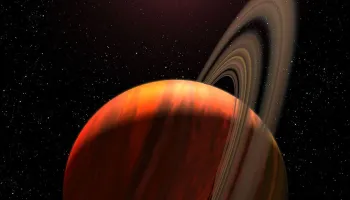
New Study Detects Ammonia and Unexpected Chill on a Distant Giant Planet
A UMD-led team found water, methane and a rare ammonia signal in the atmosphere of HATS-6 b, a large planet orbiting a tiny star—raising new questions about how giant planets form.

University of Maryland Physicist Zohreh Davoudi Named 2026 Schmidt Polymath
Davoudi will receive up to $2.5 million to explore how the universe works using cutting-edge tools such as quantum computing and sensing.

UMD Computer Science Undergraduate Program Ranks in the Top 20 for the 7th Consecutive Year
The program ranks in the Top 10 among public institutions overall and for the specialties of artificial intelligence and cybersecurity, according to U.S. News & World Report.
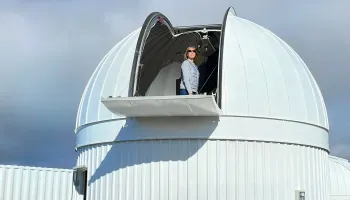
Kelly Fast (M.S. ’93, Ph.D. ’05, astronomy) is NASA’s acting planetary defense officer, overseeing U.S. efforts and global coordination to survey the sky, calculate orbits, study physical properties and identify possible impact risks of near-Earth objects.

Noriko Maitland Receives UMD Provost’s Academic Advisor of the Year Award
The Department of Computer Science academic advisor contributed to several initiatives to address student advising needs and improve how the department delivers information and resources.

The Code They Couldn't Talk About
Eileen Buckholtz (M.S. ’73, computer science) is publishing a book, "Queens of Code: Inspiring True Stories from NSA’s Computing Women," in November 2026.

UMD Alumni Bring Local Law into the AI Age
University of Maryland alumni Denis Peskoff (Ph.D. ’21, computer science) and Joe Barrow (Ph.D. ’22, computer science) developed the largest machine-readable collection of local law ever assembled in the country.
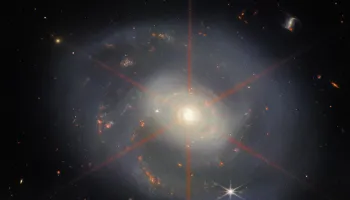
Studying the ‘Wild West’ of the Early Universe
Astronomy postdoctoral researcher Erini Lambrides’ research on black hole formation earned her a coveted spot on Scientific American’s Young American Scientists list.
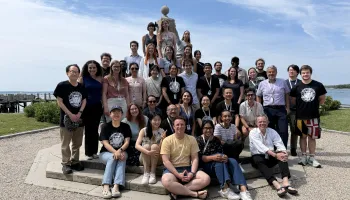
Guiding New Generations of Neuroscientists
This summer, three UMD researchers played important roles in the prestigious Marine Biological Laboratory’s summer neurobiology course.
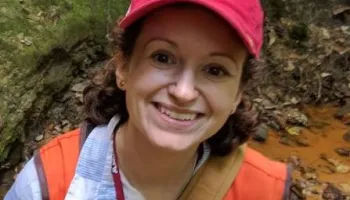
Marcie Occhi (B.S. ’09, M.S. ’11, geology) digs her work mapping the history of Virginia’s rocks and minerals.